Han Yu, Yuan Mei, Guo Yi-Sha, Shen Xin-Ya, Gao Zhen-Kun, Bi Xia
Department of Sport Rehabilitation, Shanghai University of Sport, Shanghai, China.
Department of Rehabilitation Medicine, Shanghai University of Medicine and Health Sciences Affiliated Zhoupu Hospital, Shanghai, China.
Front Cell Neurosci. 2021 Aug 2;15:704334. doi: 10.3389/fncel.2021.704334. eCollection 2021.
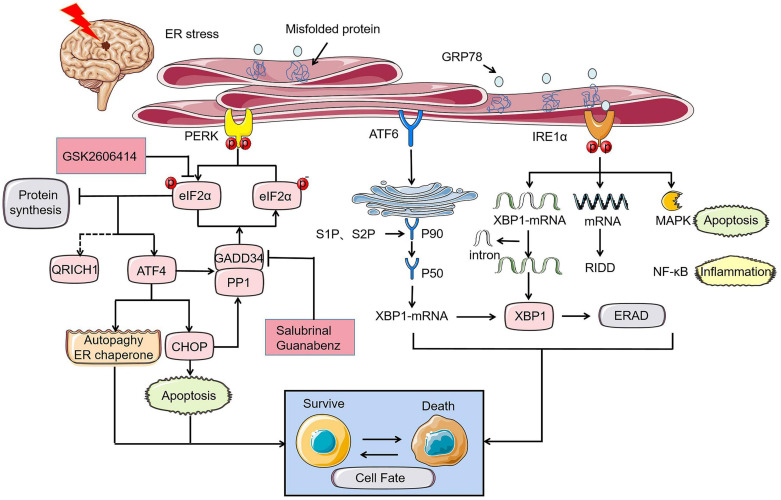
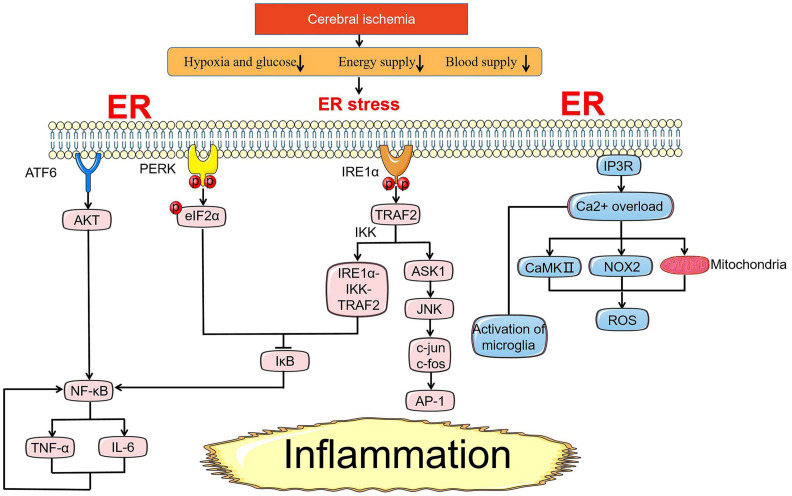
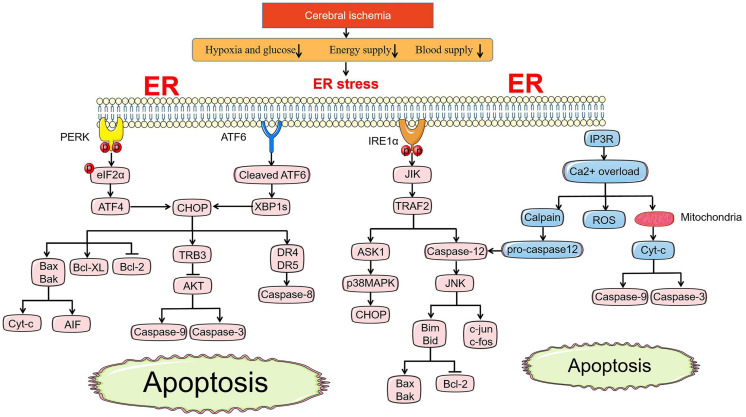
Endoplasmic reticulum (ER) is the main organelle for protein synthesis, trafficking and maintaining intracellular Ca homeostasis. The stress response of ER results from the disruption of ER homeostasis in neurological disorders. Among these disorders, cerebral ischemia is a prevalent reason of death and disability in the world. ER stress stemed from ischemic injury initiates unfolded protein response (UPR) regarded as a protection mechanism. Important, disruption of Ca homeostasis resulted from cytosolic Ca overload and depletion of Ca in the lumen of the ER could be a trigger of ER stress and the misfolded protein synthesis. Brain cells including neurons, glial cells and endothelial cells are involved in the complex pathophysiology of ischemic stroke. This is generally important for protein underfolding, but even more for cytosolic Ca overload. Mild ER stress promotes cells to break away from danger signals and enter the adaptive procedure with the activation of pro-survival mechanism to rescue ischemic injury, while chronic ER stress generally serves as a detrimental role on nerve cells via triggering diverse pro-apoptotic mechanism. What's more, the determination of some proteins in UPR during cerebral ischemia to cell fate may have two diametrically opposed results which involves in a specialized set of inflammatory and apoptotic signaling pathways. A reasonable understanding and exploration of the underlying molecular mechanism related to ER stress and cerebral ischemia is a prerequisite for a major breakthrough in stroke treatment in the future. This review focuses on recent findings of the ER stress as well as the progress research of mechanism in ischemic stroke prognosis provide a new treatment idea for recovery of cerebral ischemia.
内质网(ER)是蛋白质合成、运输和维持细胞内钙稳态的主要细胞器。内质网应激反应源于神经疾病中内质网稳态的破坏。在这些疾病中,脑缺血是全球死亡和残疾的常见原因。缺血性损伤引发的内质网应激会启动未折叠蛋白反应(UPR),这被视为一种保护机制。重要的是,胞质钙超载和内质网腔钙耗竭导致的钙稳态破坏可能是内质网应激和错误折叠蛋白合成的触发因素。包括神经元、胶质细胞和内皮细胞在内的脑细胞参与了缺血性中风的复杂病理生理过程。这对蛋白质错误折叠通常很重要,但对胞质钙超载更为重要。轻度内质网应激通过激活促生存机制促进细胞摆脱危险信号并进入适应性过程以挽救缺血性损伤,而慢性内质网应激通常通过触发多种促凋亡机制对神经细胞起有害作用。此外,脑缺血期间未折叠蛋白反应中某些蛋白质对细胞命运的决定可能产生两种截然相反的结果,这涉及一组特定的炎症和凋亡信号通路。合理理解和探索与内质网应激和脑缺血相关的潜在分子机制是未来中风治疗取得重大突破的先决条件。本综述重点关注内质网应激的最新发现以及缺血性中风预后机制的研究进展,为脑缺血的恢复提供了新的治疗思路。