Feng Xue, Tan Xi, Alenzi Ebtihag O, Rai Pragya, Chang Jongwha
Department of Pharmaceutical Systems and Policy, West Virginia University, School of Pharmacy, Morgantown, WV University of Texas at El Paso, School of Pharmacy, El Paso, TX.
Medicine (Baltimore). 2016 Dec;95(51):e5656. doi: 10.1097/MD.0000000000005656.
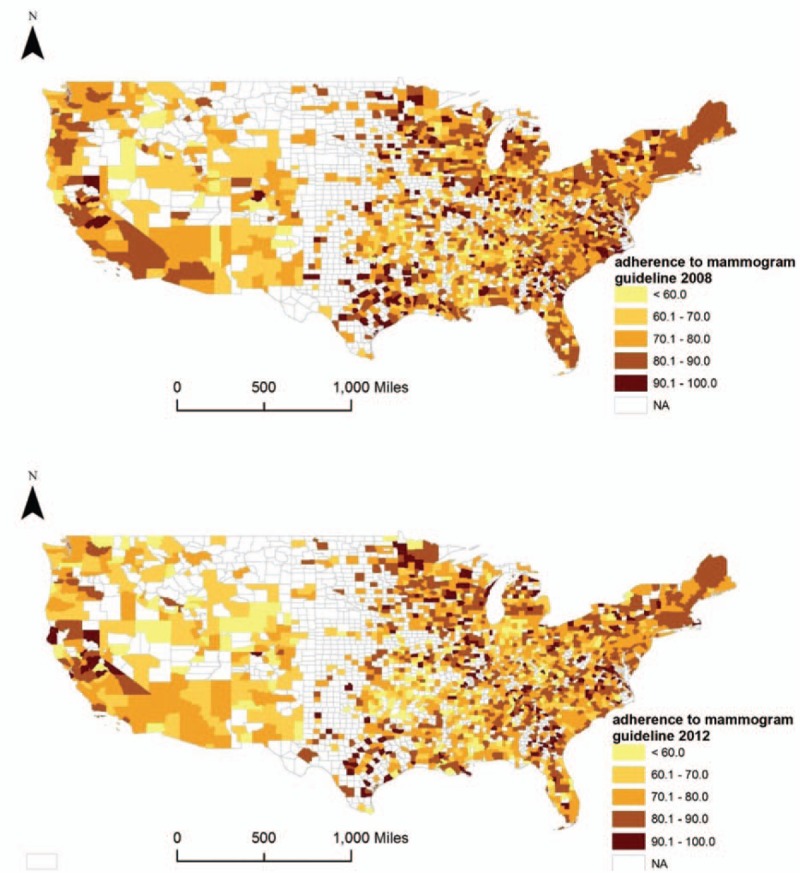
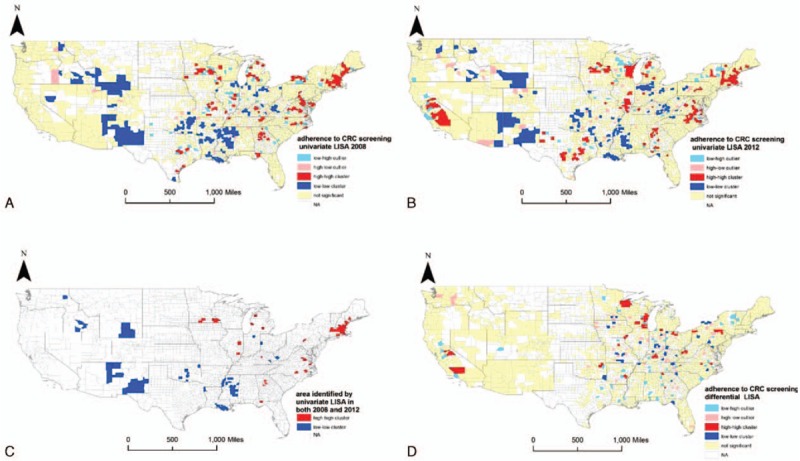
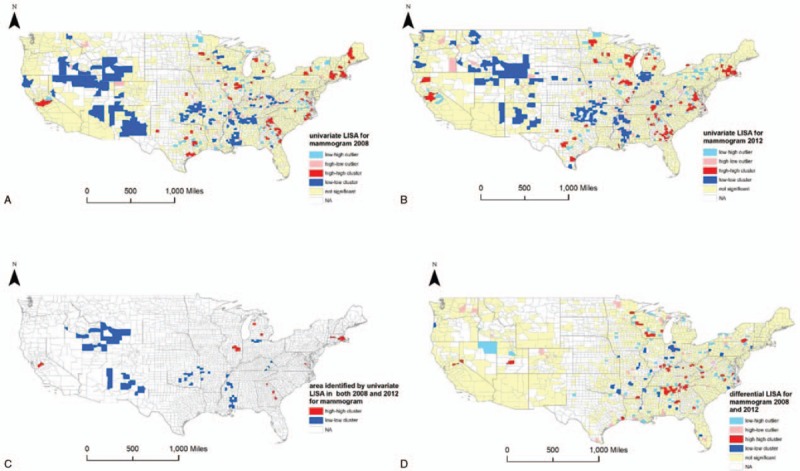
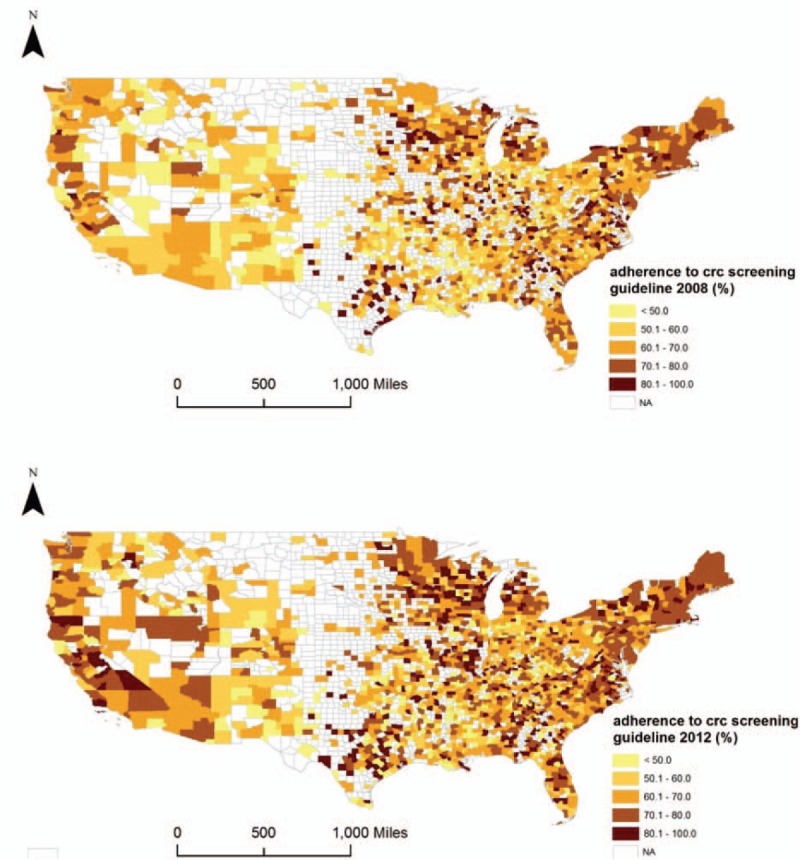
Cancer screening tests are important tools to combat cancer-related morbidity and mortality. There is limited up-to-date research on spatial and temporal variations of colorectal and breast cancer screening in the United States.County-level data of cancer screening adherence rates were generated from 2008 to 2012 Behavioral Risk Factor Surveillance System. We performed the univariate local indicators for spatial analyses (LISA) for the geographic differences of screening adherence rate and the differential LISA for the change of screening adherence rate from 2008 to 2012.In the univariate LISA, low-to-low clusters were consistently identified in counties of New Mexico, Wyoming, and Mississippi (P < 0.05) for both screenings. In the differential LISA, we found low-to-low clusters in Indiana counties (P < 0.05) for mammography screening, which implied that counties with a below-average difference in mammography adherence were surrounded by counties of below-average difference in adherence rates. A high-to-high cluster was also identified in the southern Appalachian counties for mammography screening (P < 0.05). No obvious spatial pattern was found for the colorectal cancer screening adherence rate across the United States.We found low-to-low clusters over time in adherence to screening guidelines for both cancer types in New Mexico, Wyoming, and Mississippi, and clusters of potential decrease in adherence to mammography screening guideline in counties of Indiana. The study also showed improvement on mammography screening clustered in southern Appalachia. The methodology adopted in this study identified areas with clusters of consistent low adherence to screening and a decrease in adherence, which implies that further research and intervention is warranted.
癌症筛查测试是对抗癌症相关发病率和死亡率的重要工具。关于美国结直肠癌和乳腺癌筛查的时空变化,目前最新的研究有限。2008年至2012年行为危险因素监测系统生成了县级癌症筛查依从率数据。我们对筛查依从率的地理差异进行了单变量局部空间自相关分析(LISA),并对2008年至2012年筛查依从率的变化进行了差异LISA分析。在单变量LISA分析中,新墨西哥州、怀俄明州和密西西比州的各县在两种筛查中均持续出现低-低聚类(P<0.05)。在差异LISA分析中,我们发现印第安纳州各县在乳腺钼靶筛查中存在低-低聚类(P<0.05),这意味着乳腺钼靶检查依从性差异低于平均水平的县被依从率差异低于平均水平的县所包围。在阿巴拉契亚南部各县进行乳腺钼靶筛查时也发现了高-高聚类(P<0.05)。美国结直肠癌筛查依从率未发现明显的空间模式。我们发现,新墨西哥州、怀俄明州和密西西比州在两种癌症类型的筛查指南依从性方面随时间推移存在低-低聚类,印第安纳州各县在乳腺钼靶筛查指南的依从性方面存在潜在下降聚类。该研究还显示阿巴拉契亚南部在乳腺钼靶筛查方面有所改善。本研究采用的方法确定了筛查依从性持续较低和依从性下降的聚类区域,这意味着有必要进行进一步的研究和干预。