Meester Reinier G S, Doubeni Chyke A, Zauber Ann G, Goede S Luuk, Levin Theodore R, Corley Douglas A, Jemal Ahmedin, Lansdorp-Vogelaar Iris
Department of Public Health, Erasmus MC University Medical Center, Rotterdam, the Netherlands.
Department of Family Medicine and Community Health, and the Department of Epidemiology, Perelman School of Medicine, University of Pennsylvania, Philadelphia, Pennsylvania.
Cancer. 2015 Jul 1;121(13):2281-5. doi: 10.1002/cncr.29336. Epub 2015 Mar 12.
The National Colorectal Cancer Roundtable, a national coalition of public, private, and voluntary organizations, has recently announced an initiative to increase colorectal cancer (CRC) screening rates in the United States to 80% by 2018. The authors evaluated the potential public health benefits of achieving this goal.
The authors simulated the 1980 through 2030 United States population of individuals aged 50 to 100 years using microsimulation modeling. Test-specific historical screening rates were based on National Health Interview Survey data for 1987 through 2013. The effects of increasing screening rates from approximately 58% in 2013 to 80% in 2018 were compared to a scenario in which the screening rate remained approximately constant. The outcomes were cancer incidence and mortality rates and numbers of CRC cases and deaths during short-term follow-up (2013-2020) and extended follow-up (2013-2030).
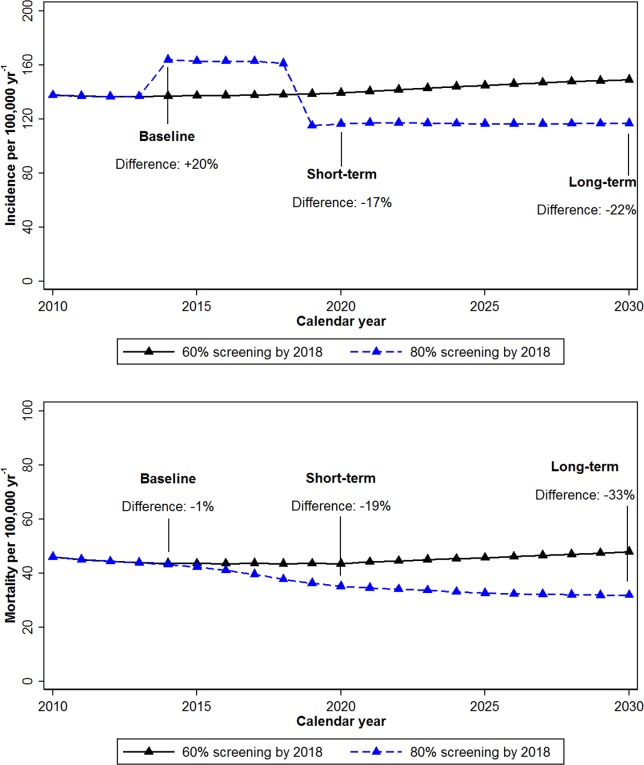
Increasing CRC screening rates to 80% by 2018 would reduce CRC incidence rates by 17% and mortality rates by 19% during short-term follow-up and by 22% and 33%, respectively, during extended follow-up. These reductions would amount to a total of 277,000 averted new cancers and 203,000 averted CRC deaths from 2013 through 2030.
Achieving the goal of increasing the uptake of CRC screening in the United States to 80% by 2018 may have a considerable public health impact by averting approximately 280,000 new cancer cases and 200,000 cancer deaths within <20 years. Cancer 2015;121:2281-2285. © 2015 The Authors. Cancer published by Wiley Periodicals, Inc. on behalf of American Cancer Society. This is an open access article under the terms of the Creative Commons Attribution-NonCommercial-NoDerivs License, which permits use and distribution in any medium, provided the original work is properly cited, the use is non-commercial and no modifications or adaptations are made.
美国国家结直肠癌圆桌会议是一个由公共、私人和志愿组织组成的全国性联盟,最近宣布了一项倡议,目标是到2018年将美国的结直肠癌(CRC)筛查率提高到80%。作者评估了实现这一目标可能带来的公共卫生效益。
作者使用微观模拟模型对1980年至2030年美国50至100岁的人群进行了模拟。特定检测的历史筛查率基于1987年至2013年的国家健康访谈调查数据。将2013年筛查率从约58%提高到2018年80%的效果与筛查率保持大致不变的情况进行了比较。结果指标为癌症发病率和死亡率,以及短期随访(2013 - 2020年)和长期随访(2013 - 2030年)期间的结直肠癌病例数和死亡数。
到2018年将结直肠癌筛查率提高到80%,在短期随访期间将使结直肠癌发病率降低17%,死亡率降低19%;在长期随访期间,发病率和死亡率将分别降低22%和33%。从2013年到2030年,这些降低将总共避免27.7万例新发癌症和20.3万例结直肠癌死亡。
实现到2018年将美国结直肠癌筛查率提高到80%的目标,可能会在不到20年的时间内避免约28万例新发癌症病例和20万例癌症死亡,从而对公共卫生产生重大影响。《癌症》2015年;121:2281 - 2285。© 2015作者。《癌症》由威利期刊公司代表美国癌症协会出版。这是一篇根据知识共享署名 - 非商业性使用 - 禁止演绎许可协议发布的开放获取文章,允许在任何媒介中使用和传播,前提是正确引用原始作品,使用是非商业性的,且不进行任何修改或改编。