Cardoso Luiz Francisco, Krokoscz Daniella Vianna C, de Paiva Edison Ferreira, Furtado Ilka Spinola, Mattar Jorge, de Souza E Sá Marcia Martiniano, de Lira Antonio Carlos Onofre
Sírio Libanês Hospital, São Paulo, Brazil.
Vasc Health Risk Manag. 2016 Dec 12;12:491-496. doi: 10.2147/VHRM.S101880. eCollection 2016.
Venous thromboembolism (VTE) is the leading cause of preventable death in hospitalized patients. However, existing prophylaxis guidelines are rarely followed.
The aim of the study was to present and discuss implementation strategies and the results of a VTE prophylaxis program for medical and surgical patients admitted to a large general hospital.
This prospective observational study was conducted to describe the strategy used to implement a VTE prophylaxis program in hospitalized medical and surgical patients and to analyze the results in terms of the risk assessment rate within the first 24 hours after admission, adequacy of the prophylaxis prescription, and prevalence of VTE in the discharge records before and after program implementation. We used the Mantel-Haenszel chi-square test for the linear trend of the data analysis and set the significance level to <0.05.
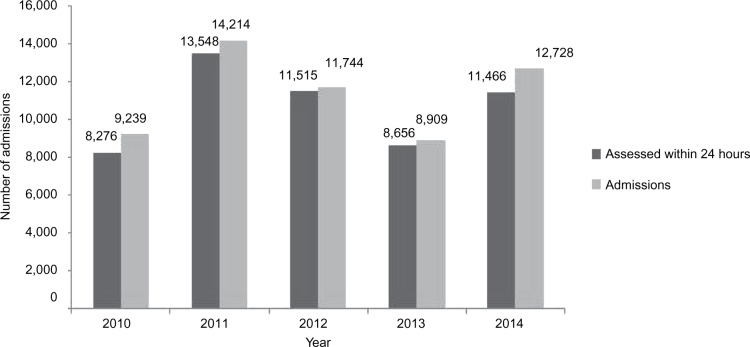
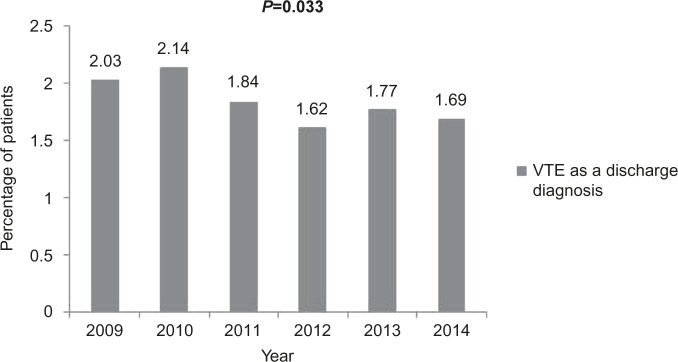
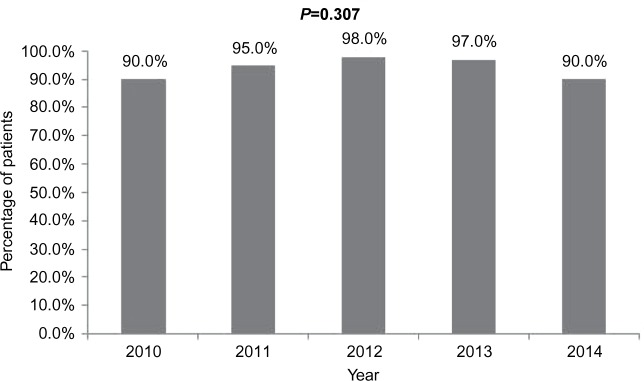
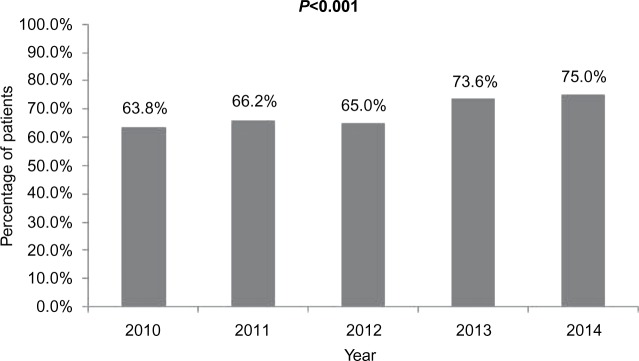
With the support of an institutional VTE prophylaxis committee, a multiple-strategy approach was used in the implementation of the protocol, which included continuing education, complete data recording using computerized systems, and continuous auditing of and feedback to the medical staff and multidisciplinary teams. Approximately 90% of patients were evaluated within the first 24 hours after admission, and no significant difference in this percentage was observed among the years analyzed. A progressive increase in adherence to protocol recommendations, from 63.8% in 2010 to 75.0% in 2014 (<0.001), was noted. The prevalence of symptomatic VTE in the discharge records of patients decreased from 2.03% in 2009 to 1.69% in 2014 (=0.033).
The implementation of a VTE prophylaxis program targeting adult patients admitted to a large hospital employing a multiple-strategy approach achieved high rates of risk assessment within 24 hours of admission, improved the adherence to prophylaxis recommendations in high-risk patients, and reduced the rate of VTE events in the discharge records.
静脉血栓栓塞症(VTE)是住院患者可预防死亡的主要原因。然而,现有的预防指南很少得到遵循。
本研究的目的是介绍并讨论一家大型综合医院针对内科和外科住院患者实施VTE预防计划的策略及结果。
本前瞻性观察性研究旨在描述在住院内科和外科患者中实施VTE预防计划所采用的策略,并从入院后24小时内的风险评估率、预防处方的充分性以及计划实施前后出院记录中VTE的患病率等方面分析结果。我们使用Mantel-Haenszel卡方检验进行数据分析的线性趋势分析,并将显著性水平设定为<0.05。
在机构VTE预防委员会的支持下,在实施该方案时采用了多策略方法,包括继续教育、使用计算机系统进行完整的数据记录以及对医务人员和多学科团队进行持续审核和反馈。约90%的患者在入院后24小时内接受了评估,在所分析的年份中该百分比无显著差异。注意到对方案建议的依从性呈逐步上升趋势,从2010年的63.8%升至2014年的75.0%(<0.001)。患者出院记录中有症状VTE的患病率从2009年的2.03%降至2014年的1.