Ma Lina, Wang Liyan, Chu Yuefeng, Li Xuerui, Cui Yujun, Chen Shengli, Zhou Jianhua, Li Chunling, Lu Zhongxin, Liu Jixing, Liu Yongsheng
State Key Laboratory of Veterinary Etiological Biology, Lanzhou Veterinary Research Institute, Chinese Academy of Agricultural Sciences, Lanzhou, Gansu, China.
State Key Laboratory of Pathogen and Biosecurity, Beijing Institute of Microbiology and Epidemiology, Beijing, China.
PLoS One. 2016 Dec 22;11(12):e0168903. doi: 10.1371/journal.pone.0168903. eCollection 2016.
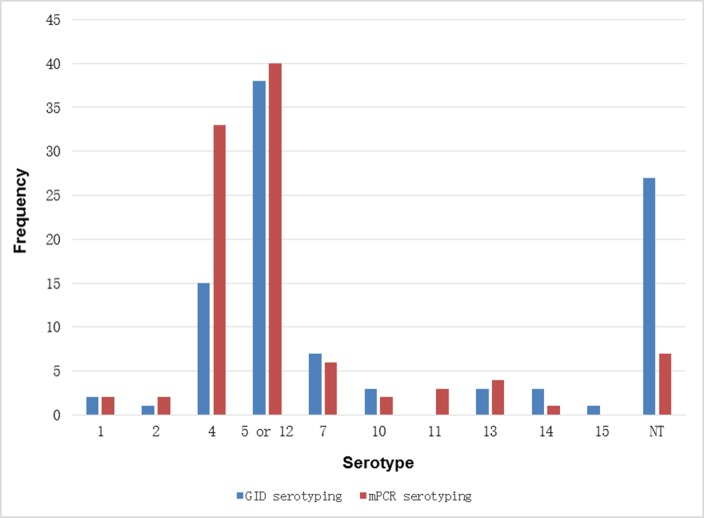
Haemophilus parasuis is classified mainly through serotyping, but traditional serotyping always yields non-typable (NT) strains and unreliable results via cross-reactions. Here, we surveyed the serotype prevalence of Chinese H. parasuis isolates using traditional serotyping (gel immuno-diffusion test, GID) and molecular serotyping (multiplex PCR, mPCR). We also investigated why discrepant results between these methods were obtained, and investigated mPCR failure through whole-genome sequencing. Of the 100 isolate tested, 73 (73%) and 93 (93%) were serotyped by the GID test and mPCR, respectively, with a concordance rate of 66% (66/100). Additionally, mPCR reduced the number of NT isolates from 27 (27%) for the GID testing, to seven (7%). Eleven isolates were sequenced, including nine serotype-discrepant isolates from mPCR and GID typing (excluding strains that were NT by GID only) and two NT isolates from both methods, and their in silico serotypes were obtained from genome sequencing based on their capsule loci. The mPCR results were supported by the in silico serotyping of the seven serotype-discrepant isolates. The discrepant results and NT isolates determined by mPCR were attributed to deletions and unknown sequences in the serotype-specific region of each capsule locus. Compared with previous investigations, this study found a similar predominant serotype profile, but a different prevalence frequency for H. parasuis, and the five most prevalent serotypes or strain groups were serotypes 5, 4, NT, 7 and 13 for mPCR, and serotypes 5, NT, 4, 7 and 13/10/14 for GID. Additionally, serotype 7 was recognized as a principal serotype in this work.
副猪嗜血杆菌主要通过血清分型进行分类,但传统血清分型总是会产生不可分型(NT)菌株,并且由于交叉反应导致结果不可靠。在此,我们使用传统血清分型(凝胶免疫扩散试验,GID)和分子血清分型(多重PCR,mPCR)对中国副猪嗜血杆菌分离株的血清型流行情况进行了调查。我们还研究了为何这两种方法会得到不一致的结果,并通过全基因组测序研究了mPCR失败的原因。在测试的100株分离株中,分别有73株(73%)和93株(93%)通过GID试验和mPCR进行了血清分型,一致率为66%(66/100)。此外,mPCR将GID检测中不可分型分离株的数量从27株(27%)减少到了7株(7%)。对11株分离株进行了测序,包括9株mPCR和GID分型结果不一致的分离株(不包括仅GID检测为不可分型的菌株)以及两种方法均为不可分型的2株分离株,并根据其荚膜位点通过基因组测序获得了它们的电子血清型。7株血清型不一致的分离株的电子血清型结果支持了mPCR结果。mPCR检测出的不一致结果和不可分型分离株归因于每个荚膜位点血清型特异性区域的缺失和未知序列。与之前的调查相比,本研究发现了相似的主要血清型谱,但副猪嗜血杆菌的流行频率不同,mPCR检测中最常见的五种血清型或菌株组为血清型5、4、不可分型、7和13,GID检测为血清型5、不可分型、4、7和13/10/14。此外,血清型7在本研究中被认定为主要血清型。