Pritzlaff Mary, Summerour Pia, McFarland Rachel, Li Shuwei, Reineke Patrick, Dolinsky Jill S, Goldgar David E, Shimelis Hermela, Couch Fergus J, Chao Elizabeth C, LaDuca Holly
Ambry Genetics, Aliso Viejo, CA, USA.
Department of Dermatology, Huntsman Cancer Institute, University of Utah, Salt Lake City, UT, USA.
Breast Cancer Res Treat. 2017 Feb;161(3):575-586. doi: 10.1007/s10549-016-4085-4. Epub 2016 Dec 22.
Genetic predisposition to male breast cancer (MBC) is not well understood. The aim of this study was to better define the predisposition genes contributing to MBC and the utility of germline multi-gene panel testing (MGPT) for explaining the etiology of MBCs.
Clinical histories and molecular results were retrospectively reviewed for 715 MBC patients who underwent MGPT from March 2012 to June 2016.
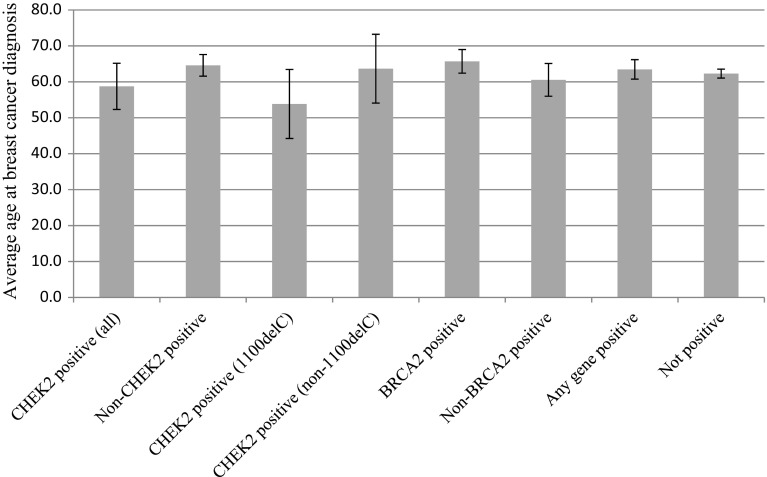
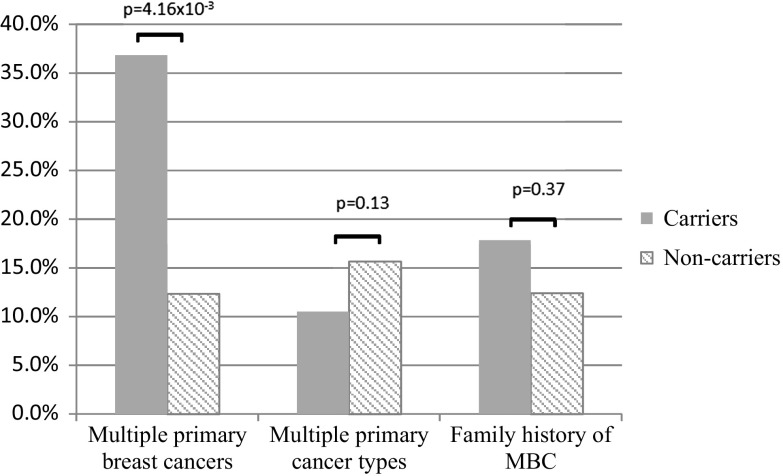
The detection rate of MGPT was 18.1% for patients tested for variants in 16 breast cancer susceptibility genes and with no prior BRCA1/2 testing. BRCA2 and CHEK2 were the most frequently mutated genes (11.0 and 4.1% of patients with no prior BRCA1/2 testing, respectively). Pathogenic variants in BRCA2 [odds ratio (OR) = 13.9; p = 1.92 × 10], CHEK2 (OR = 3.7; p = 6.24 × 10), and PALB2 (OR = 6.6, p = 0.01) were associated with significantly increased risks of MBC. The average age at diagnosis of MBC was similar for patients with (64 years) and without (62 years) pathogenic variants. CHEK2 1100delC carriers had a significantly lower average age of diagnosis (n = 7; 54 years) than all others with pathogenic variants (p = 0.03). No significant differences were observed between history of additional primary cancers (non-breast) and family history of male breast cancer for patients with and without pathogenic variants. However, patients with pathogenic variants in BRCA2 were more likely to have a history of multiple primary breast cancers.
These data suggest that all MBC patients regardless of age of diagnosis, history of multiple primary cancers, or family history of MBC should be offered MGPT.
男性乳腺癌(MBC)的遗传易感性尚未得到充分了解。本研究的目的是更好地确定导致MBC的易感基因,以及种系多基因检测板检测(MGPT)在解释MBC病因方面的作用。
回顾性分析了2012年3月至2016年6月期间接受MGPT检测的715例MBC患者的临床病史和分子检测结果。
在16个乳腺癌易感基因中检测变异且之前未进行BRCA1/2检测的患者,MGPT的检测率为18.1%。BRCA2和CHEK2是最常发生突变的基因(在之前未进行BRCA1/2检测的患者中分别占11.0%和4.1%)。BRCA2(优势比[OR]=13.9;p=1.92×10)、CHEK2(OR=3.7;p=6.24×10)和PALB2(OR=6.6,p=0.01)中的致病性变异与MBC风险显著增加相关。有致病性变异(64岁)和无致病性变异(62岁)的MBC患者的平均诊断年龄相似。CHEK2 1100delC携带者的平均诊断年龄(n=7;54岁)显著低于所有其他有致病性变异的患者(p=0.03)。有和无致病性变异的患者在其他原发性癌症(非乳腺癌)病史和男性乳腺癌家族史方面未观察到显著差异。然而,BRCA2有致病性变异的患者更有可能有多发原发性乳腺癌病史。
这些数据表明,所有MBC患者,无论诊断年龄、多发原发性癌症病史或MBC家族史如何,都应接受MGPT检测。