Center for RNA Molecular Biology, Case Western Reserve University School of Medicine, Cleveland, Ohio 44106, USA.
Nat Commun. 2016 Dec 23;7:14021. doi: 10.1038/ncomms14021.
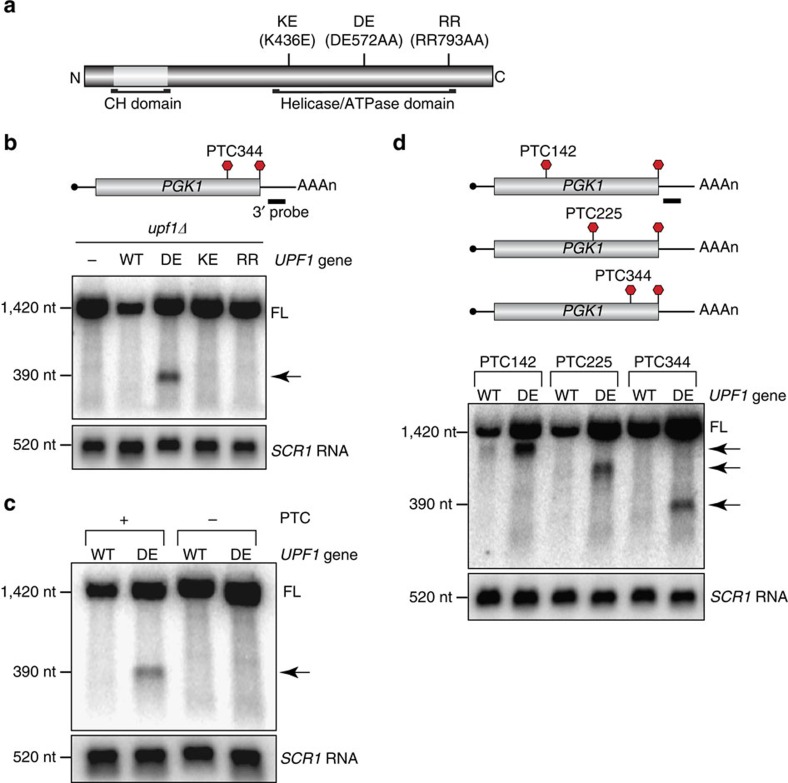
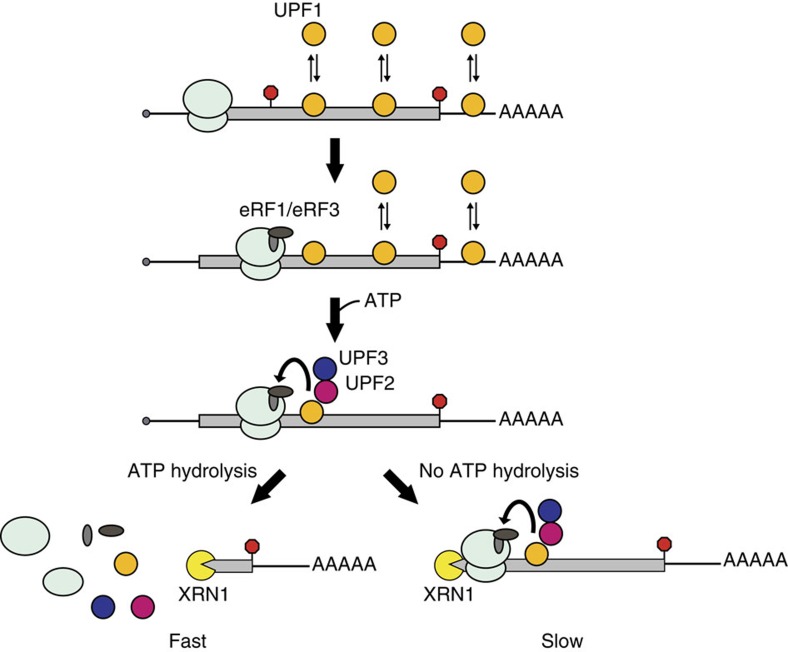
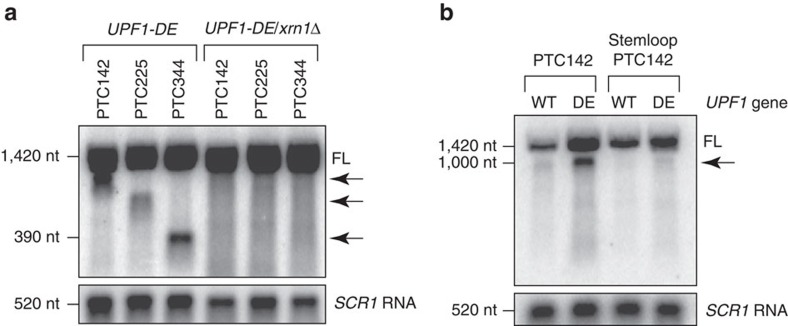
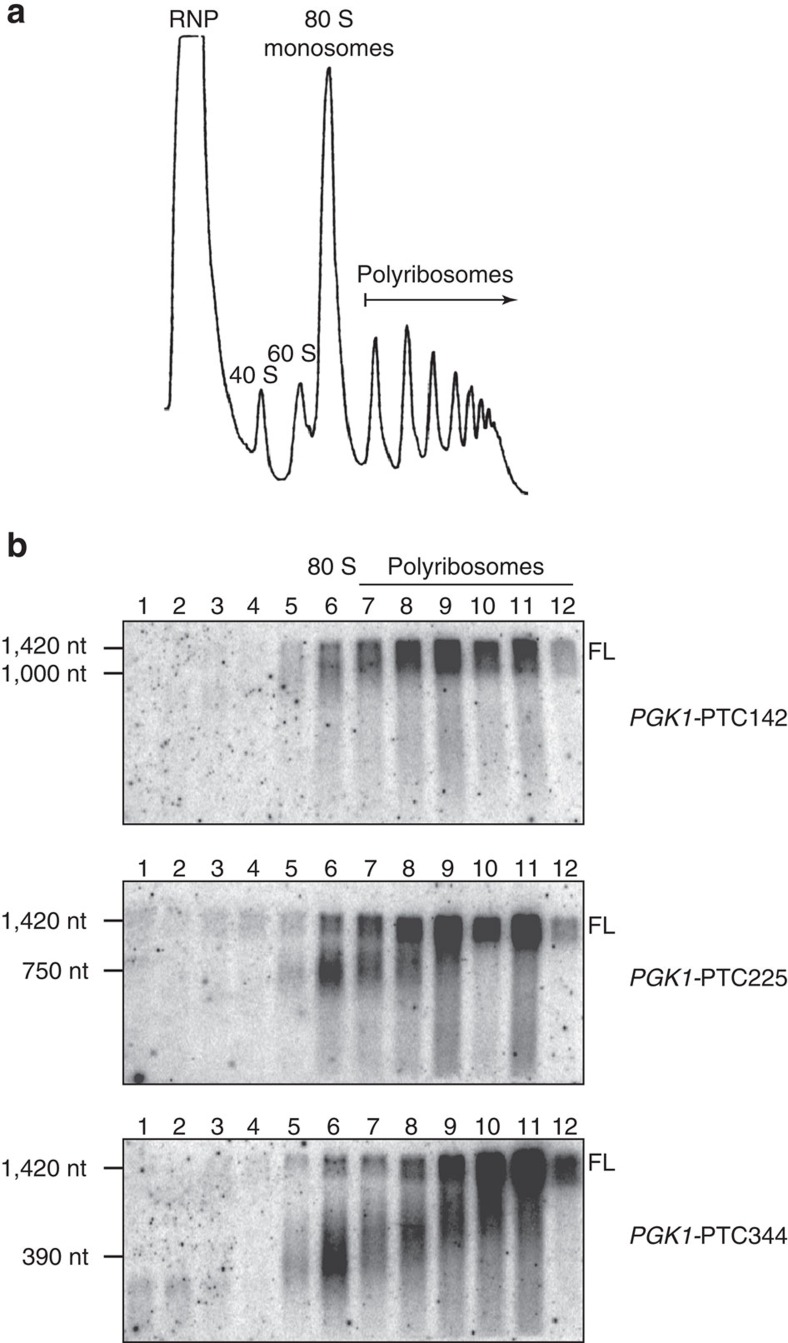
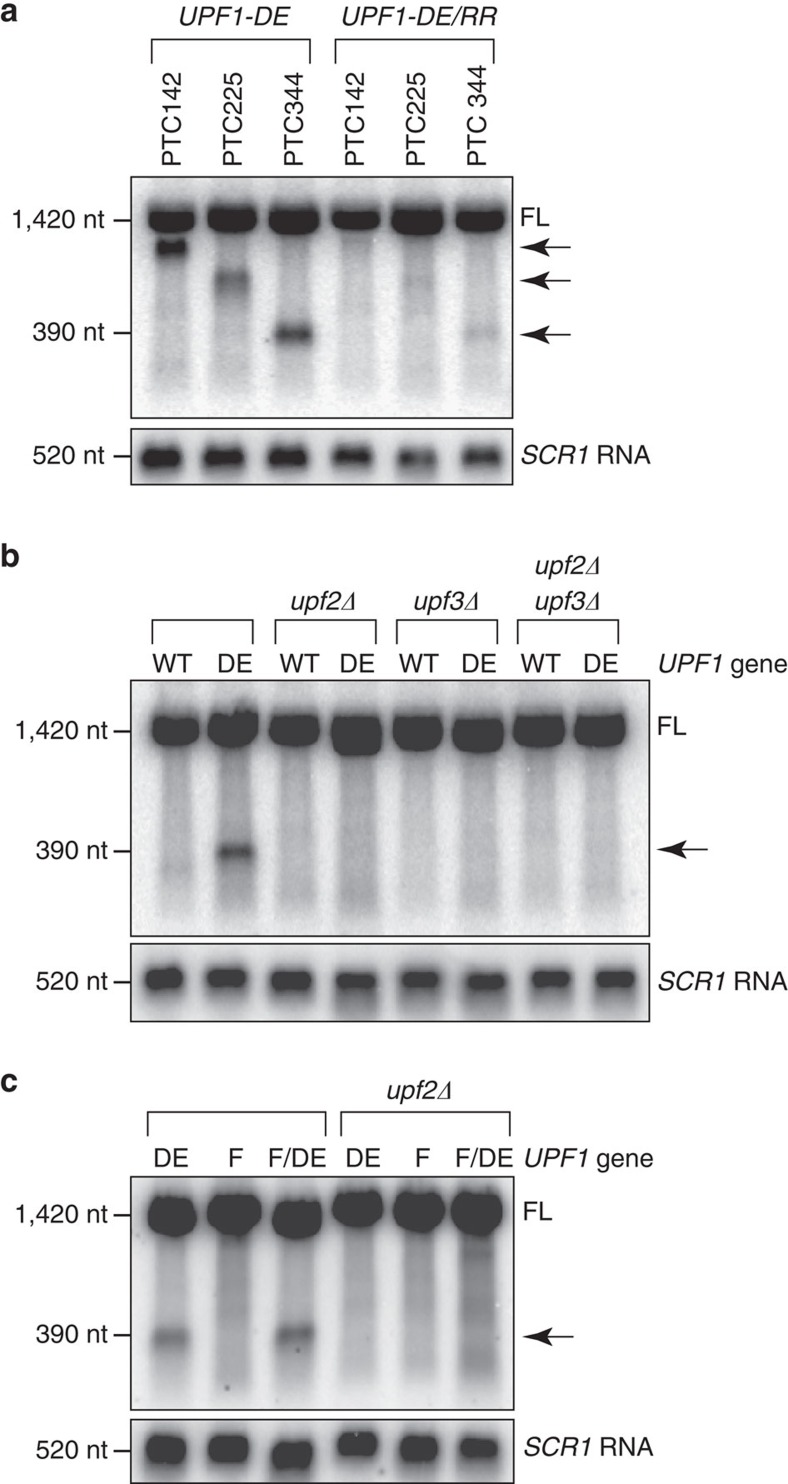
Nonsense-mediated mRNA decay (NMD) represents a eukaryotic quality control pathway that recognizes and rapidly degrades transcripts harbouring nonsense mutations to limit accumulation of non-functional and potentially toxic truncated polypeptides. A critical component of the NMD machinery is UPF1, an RNA helicase whose ATPase activity is essential for NMD, but for which the precise function and site of action remain unclear. We provide evidence that ATP hydrolysis by UPF1 is required for efficient translation termination and ribosome release at a premature termination codon. UPF1 ATPase mutants accumulate 3' RNA decay fragments harbouring a ribosome stalled during premature termination that impedes complete degradation of the mRNA. The ability of UPF1 to impinge on premature termination, moreover, requires ATP-binding, RNA-binding and NMD cofactors UPF2 and UPF3. Our results reveal that ATP hydrolysis by UPF1 modulates a functional interaction between the NMD machinery and terminating ribosomes necessary for targeting substrates to accelerated degradation.
无意义介导的 mRNA 降解(NMD)是一种真核质量控制途径,可识别并迅速降解含有无义突变的转录本,以限制非功能和潜在毒性截断多肽的积累。NMD 机制的关键组成部分是 UPF1,一种 RNA 解旋酶,其 ATP 酶活性对于 NMD 是必不可少的,但对于其确切的功能和作用位点仍不清楚。我们提供的证据表明,UPF1 的 ATP 水解对于在提前终止密码子处有效终止翻译和核糖体释放是必需的。UPF1 ATP 酶突变体积累了含有核糖体停滞的 3' RNA 降解片段,这种核糖体停滞会阻碍 mRNA 的完全降解。此外,UPF1 影响提前终止的能力需要 ATP 结合、RNA 结合和 NMD 辅助因子 UPF2 和 UPF3。我们的结果表明,UPF1 的 ATP 水解调节了 NMD 机制和终止核糖体之间的功能相互作用,这种相互作用对于将底物靶向加速降解是必要的。