Hull Dobrina N, Cooksley Helen, Chokshi Shilpa, Williams Richard O, Abraham Sonya, Taylor Peter C
Department of Medicine, Imperial College London, London, UK.
Kennedy Institute of Rheumatology, Nuffield Department of Orthopaedics, Rheumatology and Musculoskeletal Sciences, University of Oxford, Botnar Research Centre, Windmill Road, Headington, Oxford, OX3 7LD, UK.
Arthritis Res Ther. 2016 Dec 23;18(1):303. doi: 10.1186/s13075-016-1197-5.
Anti-TNF agents have revolutionised rheumatoid arthritis (RA) treatment; however, a third of patients fail to achieve therapeutic responses. Unexpectedly, studies in murine and human arthritis have indicated that anti-TNF treatment can increase circulating T helper 17 (Th17) cells, but the relationship to treatment response is unclear. To identify immune correlates of anti-TNF treatment response, we conducted a longitudinal study using clinical, ultrasound and T cell assessments.
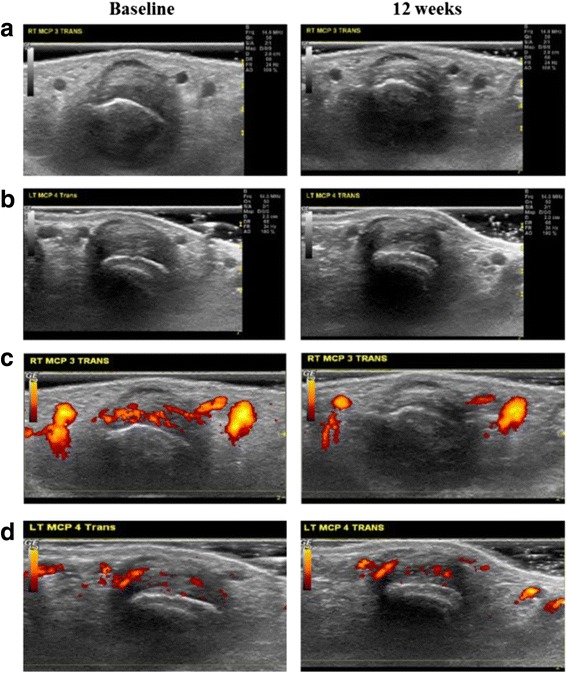
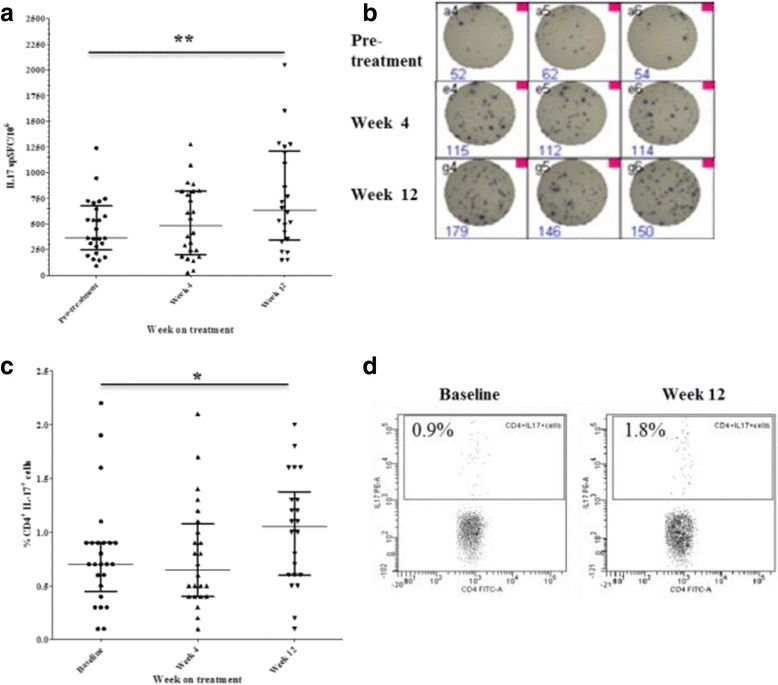
Patients with RA (n = 25) were studied at protocol visits during the initial 12 weeks of anti-TNF treatment. Improvement in the disease activity score of 28 joints (DAS28) >1.2 defined treatment responders (n = 16) and non-responders (n = 9). Changes in synovial thickening and vascularity of 10 metacarpophalangeal joints were quantitatively assessed by grey scale and power Doppler ultrasound. The frequency of circulating Th17 cells was determined by IL17 enzyme-linked immunospot assay (Elispot) and flow cytometry (fluorescence-activated cell sorting (FACS)).
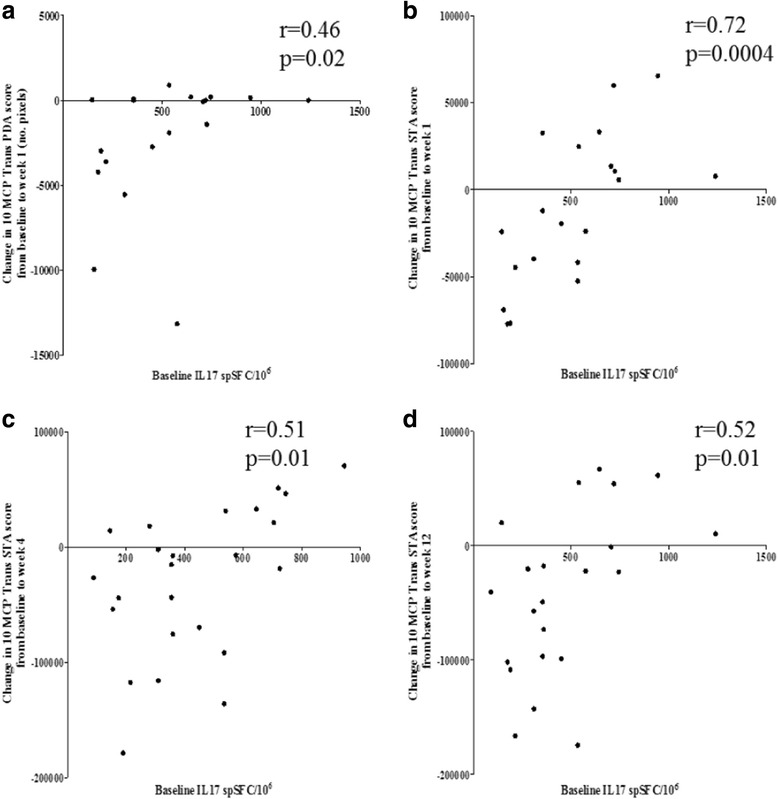
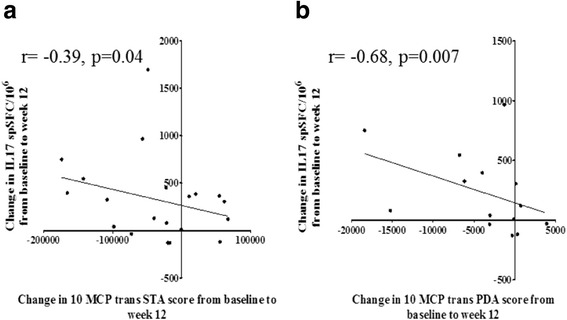
The frequency of circulating IL17-producing cells increased significantly 12 weeks after anti-TNF initiation (Elispot median (range) specific spot forming cells (spSFC)/10 360 (280-645) vs 632 (367 - 1167), p = 0.003). The increase in CD4 + IL17+ cells at 12 weeks was confirmed by FACS (median (range) %, 0.7 (0.5-0.9) vs 1.05 (0.6-1.3); p = 0.01). The increase in circulating Th17 cells inversely correlated with reduction in synovial vascularity (r = -0.68, p = 0.007) and thickening (r = -0.39; p = 0.04). Higher frequencies of circulating Th17 cells at baseline were associated with poorer anti-TNF treatment response defined by ultrasonographic measures.
These results demonstrate a link between changes in circulating Th17 cells with resolution of ultrasonographic features of synovial inflammation and vascularity during anti-TNF treatment. The findings may reflect redistribution of Th17 cells from inflamed joints or TNF-driven regulation of Th17 cell production.
ClinicalTrials.gov: NCT01060098 . Registered 29 January 2010.
抗TNF药物彻底改变了类风湿关节炎(RA)的治疗方式;然而,三分之一的患者未能实现治疗反应。出乎意料的是,在小鼠和人类关节炎研究中表明,抗TNF治疗可增加循环T辅助细胞17(Th17),但与治疗反应的关系尚不清楚。为了确定抗TNF治疗反应的免疫相关性,我们进行了一项使用临床、超声和T细胞评估的纵向研究。
在抗TNF治疗的最初12周期间,对25例RA患者进行方案访视研究。28个关节疾病活动评分(DAS28)改善>1.2定义为治疗反应者(n = 16)和无反应者(n = 9)。通过灰阶和能量多普勒超声定量评估10个掌指关节的滑膜增厚和血管形成变化。通过IL17酶联免疫斑点试验(Elispot)和流式细胞术(荧光激活细胞分选(FACS))测定循环Th17细胞的频率。
抗TNF治疗开始12周后,循环中产生IL17细胞的频率显著增加(Elispot中位数(范围)特异性斑点形成细胞(spSFC)/10 360(280 - 645)对632(367 - 1167),p = 0.003)。FACS证实12周时CD4 + IL17 +细胞增加(中位数(范围)%,0.7(0.5 - 0.9)对1.05(0.6 - 1.3);p = 0.01)。循环Th17细胞的增加与滑膜血管形成的减少呈负相关(r = -0.68,p = 0.007)和增厚(r = -0.39;p = 0.04)。基线时循环Th17细胞频率较高与超声测量定义的抗TNF治疗反应较差相关。
这些结果表明,在抗TNF治疗期间,循环Th17细胞的变化与滑膜炎症和血管形成的超声特征消退之间存在联系。这些发现可能反映了Th17细胞从炎症关节的重新分布或TNF驱动的Th17细胞产生调节。
ClinicalTrials.gov:NCT01060098。2010年1月29日注册。