Tian Peijun, Yan Li
Department of Haematology, Ankang City Central Hospitalg, Ankang, Shaanxi, China (mainland).
Tumor Department of Hematology, Shaanxi Province Chinese Medicine Hospital, Ankang, Shaanxi, China (mainland).
Med Sci Monit. 2016 Dec 25;22:5116-5123. doi: 10.12659/msm.899114.
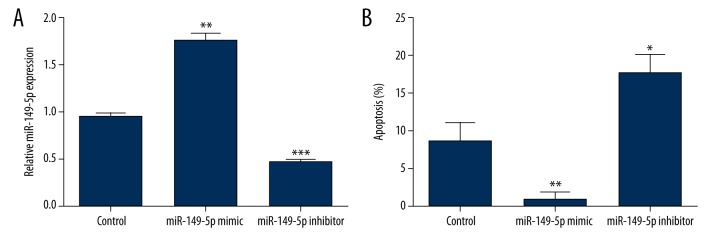
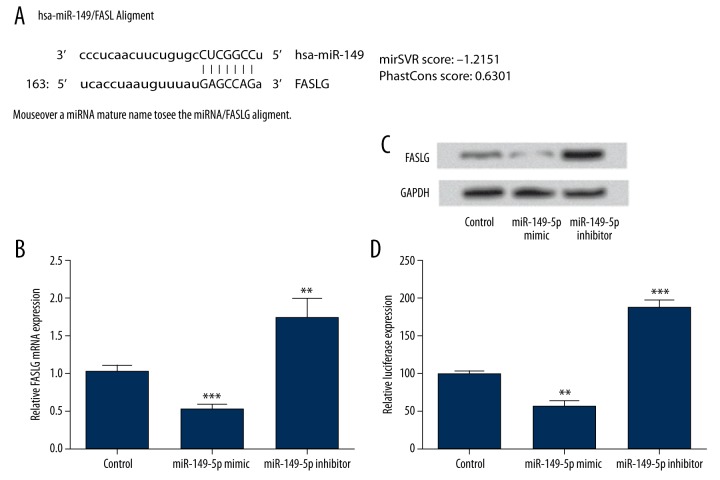
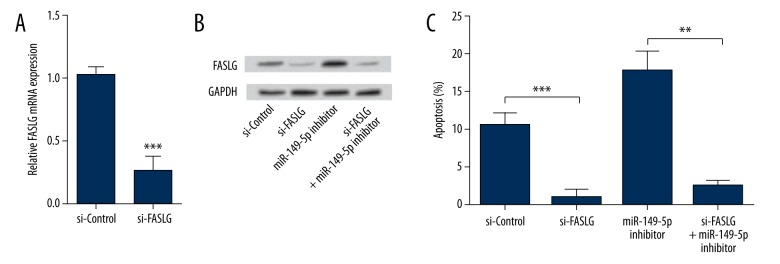
BACKGROUND This study was aimed to reveal the role of miR-149-5p in acute myeloid leukemia (AML) cells apoptosis and the possible mechanism involved. MATERIAL AND METHODS The expression of miR-149-5p in leukemia cell lines, as well as the blood and bone marrow (BM) samples from leukemia patients, were monitored by reverse-transcription polymerase chain reaction (RT-PCR). AML cell line THP-1 was transfected with miR-149-5p mimic or inhibitor, and then cell apoptosis was determined using the APO Percentage assay kit. The target of miR-149-5p was predicted by using the microRNA.org database, and verified by RT-PCR, Western blot, and Dual-Luciferase reporter assays. Further, small interfering RNA (siRNA) against the target gene was co-transfected with miR-149-5p inhibitor, and then the cell apoptosis and the expression of apoptosis-related proteins were assessed. RESULTS MiR-149-5p was significantly up-regulated in leukemia cell lines and samples from leukemia patients (P<0.01 or P<0.001), especially in THP-1 cells and samples from AML patients. Cell apoptosis was significantly decreased by miR-149-5p overexpression (P<0.01) and increased by miR-149-5p suppression (P<0.05). Fas Ligand (FASLG) was a direct target of miR-149-5p, and was negatively regulated by miR-149-5p. More importantly, the inductive effects of miR-149-5p suppression on cell apoptosis were abrogated by si-FASLG (P<0.01). Furthermore, the up-regulative effects of miR-149-5p suppression on the phosphorylated form of Fas-associated via death domain (p-FADD), caspase-8, caspase-2, caspase-3, and the cleaved forms of these caspases were abrogated by si-FASLG. CONCLUSIONS Inhibition of miR-149-5p can induce apoptosis in THP-1 cells. These inductive effects might be via targeting FASLG and activating FADD and caspases.
背景 本研究旨在揭示miR-149-5p在急性髓系白血病(AML)细胞凋亡中的作用及其可能涉及的机制。
材料与方法 通过逆转录聚合酶链反应(RT-PCR)监测白血病细胞系以及白血病患者血液和骨髓(BM)样本中miR-149-5p的表达。用miR-149-5p模拟物或抑制剂转染AML细胞系THP-1,然后使用APO百分比检测试剂盒测定细胞凋亡。使用microRNA.org数据库预测miR-149-5p的靶标,并通过RT-PCR、蛋白质免疫印迹法和双荧光素酶报告基因检测进行验证。此外,针对靶基因的小干扰RNA(siRNA)与miR-149-5p抑制剂共转染,然后评估细胞凋亡及凋亡相关蛋白的表达。
结果 miR-149-5p在白血病细胞系和白血病患者样本中显著上调(P<0.01或P<0.001),尤其是在THP-1细胞和AML患者样本中。miR-149-5p过表达显著降低细胞凋亡(P<0.01),而miR-149-5p抑制则增加细胞凋亡(P<0.05)。Fas配体(FASLG)是miR-149-5p的直接靶标,且受miR-149-5p负调控。更重要的是,si-FASLG消除了miR-149-5p抑制对细胞凋亡的诱导作用(P<0.01)。此外,si-FASLG消除了miR-149-5p抑制对Fas相关死亡结构域磷酸化形式(p-FADD)、半胱天冬酶-8、半胱天冬酶-2、半胱天冬酶-3以及这些半胱天冬酶切割形式的上调作用。
结论 抑制miR-149-5p可诱导THP-1细胞凋亡。这些诱导作用可能是通过靶向FASLG并激活FADD和半胱天冬酶来实现的。