Koh Hyun Min, Jang Bo Geun, Hyun Chang Lim, Kim Young Sill, Hyun Jin Won, Chang Weon Young, Maeng Young Hee
Department of Pathology, Jeju National University School of Medicine, Jeju, Korea.
Department of Biochemistry, Jeju National University School of Medicine, Jeju, Korea.
J Pathol Transl Med. 2017 Jan;51(1):32-39. doi: 10.4132/jptm.2016.10.17. Epub 2016 Dec 25.
Aurora kinase A (AURKA), or STK15/BTAK, is a member of the serine/threonine kinase family and plays important roles in mitosis and chromosome stability. This study investigated the clinical significance of AURKA expression in colorectal cancer patients in Korea.
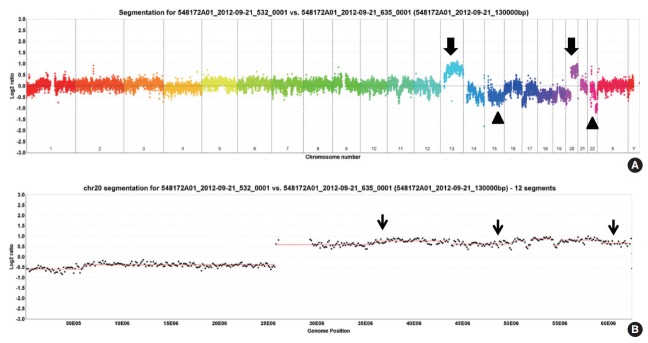
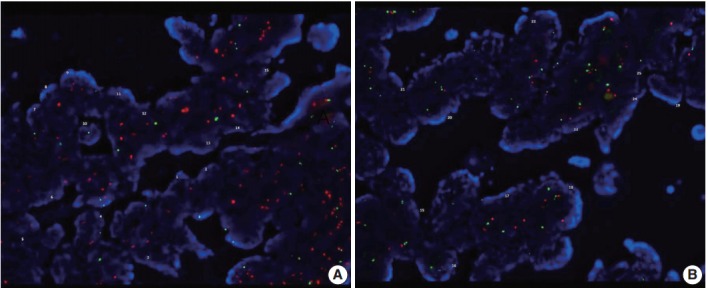
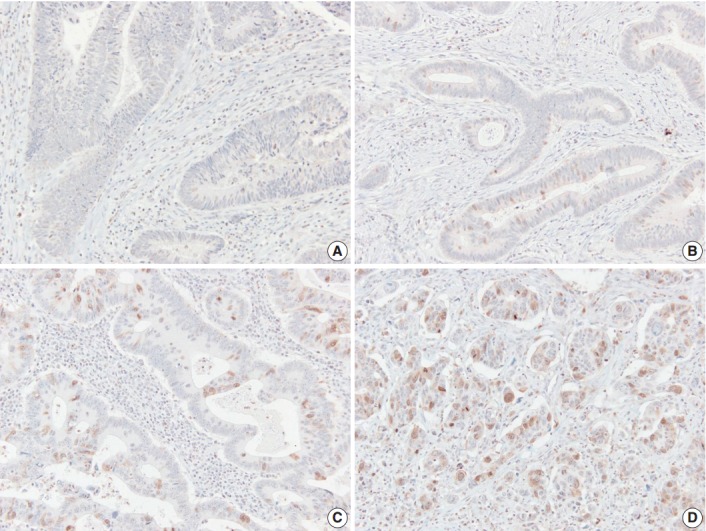
AURKA protein expression was evaluated by immunohistochemistry in 151 patients with colorectal adenocarcinoma using tissue microarray blocks. We analyzed the relationship between clinicopathological characteristics and AURKA expression. In addition, the prognostic significance of various clinicopathological data for progression-free survival (PFS) was assessed. Also we evaluated copy number variations by array comparative genomic hybridization and gene amplification using fluorescence hybridization in colorectal carcinoma tissues.
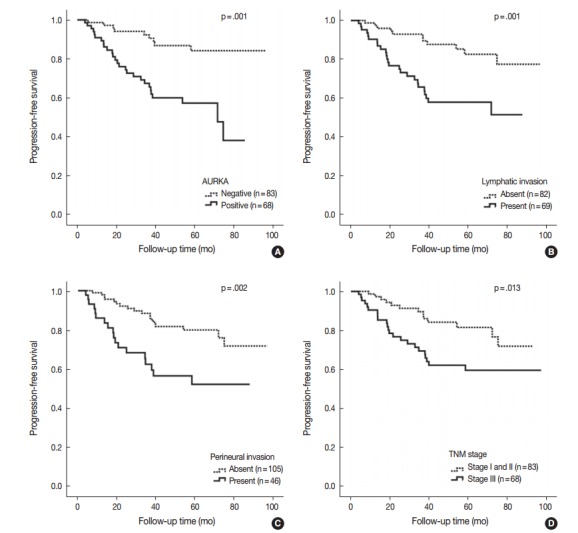
gene amplification was found more frequently in the 20q13.2-13.33 gain-positive group than the group with no significant gain on the -containing locus. AURKA protein expression was detected in 45% of the cases (68/151). Positive staining for AURKA was observed more often in male patients (p = .035) and distally located tumors (p = .021). PFS was shorter in patients with AURKA expression compared to those with low-level AURKA expression (p < .001). Univariate analysis revealed that AURKA expression (p = .001), age (p = .034), lymphatic invasion (p = .001), perineural invasion (p = .002), and TNM stage (p = .013) significantly affected PFS. In a multivariate analysis of PFS, a Cox proportional hazard model confirmed that AURKA expression was an independent and significant prognostic factor in colorectal adenocarcinoma (hazard ratio, 3.944; p < .001).
AURKA could serve as an independent factor to predict a poor prognosis in Korean colorectal adenocarcinoma patients.
极光激酶A(AURKA),即丝氨酸/苏氨酸激酶15(STK15)/膀胱癌激酶(BTAK),是丝氨酸/苏氨酸激酶家族成员,在有丝分裂和染色体稳定性中发挥重要作用。本研究调查了AURKA表达在韩国结直肠癌患者中的临床意义。
使用组织微阵列模块,通过免疫组织化学评估151例结直肠腺癌患者的AURKA蛋白表达。我们分析了临床病理特征与AURKA表达之间的关系。此外,评估了各种临床病理数据对无进展生存期(PFS)的预后意义。我们还通过阵列比较基因组杂交评估拷贝数变异,并使用荧光杂交评估结直肠癌组织中的基因扩增。
在20q13.2 - 13.33增益阳性组中发现基因扩增比在含该位点无显著增益的组中更频繁。在45%的病例(68/151)中检测到AURKA蛋白表达。男性患者(p = 0.035)和远端肿瘤(p = 0.021)中更常观察到AURKA阳性染色。与低水平AURKA表达的患者相比,AURKA表达的患者PFS更短(p < 0.001)。单因素分析显示,AURKA表达(p = 0.001)、年龄(p = 0.034)、淋巴浸润(p = 0.001)、神经周围浸润(p = 0.002)和TNM分期(p = 0.013)显著影响PFS。在PFS的多因素分析中,Cox比例风险模型证实AURKA表达是结直肠腺癌的独立且显著的预后因素(风险比,3.944;p < 0.001)。
AURKA可作为预测韩国结直肠腺癌患者预后不良的独立因素。