Medhasi Sadeep, Pinthong Darawan, Pasomsub Ekawat, Vanwong Natchaya, Ngamsamut Nattawat, Puangpetch Apichaya, Chamnanphon Monpat, Hongkaew Yaowaluck, Pratoomwun Jirawat, Limsila Penkhae, Sukasem Chonlaphat
Department of Pharmacology, Faculty of Science, Mahidol UniversityBangkok, Thailand; Division of Pharmacogenomics and Personalized Medicine, Department of Pathology, Faculty of Medicine Ramathibodi Hospital, Mahidol UniversityBangkok, Thailand; Laboratory for Pharmacogenomics, Somdech Phra Debaratana Medical Center, Ramathibodi HospitalBangkok, Thailand.
Department of Pharmacology, Faculty of Science, Mahidol University Bangkok, Thailand.
Front Pharmacol. 2016 Dec 2;7:475. doi: 10.3389/fphar.2016.00475. eCollection 2016.
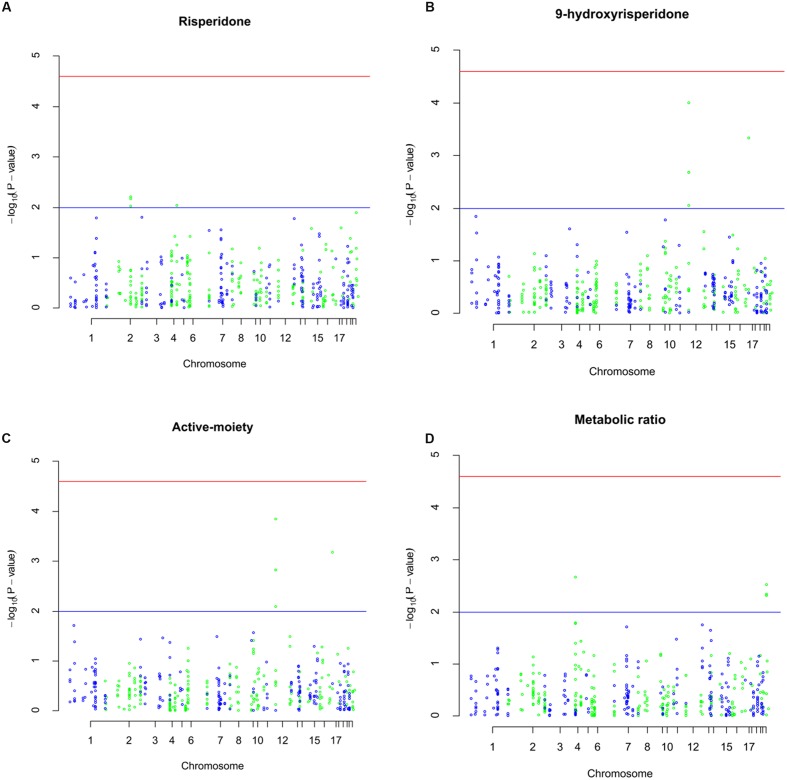
The present study sought to investigate the genetic variants in drug metabolizing enzyme and transporter (DMET) genes associated with steady-state plasma concentrations of risperidone among Thai autism spectrum disorder (ASD) patients. ASD patients taking risperidone for at least 1 month were enrolled for this pharmacogenomic study. Genotyping profile was obtained using Affymetrix DMET Plus array interrogating 1931 variants in 231 genes. Steady-state plasma risperidone and 9-hydroxyrisperidone were measured using liquid chromatography/tandem mass spectrometry assay. The final analysis included 483 markers for 167 genes. Six variants, (c.3084A > G, c.420A > G, c.368G > A, and c.236G > A) and (c.690G > A and c.-5360G > A), were found to be associated with plasma concentrations of risperidone. 9-Hydroxyrisperidone and the total active-moiety levels were associated with six gene variants, (c.-11187G > A and c.521T > C), (c.334G > T, c.699A > G, and c.1557G > A), and c.438C > G. Polymorphisms in c.448A > G and (c.1661G > C, c.4180G > C, and c.-2178G > A) showed considerable but not significant associations with metabolic ratio. This pharmacogenomic study identifies new genetic variants of DMET genes in monitoring risperidone therapy.
本研究旨在调查泰国自闭症谱系障碍(ASD)患者中与利培酮稳态血药浓度相关的药物代谢酶和转运体(DMET)基因的遗传变异。服用利培酮至少1个月的ASD患者被纳入这项药物基因组学研究。使用Affymetrix DMET Plus芯片对231个基因中的1931个变异进行基因分型。采用液相色谱/串联质谱分析法测定稳态血药浓度的利培酮和9-羟基利培酮。最终分析包括167个基因的483个标记。发现6个变异(c.3084A>G、c.420A>G、c.368G>A和c.236G>A)以及(c.690G>A和c.-5360G>A)与利培酮的血药浓度相关。9-羟基利培酮和总活性部分水平与6个基因变异相关,(c.-11187G>A和c.521T>C)、(c.334G>T、c.699A>G和c.1557G>A)以及c.438C>G。c.448A>G和(c.1661G>C、c.4180G>C和c.-2178G>A)的多态性与代谢率显示出相当大但不显著的关联。这项药物基因组学研究确定了DMET基因在监测利培酮治疗中的新遗传变异。