Ulich T R, del Castillo J, Busser K, Guo K Z, Yin S M
Department of Pathology, University of California, College of Medicine, Irvine 92717.
Am J Pathol. 1989 Oct;135(4):663-70.
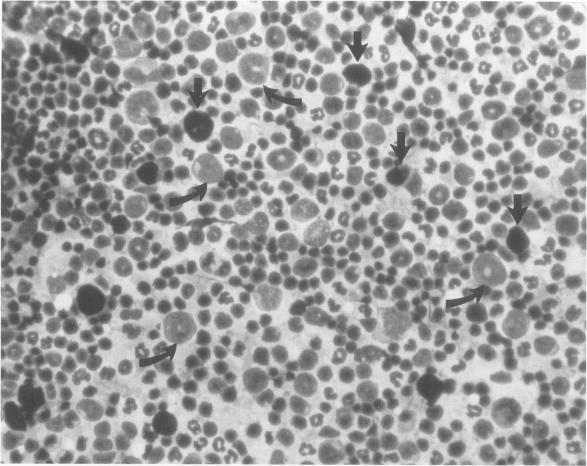
Recombinant human IL-3 administered intravenously to rats as a single injection induced peripheral neutrophilia and monocytosis beginning at 4 to 6 hours after injection, peaking at 8 hours, and subsiding to normal by 12 to 24 hours. IL-3 did not induce an initial neutropenia such as accompanies endotoxin-, G-CSF-, and TNF-induced neutrophilia, or lymphopenia such as accompanies endotoxin-, IL-1-, and TNF-induced neutrophilia. The IL-3-induced peripheral neutrophilia was accompanied by a decrease in mature marrow neutrophils, indicating that the mechanism of neutrophilia was through marrow release rather than by demargination, which occurs after the administration of epinephrine or IL-6. The release of mature marrow neutrophils further suggests that IL-3 either has intrinsic neutrophil releasing activity or indirectly causes neutrophil release through the gene expression of a second cytokine. IL-3 induced a striking left-shifted myeloid hyperplasia in the bone marrow at 8 hours that morphologically was very similar to that observed after administration of endotoxin, a finding consistent with the hypothesis of previous investigators that endotoxin may in part act indirectly on hematopoietic cells by eliciting local marrow production of IL-3. Finally, IL-3 induced an increase in marrow pronormoblasts at 8 hours, consistent with the in vitro proliferative effect of IL-3 on erythroid stem cells. The combination of IL-3 and IL-6 induced a synergistic peripheral neutrophilia and monocytosis and a striking synergistic increase in marrow mast cells. The combination of IL-3 and IL-6 also induced an erythroid and left-shifted myeloid hyperplasia such as would be expected given the individual effects of these hematopoietic growth factors.
将重组人白细胞介素-3以单次注射的方式静脉注射给大鼠后,在注射后4至6小时开始诱导外周血中性粒细胞增多和单核细胞增多,8小时达到峰值,12至24小时恢复正常。白细胞介素-3不会诱导如内毒素、粒细胞集落刺激因子和肿瘤坏死因子诱导的中性粒细胞增多所伴随的初始中性粒细胞减少,也不会诱导如内毒素、白细胞介素-1和肿瘤坏死因子诱导的中性粒细胞增多所伴随的淋巴细胞减少。白细胞介素-3诱导的外周血中性粒细胞增多伴随着成熟骨髓中性粒细胞的减少,这表明中性粒细胞增多的机制是通过骨髓释放,而不是像肾上腺素或白细胞介素-6给药后发生的边缘白细胞游出。成熟骨髓中性粒细胞的释放进一步表明,白细胞介素-3要么具有内在的中性粒细胞释放活性,要么通过第二种细胞因子的基因表达间接导致中性粒细胞释放。白细胞介素-3在8小时时诱导骨髓中明显的左移髓系增生,形态学上与内毒素给药后观察到的非常相似,这一发现与先前研究者的假设一致,即内毒素可能部分通过引发局部骨髓产生白细胞介素-3而间接作用于造血细胞。最后,白细胞介素-3在8小时时诱导骨髓原成红细胞增多,这与白细胞介素-3对红系干细胞的体外增殖作用一致。白细胞介素-3和白细胞介素-6的联合诱导了协同的外周血中性粒细胞增多和单核细胞增多以及骨髓肥大细胞的显著协同增加。白细胞介素-3和白细胞介素-6的联合还诱导了红系和左移髓系增生,鉴于这些造血生长因子的个体作用,这是可以预期的。