Cao Wuteng, Lian Yanbang, Liu Dechao, Li Fangqian, Zhu Pan, Zhou Zhiyang
Department of Radiology, Sixth Affiliated Hospital (Gastrointestinal Hospital) of Sun Yat-sen University, Guangzhou, Guangdong, China.
Department of Radiology, Sixth Affiliated Hospital (Gastrointestinal Hospital) of Sun Yat-sen University, Guangzhou, Guangdong, China
Gastroenterol Rep (Oxf). 2017 Aug;5(3):226-231. doi: 10.1093/gastro/gow039. Epub 2016 Dec 26.
This study aimed to compare the accuracy of rectal cancer restaging after neoadjuvant therapy with 3D CUBE sequence with 2D T2-weighted fast spin-echo (FSE) sequence.
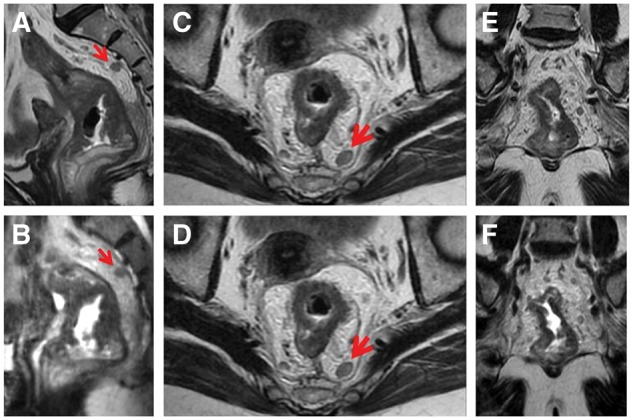
This retrospective study comprised 72 patients with rectal cancer confirmed by colonoscopy and biopsy. After neoadjuvant therapy, all patients underwent pelvic magnetic resonance imaging (MRI) examination at 1.5T MRI sequences including a single coronal 3D CUBE T2-weighted FSE sequence with 1.4 mm thickness and a 2D T2-weighted FSE sequence in the sagittal, coronal and axial planes with 5 mm thickness. The total acquisition time of the two sequences was recorded. Results were compared with postsurgical pathology (gold standard). The diagnostic accuracy was evaluated; and receiver operating characteristic (ROC) curves and the area under the curves (AUC) were calculated.
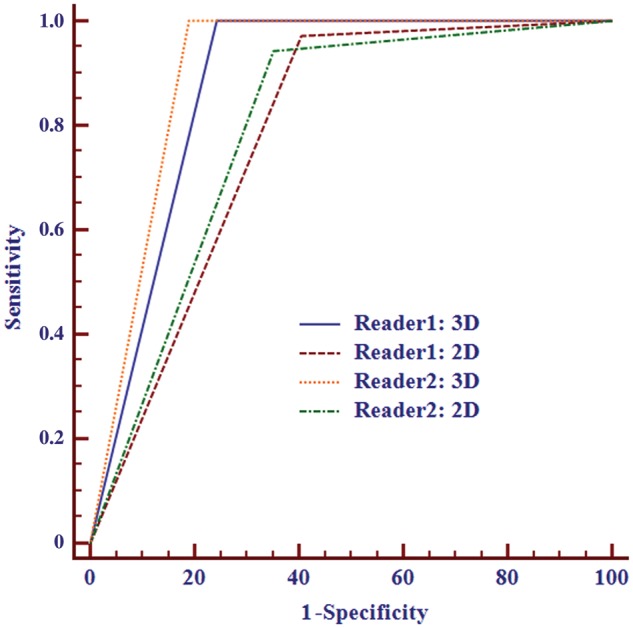
The T category staging accuracy of 3D T2WI and 2D T2WI was 81.9% and 72.2%, respectively, for reviewer 1 and 86.1% and 75.0% for reviewer 2. The AUC of 3D was higher than that of 2D (0.878 vs. 0.783 for reader 1 and 0.905 vs. 0.796 for reader 2; both P < 0.05) when judging whether the tumor broke through the muscle layer. There was no significant difference between 3D and 2D in judging whether lymph nodes were malignant (AUC 0.719 vs. 0.698 for reader 1 and 0.740 vs. 0.698 for reader 2; both P > 0.05). There were no significant differences in the visibility of the rectal wall layer, tumor lesion and the overall image quality (all P > 0.05). Compared with 2D sequences, the 3D sequence had shorter acquisition time and higher signal intensity ratio (both P < 0.05).
3D CUBE T2-weighted sequences offer better diagnostic accuracy in rectal cancer restaging after neoadjuvant therapy when compared with 2D T2-weighted FSE sequences; it has a shorter scanning time and more versatility of orientation reconstruction.
本研究旨在比较三维(3D)CUBE序列与二维(2D)T2加权快速自旋回波(FSE)序列在新辅助治疗后直肠癌再分期中的准确性。
本回顾性研究纳入72例经结肠镜检查及活检确诊的直肠癌患者。新辅助治疗后,所有患者均在1.5T磁共振成像(MRI)序列下行盆腔MRI检查,包括层厚1.4 mm的单次冠状位3D CUBE T2加权FSE序列,以及矢状位、冠状位和轴位上层厚5 mm的2D T2加权FSE序列。记录两种序列的总采集时间。将结果与术后病理(金标准)进行比较。评估诊断准确性;计算受试者工作特征(ROC)曲线及曲线下面积(AUC)。
对于审阅者1,3D T2WI和2D T2WI的T分期准确率分别为81.9%和72.2%,对于审阅者2分别为86.1%和75.0%。在判断肿瘤是否突破肌层时,3D序列的AUC高于2D序列(审阅者1:0.878对0.783;审阅者2:0.905对0.796;P均<0.05)。在判断淋巴结是否为恶性方面,3D与2D之间无显著差异(审阅者1:AUC 0.719对0.698;审阅者2:AUC 0.740对0.698;P均>0.05)。直肠壁层、肿瘤病变的显示及整体图像质量方面均无显著差异(P均>0.05)。与2D序列相比,3D序列采集时间更短,信号强度比更高(P均<0.05)。
与2D T2加权FSE序列相比,3D CUBE T2加权序列在新辅助治疗后直肠癌再分期中具有更好的诊断准确性;扫描时间更短,方向重建更具灵活性。