Department of Community Medicine & Health Care, University of Connecticut Health Center, 263 Farmington Avenue, MC 6325, Farmington, CT, 06030-6325, USA.
Institute for Collaboration on Health, Intervention, and Policy, University of Connecticut, Storrs, CT, USA.
AIDS Behav. 2017 Nov;21(11):3100-3110. doi: 10.1007/s10461-016-1637-x.
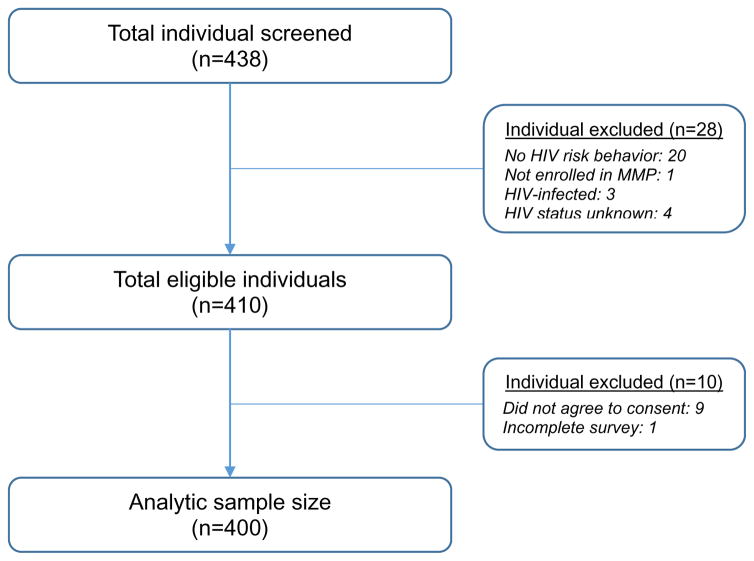
Despite promising trends of the efficacy of mobile health (mHealth) based strategies to a broad range of health conditions, very few if any studies have been done in terms of the examining the use of mHealth in HIV prevention efforts among people who use drugs in treatment. Thus, the goal of this study was to gain insight into the real-world acceptance of mHealth approaches among high-risk people who use drugs in treatment. A convenience sample of 400 HIV-negative drug users, who reported drug- and/or sex-related risk behaviors, were recruited from a methadone clinic in New Haven, Connecticut. Participants completed standardized assessments of drug- and sex-related risk behaviors, neurocognitive impairment (NCI), and measures of communication technology access and utilization, and mHealth acceptance. We found a high prevalence of current ownership and use of mobile technologies, such as cell phone (91.5%) including smartphone (63.5%). Participants used mobile technologies to communicate mostly through phone calls (M = 4.25, SD = 1.24), followed by text messages (M = 4.21, SD = 1.29). Participants expressed interest in using mHealth for medication reminders (72.3%), receive information about HIV (65.8%), and to assess drug-related (72.3%) and sex-related behaviors (64.8%). Furthermore, participants who were neurocognitively impaired were more likely to use cell phone without internet and show considerable interest in using mHealth as compared to those without NCI. The findings from this study provide empirical evidence that mHealth-based programs, specifically cell phone text messaging-based health programs, may be acceptable to this high-risk population.
尽管移动健康 (mHealth) 策略在广泛的健康状况方面显示出了有希望的效果,但很少有研究针对在治疗中使用毒品的人群中使用 mHealth 进行 HIV 预防工作进行评估。因此,本研究的目的是深入了解治疗中使用毒品的高危人群对 mHealth 方法的实际接受程度。从康涅狄格州纽黑文的美沙酮诊所招募了 400 名 HIV 阴性的吸毒者,他们报告了与毒品和/或性相关的风险行为,作为便利样本。参与者完成了关于毒品和性相关风险行为、神经认知障碍 (NCI) 以及通信技术获取和使用的测量以及 mHealth 接受程度的标准化评估。我们发现当前拥有和使用移动技术(如手机(91.5%),包括智能手机(63.5%))的情况非常普遍。参与者主要通过电话(M=4.25,SD=1.24)使用移动技术进行交流,其次是短信(M=4.21,SD=1.29)。参与者表示有兴趣使用 mHealth 来提醒用药(72.3%)、获取有关 HIV 的信息(65.8%)以及评估与药物相关的行为(72.3%)和与性相关的行为(64.8%)。此外,与没有神经认知障碍的参与者相比,神经认知障碍患者更有可能使用没有互联网的手机,并且对使用 mHealth 表现出极大的兴趣。这项研究的结果提供了经验证据,表明基于 mHealth 的计划,特别是基于手机短信的健康计划,可能对这一高危人群是可接受的。