Jongbloed Kate, Friedman Anton J, Pearce Margo E, Van Der Kop Mia L, Thomas Vicky, Demerais Lou, Pooyak Sherri, Schechter Martin T, Lester Richard T, Spittal Patricia M
School of Population and Public Health, Faculty of Medicine, University of British Columbia, 2206 East Mall, Vancouver, BC, V6T 1Z3, Canada.
The Cedar Project, Centre for Health Evaluation and Outcome Sciences, St. Paul's Hospital, 588-1081 Burrard Street, Vancouver, BC, V6Z 1Y6, Canada.
Trials. 2016 Mar 9;17(1):128. doi: 10.1186/s13063-016-1250-3.
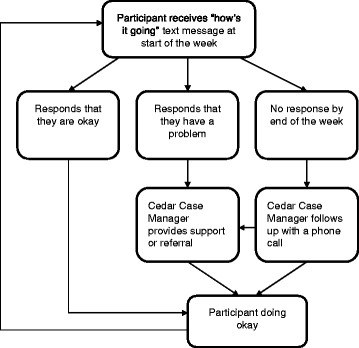
Despite successes in preventing and treating HIV, Indigenous people in Canada continue to face disproportionately high rates of HIV infection. Programs that support healing from lifetime trauma, support connection to culture, and reduce drug-related harms are critical to preventing HIV among young Indigenous people who use drugs. The Cedar Project WelTel mHealth intervention proposed here is a structured mobile-phone initiative to connect young Indigenous people who use drugs with Cedar Case Managers in a community-based setting. The intervention consists of a package of supports, including a mobile phone and cellular plan, weekly two-way text messaging, and support from Cedar Case Managers.
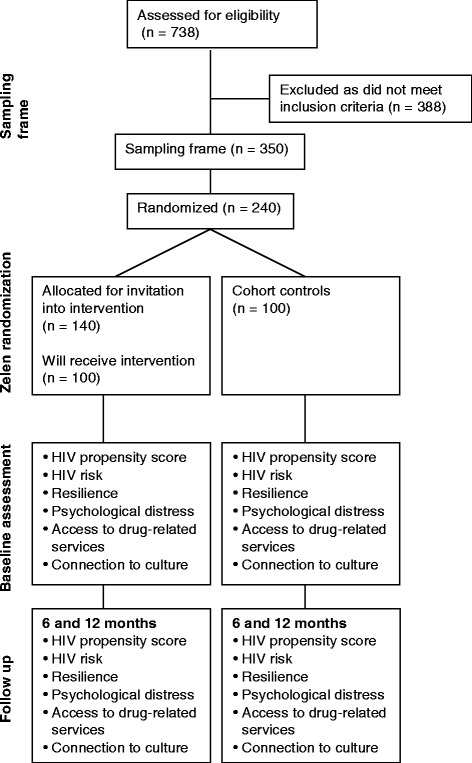
The Cedar Project WelTel mHealth study is a multi-site Zelen pre-randomized trial to measure the effect of a two-way supportive text-message intervention to reduce HIV vulnerability among young Indigenous people who use illicit drugs in two Canadian cities. The trial is nested within the Cedar Project, an ongoing cohort study addressing HIV and hepatitis C vulnerability among young Indigenous people who use drugs in Vancouver and Prince George, British Columbia. The Cedar Project Partnership, an independent body of Indigenous Elders, leaders, and health/social service experts, governs all aspects of the study. Two hundred participants will be followed over a 16-month period, with HIV propensity score at 6 months as the primary outcome. Secondary outcomes include HIV propensity at 1 year, HIV risk, resilience, psychological distress, access to drug-related services, and connection to culture measured at 6 months and 1 year. Primary analysis is by intention to treat.
Culturally safe interventions that address barriers to HIV prevention while supporting the strength of young Indigenous people who use drugs are urgently needed. Despite presenting a tremendous opportunity to connect young, highly transient Indigenous people who use drugs to prevention services, supportive two-way mHealth programs have yet to be tested for HIV prevention in a community-based setting with this population.
ClinicalTrials.gov NCT02437123 https://clinicaltrials.gov/show/NCT02437123 (registered 4 May 2015). Protocol version: 24 July 2015.
尽管在预防和治疗艾滋病毒方面取得了成功,但加拿大的原住民感染艾滋病毒的比例仍然过高。支持从终身创伤中康复、促进文化联系以及减少与毒品相关危害的项目,对于预防吸毒的年轻原住民感染艾滋病毒至关重要。本文提出的雪松项目WelTel移动健康干预措施,是一项结构化的手机倡议,旨在让吸毒的年轻原住民在社区环境中与雪松项目的个案管理员取得联系。该干预措施包括一系列支持,如一部手机和手机套餐、每周的双向短信服务,以及来自雪松项目个案管理员的支持。
雪松项目WelTel移动健康研究是一项多地点的泽伦预随机试验,旨在测量双向支持性短信干预措施对加拿大两个城市中吸毒的年轻原住民降低艾滋病毒易感性的效果。该试验嵌套在雪松项目中,雪松项目是一项正在进行的队列研究,关注不列颠哥伦比亚省温哥华市和乔治王子市吸毒的年轻原住民中的艾滋病毒和丙型肝炎易感性。雪松项目伙伴关系由原住民长老、领袖以及健康/社会服务专家组成的独立机构,负责该研究的各个方面。200名参与者将在16个月的时间内接受跟踪,以6个月时的艾滋病毒倾向得分作为主要结果。次要结果包括1年时的艾滋病毒倾向、艾滋病毒风险、恢复力、心理困扰、获得与毒品相关服务的情况,以及在6个月和1年时测量的文化联系。主要分析采用意向性分析。
迫切需要采取具有文化安全性的干预措施,解决艾滋病毒预防的障碍,同时增强吸毒的年轻原住民的力量。尽管为将流动频繁的吸毒年轻原住民与预防服务联系起来提供了巨大机会,但支持性的双向移动健康项目尚未在以该人群为对象的社区环境中进行艾滋病毒预防测试。
ClinicalTrials.gov NCT02437123 https://clinicaltrials.gov/show/NCT02437123(2015年5月4日注册)。方案版本:2015年7月24日。