Ogle Molly E, Olingy Claire E, Awojoodu Anthony O, Das Anusuya, Ortiz Rafael A, Cheung Hoi Yin, Botchwey Edward A
Wallace H. Coulter Department of Biomedical Engineering, Georgia Institute of Technology and Emory University, Atlanta, Georgia, USA.
Department of Biomedical Engineering, University of Virginia, Charlottesville, Virginia, USA.
Stem Cells. 2017 Apr;35(4):1040-1052. doi: 10.1002/stem.2556. Epub 2017 Jan 19.
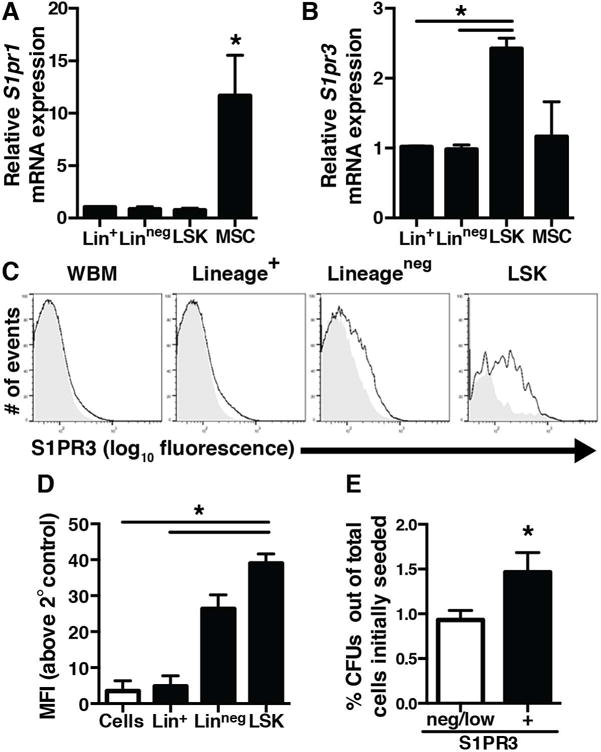
Hematopoietic stem and progenitor cells (HSPCs) egress from bone marrow (BM) during homeostasis and at increased rates during stress; however, the mechanisms regulating their trafficking remain incompletely understood. Here we describe a novel role for lipid receptor, sphingosine-1-phosphate receptor 3 (S1PR3), in HSPC residence within the BM niche. HSPCs expressed increased levels of S1PR3 compared to differentiated BM cells. Pharmacological antagonism or knockout (KO) of S1PR3 mobilized HSPCs into blood circulation, suggesting that S1PR3 influences niche localization. S1PR3 antagonism suppressed BM and plasma SDF-1, enabling HSPCs to migrate toward S1P-rich plasma. Mobilization synergized with AMD3100-mediated antagonism of CXCR4, which tethers HSPCs in the niche, and recovered homing deficits of AMD3100-treated grafts. S1PR3 antagonism combined with AMD3100 improved re-engraftment and survival in lethally irradiated recipients. Our studies indicate that S1PR3 and CXCR4 signaling cooperate to maintain HSPCs within the niche under homeostasis. These results highlight an important role for S1PR3 in HSPC niche occupancy and trafficking that can be harnessed for both rapid clinical stem cell mobilization and re-engraftment strategies, as well as the opportunity to design novel therapeutics for control of recruitment, homing, and localization through bioactive lipid signaling. Stem Cells 2017;35:1040-1052.
造血干细胞和祖细胞(HSPCs)在稳态期间从骨髓(BM)中流出,在应激状态下流出速率增加;然而,调节其运输的机制仍未完全了解。在这里,我们描述了脂质受体鞘氨醇-1-磷酸受体3(S1PR3)在HSPCs驻留在BM生态位中的新作用。与分化的BM细胞相比,HSPCs表达的S1PR3水平更高。S1PR3的药理学拮抗或敲除(KO)将HSPCs动员到血液循环中,表明S1PR3影响生态位定位。S1PR3拮抗作用抑制了BM和血浆中的SDF-1,使HSPCs能够向富含S1P的血浆迁移。动员与AMD3100介导的CXCR4拮抗作用协同,CXCR4将HSPCs束缚在生态位中,并恢复了AMD3100处理的移植物的归巢缺陷。S1PR3拮抗作用与AMD3100联合使用可提高致死性照射受体的再植入率和存活率。我们的研究表明,在稳态下,S1PR3和CXCR4信号协同作用以维持HSPCs在生态位内。这些结果突出了S1PR3在HSPC生态位占据和运输中的重要作用,这可用于快速临床干细胞动员和再植入策略,以及通过生物活性脂质信号设计控制募集、归巢和定位的新型疗法的机会。《干细胞》2017年;35:1040 - 1052。