Hersek Sinan, Toreyin Hakan, Teague Caitlin N, Millard-Stafford Mindy L, Jeong Hyeon-Ki, Bavare Miheer M, Wolkoff Paul, Sawka Michael N, Inan Omer T
IEEE Trans Biomed Eng. 2017 Oct;64(10):2353-2360. doi: 10.1109/TBME.2016.2641958. Epub 2016 Dec 22.
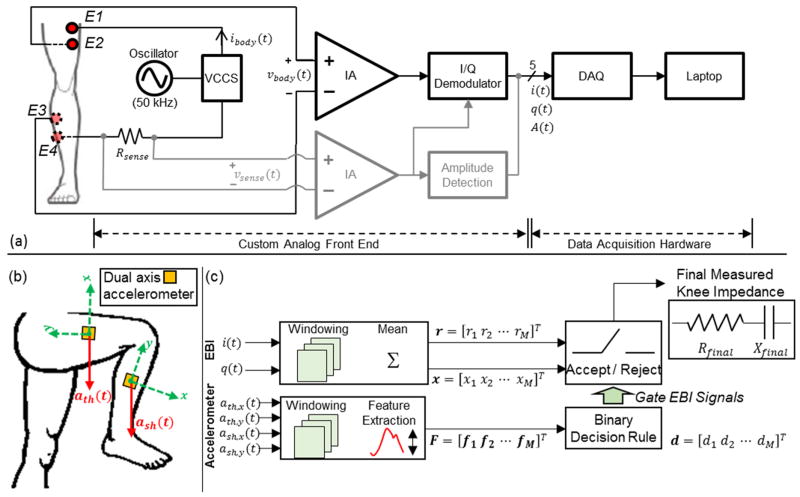
We designed and validated a portable electrical bioimpedance (EBI) system to quantify knee joint health.
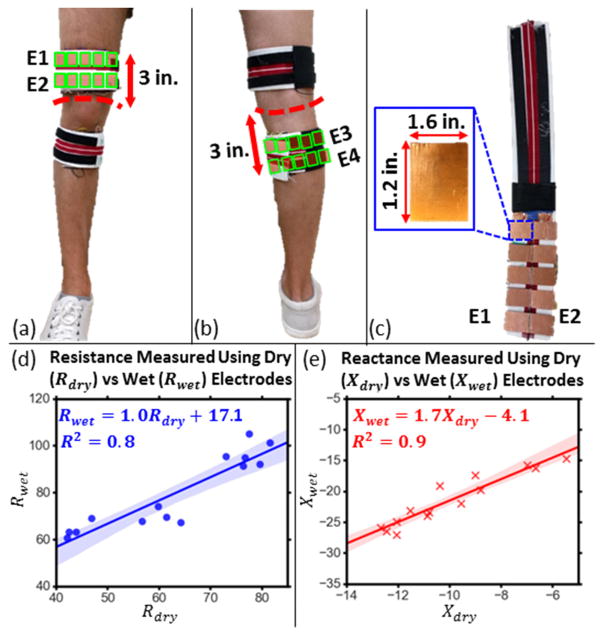
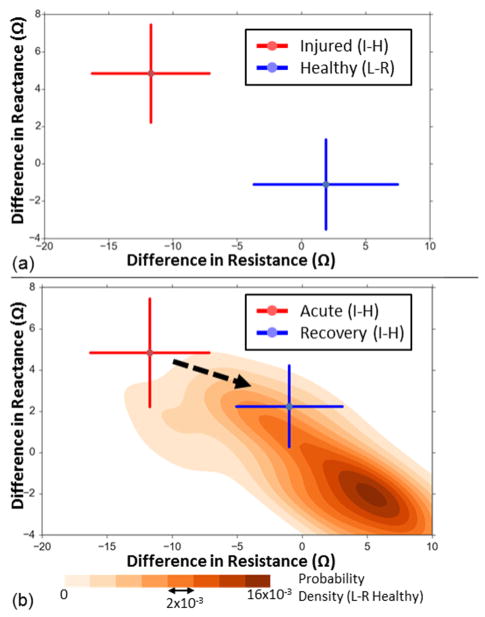
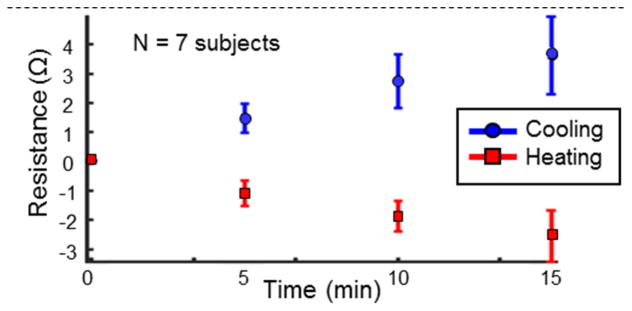
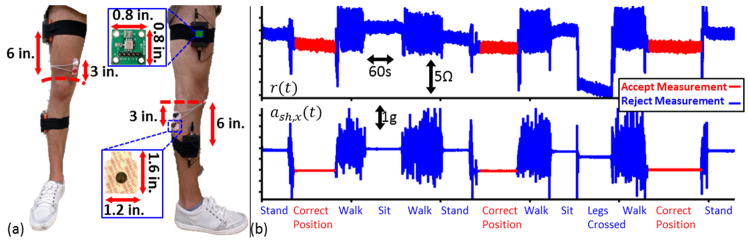
Five separate experiments were performed to demonstrate the: 1) ability of the EBI system to assess knee injury and recovery; 2) interday variability of knee EBI measurements; 3) sensitivity of the system to small changes in interstitial fluid volume; 4) reducing the error of EBI measurements using acceleration signals; and 5) use of the system with dry electrodes integrated to a wearable knee wrap.
This study demonstrates the use of wearable EBI measurements in monitoring knee joint health.
The proposed wearable system has the potential for assessing knee joint health outside the clinic/lab and help guide rehabilitation.
我们设计并验证了一种便携式生物电阻抗(EBI)系统,用于量化膝关节健康状况。
进行了五项独立实验,以证明:1)EBI系统评估膝关节损伤和恢复情况的能力;2)膝关节EBI测量的日间变异性;3)系统对组织间液体积微小变化的敏感性;4)使用加速度信号减少EBI测量误差;5)将该系统与集成在可穿戴护膝上的干电极配合使用。
1)左右膝关节电阻(R)和电抗(X)的绝对差值能够区分受伤和健康的膝关节(p < 0.05);康复后受伤受试者的R绝对差值显著降低(p < 0.05)。2)膝关节R绝对差值的平均日间变异性(标准差)为2.5Ω,X为1.2Ω。3)局部加热/冷却导致膝关节R显著降低/升高(p < 0.01)。4)所提出的受试者位置检测算法在检测受试者处于正确测量位置时,留一法交叉验证准确率达到97.4%,精度达到98.2%。5)使用湿电极和设计的可穿戴护膝测量的膝关节R和X之间的线性回归具有高度相关性(R分别为0.8和0.9)。
本研究证明了可穿戴EBI测量在监测膝关节健康中的应用。
所提出的可穿戴系统具有在诊所/实验室之外评估膝关节健康状况并帮助指导康复的潜力。