Klaassen Zachary, Howard Lauren E, de Hoedt Amanda, Amling Christopher L, Aronson William J, Cooperberg Matthew R, Kane Christopher J, Terris Martha K, Freedland Stephen J
Department of Surgery, Section of Urology, Medical College of Georgia, Augusta University, Augusta, Georgia.
Department of Surgery, Division of Urology, Durham Veterans Affairs Medical Center, Durham, North Carolina.
Cancer. 2017 May 1;123(9):1528-1535. doi: 10.1002/cncr.30505. Epub 2016 Dec 27.
Skeletal-related events (SREs) are common complications of bone metastatic castration-resistant prostate cancer (mCRPC). To the authors' knowledge, there are limited data regarding which factors predict SREs. The authors identified risk factors for SREs in men with bone mCRPC using characteristics commonly available in the medical record.
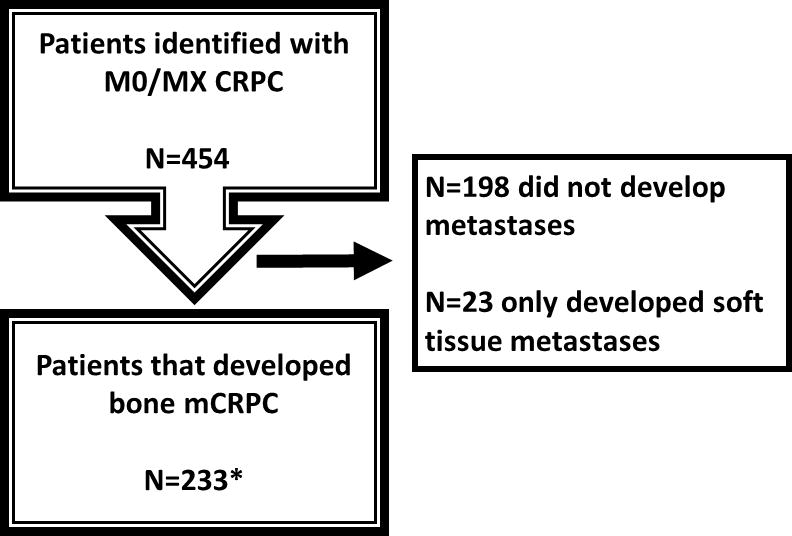
Data from 454 patients with nonmetastatic CRPC were identified from 2 Veteran Affairs Medical Centers from 2000 through 2013. Among these men, 233 (51%) developed bone metastases during follow-up and represented the study cohort. First occurrence of an SRE was abstracted from the medical records. A stepwise multivariable Cox model was used to select the strongest predictors of time to SRE.
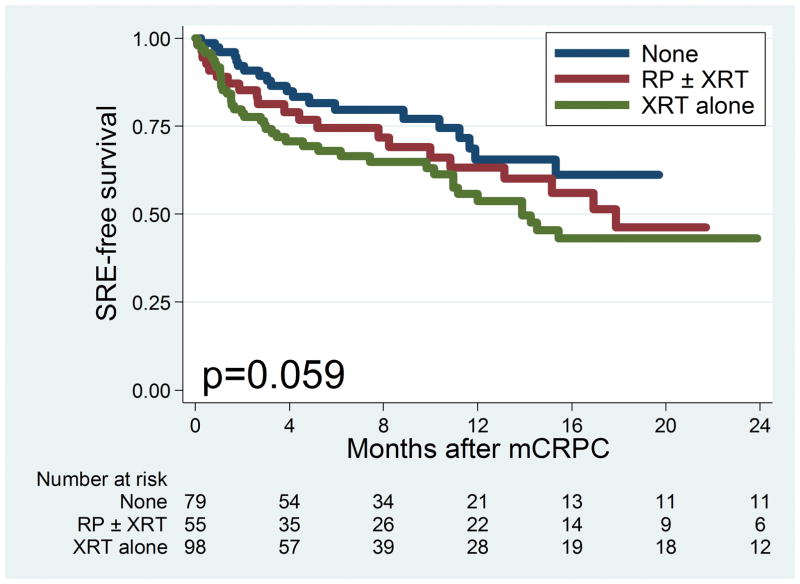
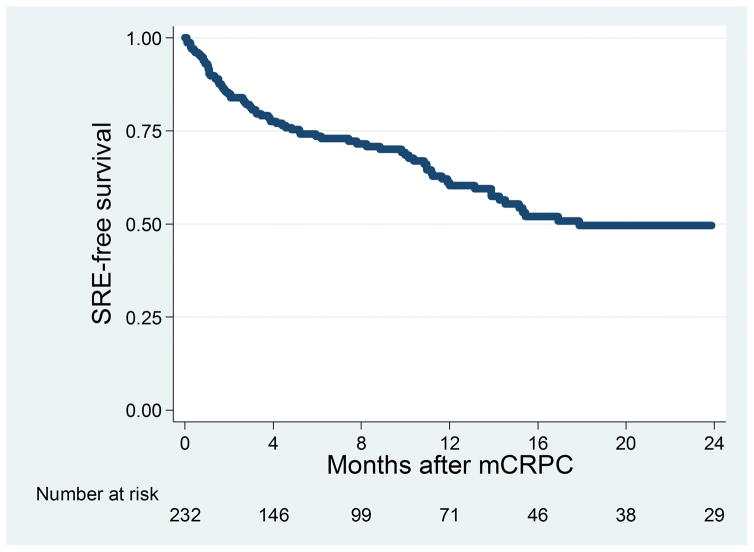
The median age of the patients at the time of diagnosis of bone mCRPC was 75 years (interquartile range, 68-81 years), and there were 153 nonblack patients (66%). During follow-up (median, 7.8 months [interquartile range, 2.9-18.3 months]), 88 patients (38%) had an SRE. On univariable analysis, more recent year of metastasis (hazard ratio [HR], 0.91), prostate-specific antigen doubling time of ≥9 months versus <9 months (HR, 0.50), and bone pain (HR, 3.34) were all found to be associated with SRE risk. On multivariable analysis, year of metastasis (HR, 0.93), biopsy Gleason score of 7 versus ≤6 (HR, 1.74), radiotherapy as the primary localized treatment versus none (HR, 2.33), and bone pain (HR, 3.64) were associated with SRE risk. The area under the curve for a multivariable model based upon these risk factors was 0.744.
The authors identified several significant predictors of SREs among men with mCRPC. In particular, men with bone pain are at high risk of an SRE. If confirmed, future trials should focus on prolonging life and reducing SRE risk in patients with mCRPC with bone pain. Cancer 2017;123:1528-1535. © 2017 American Cancer Society.
骨相关事件(SREs)是骨转移去势抵抗性前列腺癌(mCRPC)的常见并发症。据作者所知,关于哪些因素可预测SREs的数据有限。作者利用病历中常见的特征确定了骨mCRPC男性患者发生SREs的危险因素。
从2个退伍军人事务医疗中心收集了2000年至2013年期间454例非转移性CRPC患者的数据。在这些男性患者中,233例(51%)在随访期间发生骨转移,构成研究队列。首次发生SREs的情况从病历中提取。采用逐步多变量Cox模型选择SREs发生时间的最强预测因素。
骨mCRPC诊断时患者的中位年龄为75岁(四分位间距,68 - 81岁),非黑人患者有153例(66%)。在随访期间(中位时间为7.8个月[四分位间距,2.9 - 18.3个月]),88例患者(38%)发生了SREs。单变量分析显示,更近的转移年份(风险比[HR],0.91)、前列腺特异性抗原倍增时间≥9个月与<9个月相比(HR,0.50)以及骨痛(HR,3.34)均与SREs风险相关。多变量分析显示,转移年份(HR,0.93)、活检Gleason评分为7与≤6相比(HR,1.74)、以放疗作为主要局部治疗与未进行放疗相比(HR,2.33)以及骨痛(HR,3.64)与SREs风险相关。基于这些危险因素的多变量模型的曲线下面积为0.744。
作者在mCRPC男性患者中确定了几个SREs的重要预测因素。特别是,有骨痛的男性发生SREs的风险很高。如果得到证实,未来的试验应侧重于延长有骨痛的mCRPC患者的生命并降低其SREs风险。《癌症》2017年;123:1528 - 1535。©2017美国癌症协会。