Max Planck Institute for Polymer Research, Ackermannweg 10, D-55128 Mainz, Germany.
Instituto de Telecomunicações, Departamento de Engenharia Electrotécnica e de Computadores, Universidade de Coimbra, 3030-290 Coimbra, Portugal.
Sci Adv. 2016 Dec 23;2(12):e1600516. doi: 10.1126/sciadv.1600516. eCollection 2016 Dec.
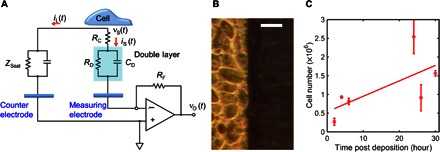
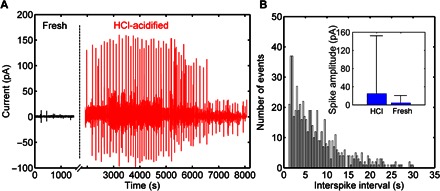
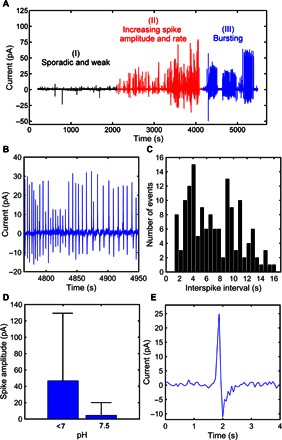
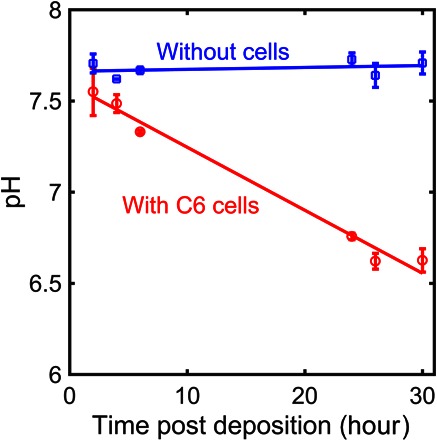
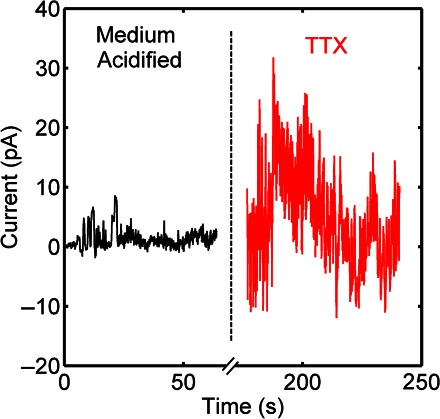
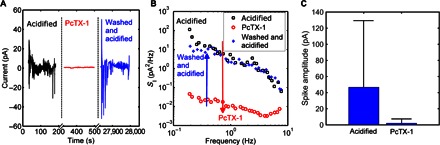
Glioma patients often suffer from epileptic seizures because of the tumor's impact on the brain physiology. Using the rat glioma cell line C6 as a model system, we performed long-term live recordings of the electrical activity of glioma populations in an ultrasensitive detection method. The transducer exploits large-area electrodes that maximize double-layer capacitance, thus increasing the sensitivity. This strategy allowed us to record glioma electrical activity. We show that although glioma cells are nonelectrogenic, they display a remarkable electrical burst activity in time. The low-frequency current noise after cell adhesion is dominated by the flow of Na ions through voltage-gated ion channels. However, after an incubation period of many hours, the current noise markedly increased. This electric bursting phenomenon was not associated with apoptosis because the cells were viable and proliferative during the period of increased electric activity. We detected a rapid cell culture medium acidification accompanying this event. By using specific inhibitors, we showed that the electrical bursting activity was prompted by extracellular pH changes, which enhanced Na ion flux through the psalmotoxin 1-sensitive acid-sensing ion channels. Our model of pH-triggered bursting was unambiguously supported by deliberate, external acidification of the cell culture medium. This unexpected, acidosis-driven electrical activity is likely to directly perturb, in vivo, the functionality of the healthy neuronal network in the vicinity of the tumor bulk and may contribute to seizures in glioma patients.
脑肿瘤患者常因肿瘤对大脑生理的影响而出现癫痫发作。我们使用大鼠脑胶质瘤细胞系 C6 作为模型系统,采用超灵敏检测方法对脑胶质瘤群体的电活动进行长期实时记录。该换能器利用大面积电极来最大化双层电容,从而提高灵敏度。这种策略使我们能够记录脑胶质瘤的电活动。我们表明,尽管脑胶质瘤细胞是非发电的,但它们会在时间上显示出显著的电爆发活动。细胞黏附后的低频电流噪声主要由通过电压门控离子通道的 Na 离子流主导。然而,在数小时的孵育期后,电流噪声明显增加。这种电爆发现象与细胞凋亡无关,因为在电活动增加期间细胞是存活和增殖的。我们检测到伴随这一事件的细胞培养液迅速酸化。通过使用特定的抑制剂,我们表明电爆发活动是由细胞外 pH 值变化引起的,这增强了 psalmotoxin 1 敏感酸感应离子通道中的 Na 离子流。我们通过故意使细胞培养液酸化来支持 pH 值触发爆发的模型,这明确证实了该模型。这种出乎意料的、由酸中毒驱动的电活动可能会直接干扰肿瘤附近健康神经元网络的功能,从而导致脑肿瘤患者癫痫发作。