Garg Neha, Zeng Yi, Edlund Anna, Melnik Alexey V, Sanchez Laura M, Mohimani Hosein, Gurevich Alexey, Miao Vivian, Schiffler Stefan, Lim Yan Wei, Luzzatto-Knaan Tal, Cai Shengxin, Rohwer Forest, Pevzner Pavel A, Cichewicz Robert H, Alexandrov Theodore, Dorrestein Pieter C
Skaggs School of Pharmacy and Pharmaceutical Sciences, University of California, San Diego, California, USA.
Department of Chemistry and Biochemistry, University of California, San Diego, California, USA.
mSystems. 2016 Dec 20;1(6). doi: 10.1128/mSystems.00139-16. eCollection 2016 Nov-Dec.
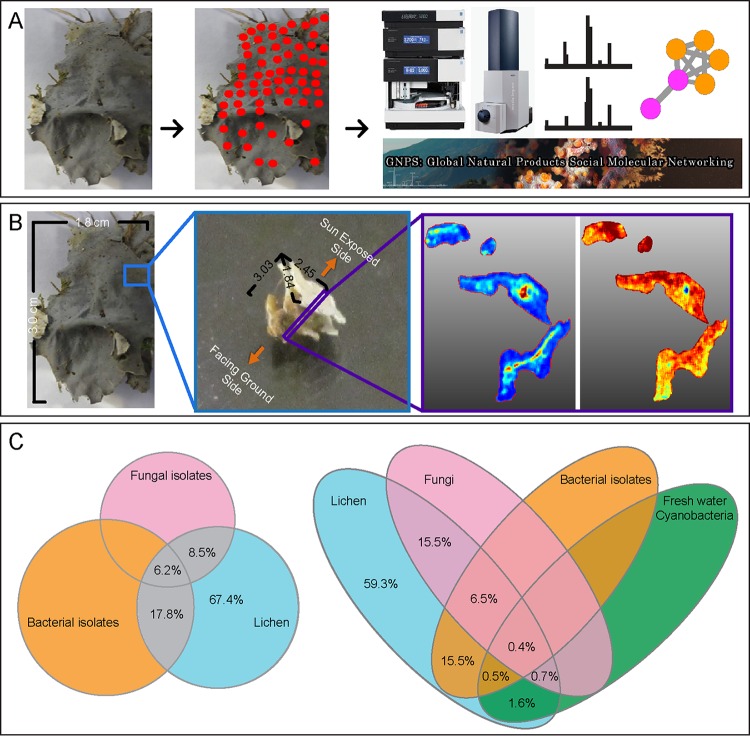
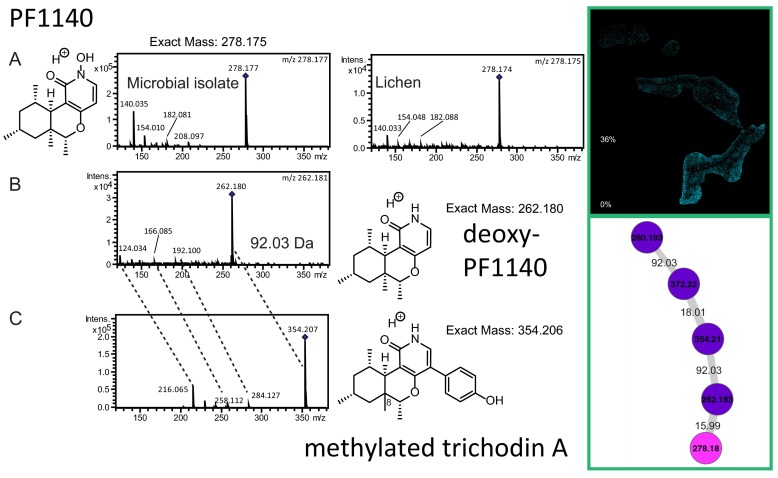
Microbes are commonly studied as individual species, but they exist as mixed assemblages in nature. At present, we know very little about the spatial organization of the molecules, including natural products that are produced within these microbial networks. Lichens represent a particularly specialized type of symbiotic microbial assemblage in which the component microorganisms exist together. These composite microbial assemblages are typically comprised of several types of microorganisms representing phylogenetically diverse life forms, including fungi, photosymbionts, bacteria, and other microbes. Here, we employed matrix-assisted laser desorption ionization-time of flight (MALDI-TOF) imaging mass spectrometry to characterize the distributions of small molecules within a lichen. In order to probe how small molecules are organized and localized within the microbial consortium, analytes were annotated and assigned to their respective producer microorganisms using mass spectrometry-based molecular networking and metagenome sequencing. The spatial analysis of the molecules not only reveals an ordered layering of molecules within the lichen but also supports the compartmentalization of unique functions attributed to various layers. These functions include chemical defense (e.g., antibiotics), light-harvesting functions associated with the cyanobacterial outer layer (e.g., chlorophyll), energy transfer (e.g., sugars) surrounding the sun-exposed cyanobacterial layer, and carbohydrates that may serve a structural or storage function and are observed with higher intensities in the non-sun-exposed areas (e.g., complex carbohydrates). Microbial communities have evolved over centuries to live symbiotically. The direct visualization of such communities at the chemical and functional level presents a challenge. Overcoming this challenge may allow one to visualize the spatial distributions of specific molecules involved in symbiosis and to define their functional roles in shaping the community structure. In this study, we examined the diversity of microbial genes and taxa and the presence of biosynthetic gene clusters by metagenomic sequencing and the compartmentalization of organic chemical components within a lichen using mass spectrometry. This approach allowed the identification of chemically distinct sections within this composite organism. Using our multipronged approach, various fungal natural products, not previously reported from lichens, were identified and two different fungal layers were visualized at the chemical level.
微生物通常作为单个物种进行研究,但它们在自然界中是以混合群体的形式存在的。目前,我们对这些微生物网络中产生的分子,包括天然产物的空间组织了解甚少。地衣代表了一种特别特殊的共生微生物群体类型,其中组成微生物共同存在。这些复合微生物群体通常由几种代表系统发育上不同生命形式的微生物组成,包括真菌、光合共生体、细菌和其他微生物。在这里,我们采用基质辅助激光解吸电离飞行时间(MALDI-TOF)成像质谱来表征地衣内小分子的分布。为了探究小分子在微生物群落中是如何组织和定位的,使用基于质谱的分子网络和宏基因组测序将分析物进行注释并分配给它们各自的产生微生物。分子的空间分析不仅揭示了地衣内分子的有序分层,还支持了归因于不同层的独特功能的区室化。这些功能包括化学防御(如抗生素)、与蓝细菌外层相关的光捕获功能(如叶绿素)、围绕暴露于阳光的蓝细菌层的能量转移(如糖类),以及可能具有结构或储存功能且在非阳光暴露区域强度较高的碳水化合物(如复合碳水化合物)。微生物群落经过几个世纪的进化形成了共生关系。在化学和功能水平上直接可视化这样的群落是一项挑战。克服这一挑战可能使人们能够可视化参与共生的特定分子的空间分布,并确定它们在塑造群落结构中的功能作用。在这项研究中,我们通过宏基因组测序研究了微生物基因和分类群的多样性以及生物合成基因簇的存在,并使用质谱研究了地衣内有机化学成分的区室化。这种方法使得能够识别这种复合生物体中化学性质不同的部分。使用我们的多管齐下的方法,鉴定出了以前在地衣中未报道过的各种真菌天然产物,并在化学水平上可视化了两个不同的真菌层。