Dhir Mashaal, Choudry Haroon A, Holtzman Matthew P, Pingpank James F, Ahrendt Steven A, Zureikat Amer H, Hogg Melissa E, Bartlett David L, Zeh Herbert J, Singhi Aatur D, Bahary Nathan
Division of Surgical Oncology, University of Pittsburgh Medical Center, Pittsburgh, Pennsylvania, 15232.
Division of Gastrointestinal Pathology, University of Pittsburgh Medical Center, Pittsburgh, Pennsylvania, 15232.
Cancer Med. 2017 Jan;6(1):195-206. doi: 10.1002/cam4.992. Epub 2016 Dec 28.
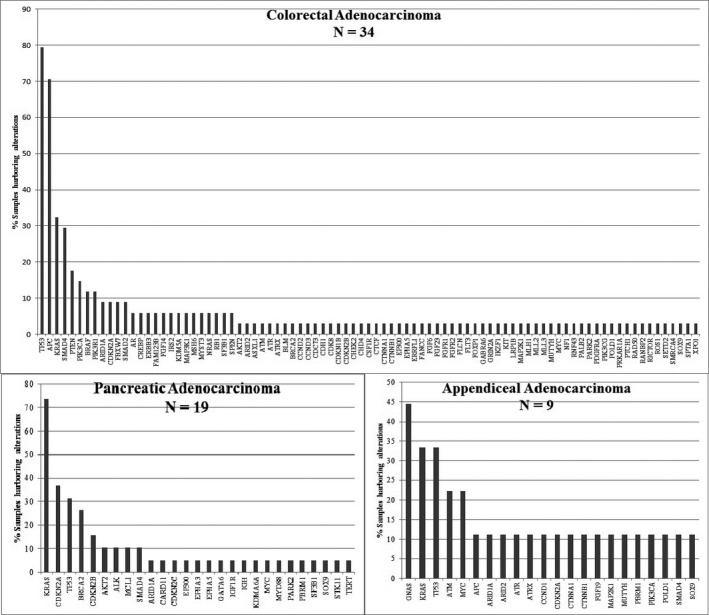
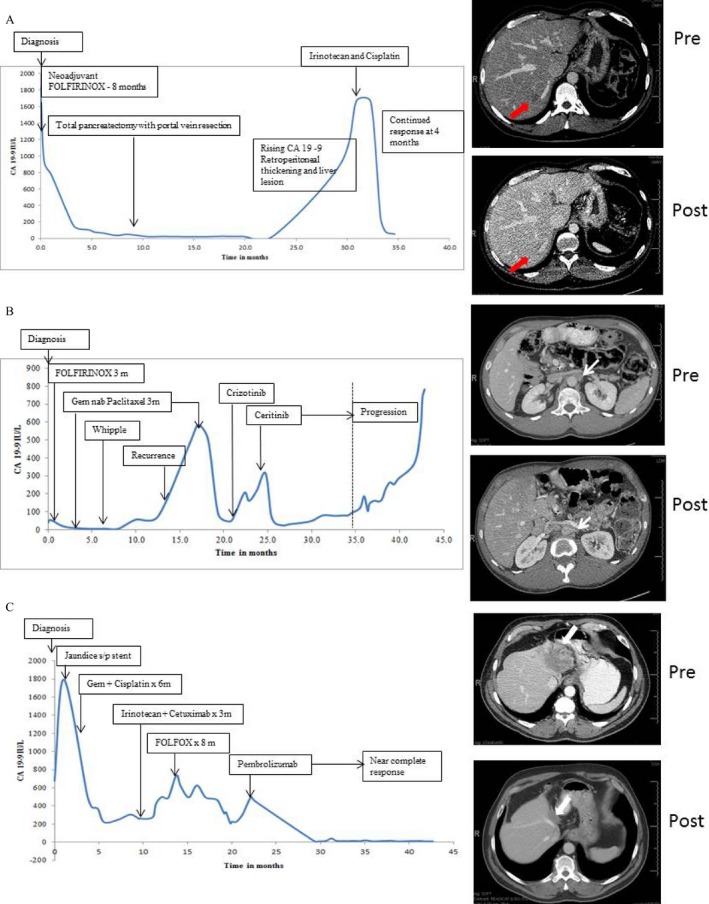
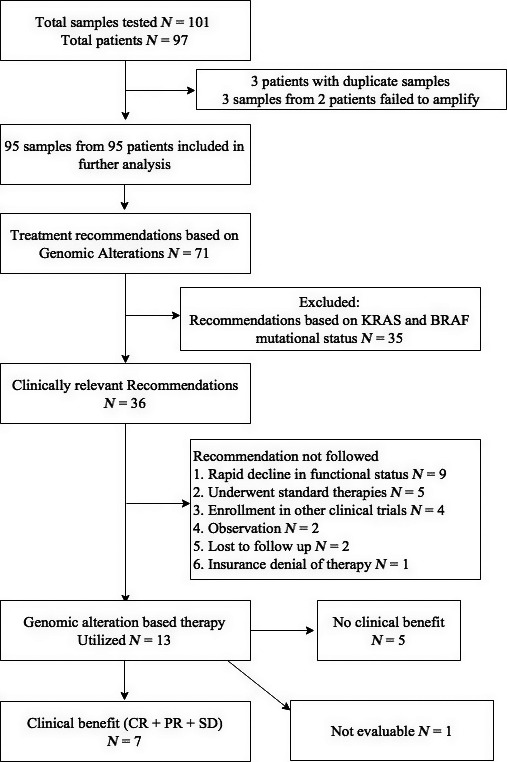
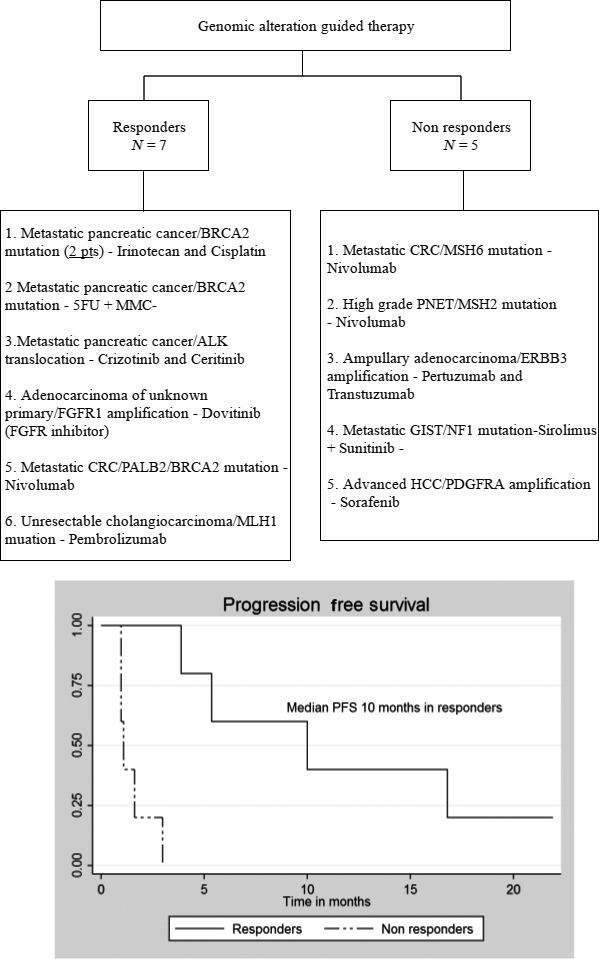
The impact of genomic profiling on the outcomes of patients with advanced gastrointestinal (GI) malignancies remains unknown. The primary objectives of the study were to investigate the clinical benefit of genomic-guided therapy, defined as complete response (CR), partial response (PR), or stable disease (SD) at 3 months, and its impact on progression-free survival (PFS) in patients with advanced GI malignancies. Clinical and genomic data of all consecutive GI tumor samples from April, 2013 to April, 2016 sequenced by FoundationOne were obtained and analyzed. A total of 101 samples from 97 patients were analyzed. Ninety-eight samples from 95 patients could be amplified making this approach feasible in 97% of the samples. After removing duplicates, 95 samples from 95 patients were included in the further analysis. Median time from specimen collection to reporting was 11 days. Genomic alteration-guided treatment recommendations were considered new and clinically relevant in 38% (36/95) of the patients. Rapid decline in functional status was noted in 25% (9/36) of these patients who could therefore not receive genomic-guided therapy. Genomic-guided therapy was utilized in 13 patients (13.7%) and 7 patients (7.4%) experienced clinical benefit (6 PR and 1 SD). Among these seven patients, median PFS was 10 months with some ongoing durable responses. Genomic profiling-guided therapy can lead to clinical benefit in a subset of patients with advanced GI malignancies. Attempting genomic profiling earlier in the course of treatment prior to functional decline may allow more patients to benefit from these therapies.
基因组分析对晚期胃肠道(GI)恶性肿瘤患者预后的影响尚不清楚。本研究的主要目的是调查基因组指导治疗的临床获益,定义为3个月时的完全缓解(CR)、部分缓解(PR)或疾病稳定(SD),以及其对晚期GI恶性肿瘤患者无进展生存期(PFS)的影响。获取并分析了2013年4月至2016年4月期间由FoundationOne测序的所有连续GI肿瘤样本的临床和基因组数据。共分析了来自97例患者的101个样本。来自95例患者的98个样本能够被扩增,这使得该方法在97%的样本中可行。去除重复样本后,来自95例患者的95个样本纳入进一步分析。从标本采集到报告的中位时间为11天。基因组改变指导的治疗建议在38%(36/95)的患者中被认为是新的且具有临床相关性。在这些患者中有25%(9/36)出现功能状态迅速下降,因此无法接受基因组指导治疗。13例患者(13.7%)接受了基因组指导治疗,7例患者(7.4%)有临床获益(6例PR和1例SD)。在这7例患者中,中位PFS为10个月,部分患者有持续的持久缓解。基因组分析指导的治疗可使一部分晚期GI恶性肿瘤患者获得临床获益。在功能下降之前的治疗过程中尽早尝试基因组分析可能会使更多患者从这些治疗中获益。