Nattinger Ann B, Wozniak Erica M, McGinley Emily L, Li Jianing, Laud Purushottam, Pezzin Liliana E
*Department of Medicine, Medical College of Wisconsin †Center for Patient Care and Outcomes Research, Medical College of Wisconsin ‡Division of Biostatistics, Institute for Health and Society, Medical College of Wisconsin, Milwaukee, WI.
Med Care. 2017 May;55(5):463-469. doi: 10.1097/MLR.0000000000000685.
Breast cancer patients exhibit survival disparities based on socioeconomic status (SES). Disparities may be attributable to access to expensive oral endocrine agents.
Define recent socioeconomic disparities in breast cancer survival and determine whether these improved after implementation of the Medicare Part D program.
Difference-in-difference natural experiment of women diagnosed and treated before or after implementation of Medicare Part D.
Female Medicare beneficiaries with early-stage breast cancer: 54,772 diagnosed in 2001 and 46,371 in 2007.
SES was based on Medicaid enrollment and zip code per capita income, all-cause mortality from Medicare, and cause of death from National Death Index.
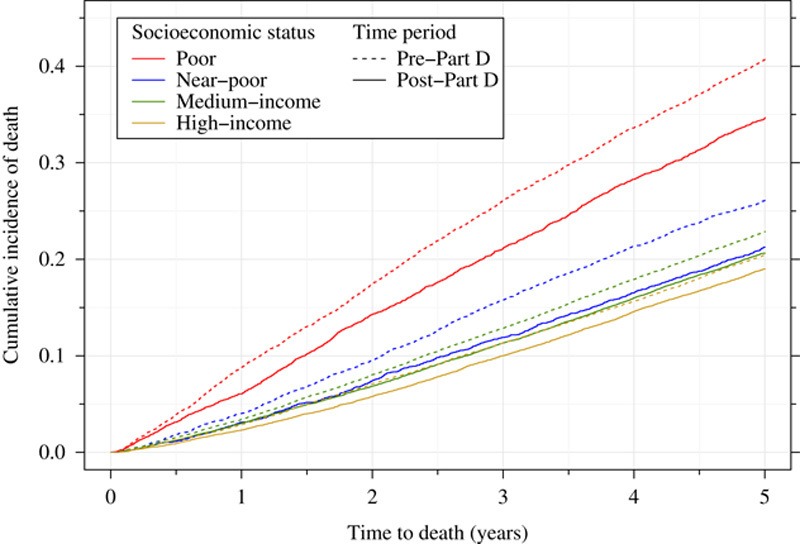
Among women diagnosed pre-Part D, 40.5% of poor beneficiaries had died within 5 years compared with 20.3% of high-income women (P<0.0001). Post-Part D, 33.6% of poor women and 18.4% of high-income women died by 5 years. After adjustment for potential confounders, improvement in all-cause mortality post-Part D was greater for poorer women compared with more affluent women (P=0.002). However, absolute improvement in breast cancer-specific mortality was 1.8%, 1.2%, and 0.8% (P=0.88 for difference in improvement by SES), respectively for poor, near-poor, and high-income women, whereas analogous improvement in mortality from other causes was 5.1%, 3.8%, and 0.9% (P=0.067 for difference in improvement by SES).
Large survival disparities by SES exist among breast cancer patients. The Part D program successfully ameliorated SES disparities in all-cause mortality. However, improvement was concentrated in causes of death other than breast cancer, suggesting remaining gaps in care.
乳腺癌患者的生存情况因社会经济地位(SES)而异。这种差异可能归因于能否获得昂贵的口服内分泌药物。
明确近期乳腺癌生存方面的社会经济差异,并确定在实施医疗保险D部分计划后这些差异是否有所改善。
对医疗保险D部分实施前后确诊并接受治疗的女性进行的双重差分自然实验。
患有早期乳腺癌的女性医疗保险受益人:2001年确诊的有54772人,2007年确诊的有46371人。
SES基于医疗补助登记情况和邮政编码对应的人均收入、医疗保险的全因死亡率以及国家死亡指数的死亡原因。
在D部分计划实施前确诊的女性中,5年内40.5%的贫困受益人死亡,而高收入女性的这一比例为20.3%(P<0.0001)。D部分计划实施后,5年内33.6%的贫困女性和18.4%的高收入女性死亡。在对潜在混杂因素进行调整后,与较富裕女性相比,贫困女性在D部分计划实施后的全因死亡率改善更大(P=0.002)。然而,贫困、接近贫困和高收入女性的乳腺癌特异性死亡率的绝对改善分别为1.8%、1.2%和0.8%(SES改善差异的P值为0.88),而其他原因导致的死亡率的类似改善分别为5.1%、3.8%和0.9%(SES改善差异的P值为0.067)。
乳腺癌患者中存在因SES导致的巨大生存差异。D部分计划成功缩小了全因死亡率方面的SES差异。然而,改善主要集中在乳腺癌以外的死亡原因上,这表明在医疗护理方面仍存在差距。