Chae Young Kwang, Ranganath Keerthi, Hammerman Peter S, Vaklavas Christos, Mohindra Nisha, Kalyan Aparna, Matsangou Maria, Costa Ricardo, Carneiro Benedito, Villaflor Victoria M, Cristofanilli Massimo, Giles Francis J
Developmental Therapeutics Program of the Division of Hematology Oncology, Chicago, IL, USA.
Robert H. Lurie Comprehensive Cancer Center of Northwestern University, Chicago, IL, USA.
Oncotarget. 2017 Feb 28;8(9):16052-16074. doi: 10.18632/oncotarget.14109.
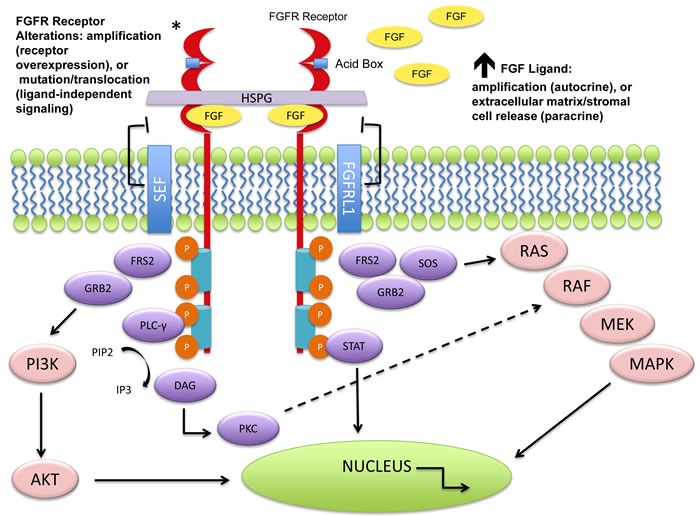
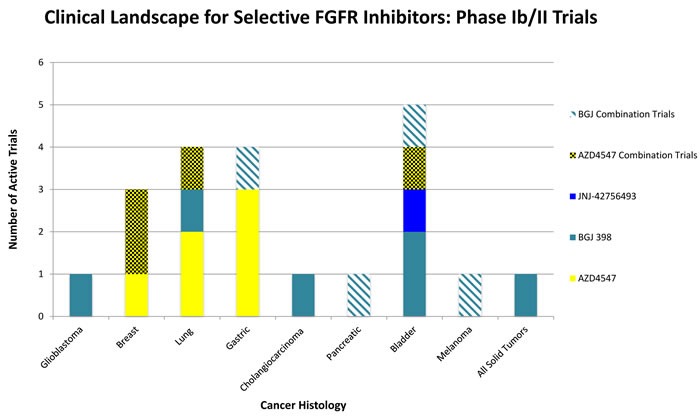
The fibroblast growth factor/fibroblast growth factor receptor (FGF/FGFR) is a tyrosine kinase signaling pathway that has a fundamental role in many biologic processes including embryonic development, tissue regeneration, and angiogenesis. Increasing evidence indicates that this pathway plays a critical role in oncogenesis via gene amplification, activating mutations, or translocation in tumors of various histologies. With multiplex sequencing technology, the detection of FGFR aberrations has become more common and is tied to cancer cell proliferation, resistance to anticancer therapies, and neoangiogenesis. Inhibition of FGFR signaling appears promising in preclinical studies, suggesting a pathway of clinical interest in the development of targeted therapy. Phase I trials have demonstrated a manageable toxicity profile. Currently, there are multiple FGFR inhibitors under study with many non-selective (multi-kinase) inhibitors demonstrating limited clinical responses. As we progress from the first generation of non-selective drugs to the second generation of selective FGFR inhibitors, it is clear that FGFR aberrations do not behave uniformly across cancer types; thus, a deeper understanding of biomarker strategies is undoubtedly warranted. This review aims to consolidate data from recent clinical trials with a focus on selective FGFR inhibitors. As Phase II clinical trials emerge, concentration on patient selection as it pertains to predicting response to therapy, feasible methods for overcoming toxicity, and the likelihood of combination therapies should be utilized. We will also discuss qualities that may be desirable in future generations of FGFR inhibitors, with the hope that overcoming these current barriers will expedite the availability of this novel class of medications.
成纤维细胞生长因子/成纤维细胞生长因子受体(FGF/FGFR)是一种酪氨酸激酶信号通路,在包括胚胎发育、组织再生和血管生成在内的许多生物学过程中发挥着重要作用。越来越多的证据表明,该通路通过基因扩增、激活突变或各种组织学肿瘤中的易位在肿瘤发生中起关键作用。借助多重测序技术,FGFR畸变的检测变得更加普遍,并且与癌细胞增殖、抗癌治疗耐药性和新生血管生成相关。在临床前研究中,抑制FGFR信号似乎很有前景,这表明该通路在靶向治疗的开发中具有临床研究价值。I期试验已证明其毒性特征可控。目前,有多种FGFR抑制剂正在研究中,许多非选择性(多激酶)抑制剂显示出有限的临床反应。随着我们从第一代非选择性药物发展到第二代选择性FGFR抑制剂,很明显FGFR畸变在不同癌症类型中的表现并不一致;因此,深入了解生物标志物策略无疑是必要的。本综述旨在整合近期临床试验的数据,重点关注选择性FGFR抑制剂。随着II期临床试验的出现,应关注与预测治疗反应相关的患者选择、克服毒性的可行方法以及联合治疗的可能性。我们还将讨论未来几代FGFR抑制剂可能需要具备的特性,希望克服这些当前障碍将加快这类新型药物的上市。