Mathers Amy J, Stoesser Nicole, Chai Weidong, Carroll Joanne, Barry Katie, Cherunvanky Anita, Sebra Robert, Kasarskis Andrew, Peto Tim E, Walker A Sarah, Sifri Costi D, Crook Derrick W, Sheppard Anna E
Division of Infectious Diseases and International Health, Department of Medicine, University of Virginia Health System, Charlottesville, Virginia, USA
Clinical Microbiology, Department of Pathology, University of Virginia Health System, Charlottesville, Virginia, USA.
Antimicrob Agents Chemother. 2017 Feb 23;61(3). doi: 10.1128/AAC.01823-16. Print 2017 Mar.
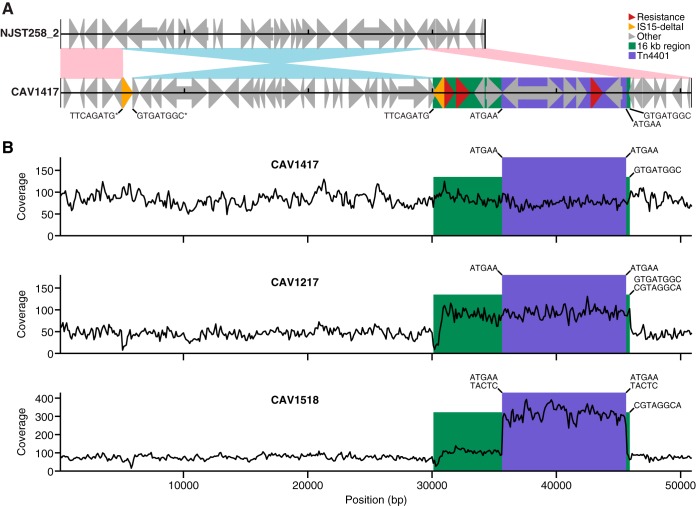
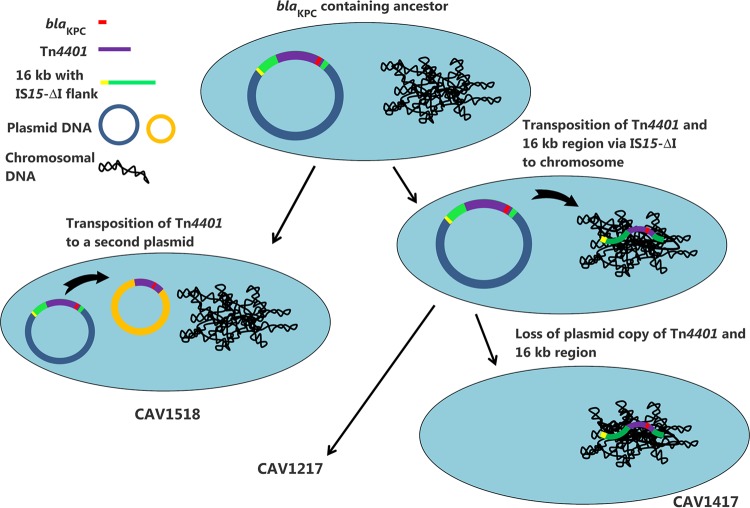
Carbapenemase genes in are mostly described as being plasmid associated. However, the genetic context of carbapenemase genes is not always confirmed in epidemiological surveys, and the frequency of their chromosomal integration therefore is unknown. A previously sequenced collection of -positive from a single U.S. institution (2007 to 2012; = 281 isolates from 182 patients) was analyzed to identify chromosomal insertions of Tn, the transposon most frequently harboring Using a combination of short- and long-read sequencing, we confirmed five independent chromosomal integration events from 6/182 (3%) patients, corresponding to 15/281 (5%) isolates. Three patients had isolates identified by perirectal screening, and three had infections which were all successfully treated. When a single copy of was in the chromosome, one or both of the phenotypic carbapenemase tests were negative. All chromosomally integrated genes were from spp., predominantly clonal group 258 (CG258), even though these represented only a small proportion of the isolates. Integration occurred via IS-ΔI-mediated transposition of a larger, composite region encompassing Tn at one locus of chromosomal integration, seen in the same strain ( ST340) in two patients. In summary, we identified five independent chromosomal integrations of in a large outbreak, demonstrating that this is not a rare event. was more frequently integrated into the chromosome of epidemic CG258 lineages (ST11, ST258, and ST340) and was more difficult to detect by routine phenotypic methods in this context. The presence of chromosomally integrated within successful, globally disseminated strains therefore is likely underestimated.
碳青霉烯酶基因大多被描述为与质粒相关。然而,在流行病学调查中,碳青霉烯酶基因的遗传背景并不总是能得到证实,因此其染色体整合的频率尚不清楚。对美国一家机构先前测序的一批产碳青霉烯酶肠杆菌科细菌(2007年至2012年;来自182名患者的281株分离株)进行分析,以确定携带碳青霉烯酶的最常见转座子Tn的染色体插入情况。通过短读长和长读长测序相结合的方法,我们从6/182(3%)名患者中确认了5个独立的染色体整合事件,对应于15/281(5%)株分离株。3名患者的分离株通过直肠周围筛查确定,3名患者有感染,所有感染均成功治愈。当染色体中存在单拷贝碳青霉烯酶基因时,一项或两项表型碳青霉烯酶检测均为阴性。所有染色体整合的碳青霉烯酶基因均来自肺炎克雷伯菌属,主要是克隆群258(CG258),尽管这些仅占分离株的一小部分。整合是通过IS-ΔI介导的一个更大的复合区域的转座发生的,该复合区域在染色体整合的一个位点包含Tn,在两名患者的同一菌株(ST340)中可见。总之,我们在一次大的暴发中确定了5个独立的碳青霉烯酶基因染色体整合事件,表明这并非罕见事件。碳青霉烯酶基因更频繁地整合到流行的CG258肺炎克雷伯菌谱系(ST11、ST258和ST340)的染色体中,在这种情况下通过常规表型方法更难检测到。因此,在成功的、全球传播的肺炎克雷伯菌菌株中,染色体整合的碳青霉烯酶基因的存在可能被低估了。