Leili Mostafa, Pirmoghani Amin, Samadi Mohammad Taghi, Shokoohi Reza, Roshanaei Ghodratollah, Poormohammadi Ali
Dept. of Environmental Health Engineering, School of Public Health, Student Research Center, Hamadan University of Medical Sciences, Hamadan, Iran.
Modeling of Noncommunicable Diseases Research Center, Department of Biostatistics and Epidemiology, School of Public Health, Hamadan University of Medical Sciences, Hamadan, Iran.
Iran J Public Health. 2016 Nov;45(11):1481-1490.
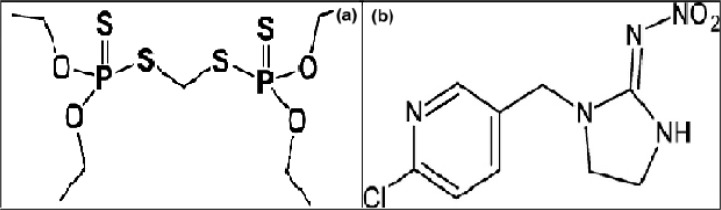
The objective of this study was to determine the residual concentrations of ethion and imidacloprid in cucumbers grown in greenhouse. The effect of some simple processing procedures on both ethion and imidacloprid residues were also studied.
Ten active greenhouses that produce cucumber were randomly selected. Ethion and imidacloprid as the most widely used pesticides were measured in cucumber samples of studied greenhouses. Moreover, the effect of storing, washing, and peeling as simple processing procedures on both ethion and imidacloprid residues were investigated.
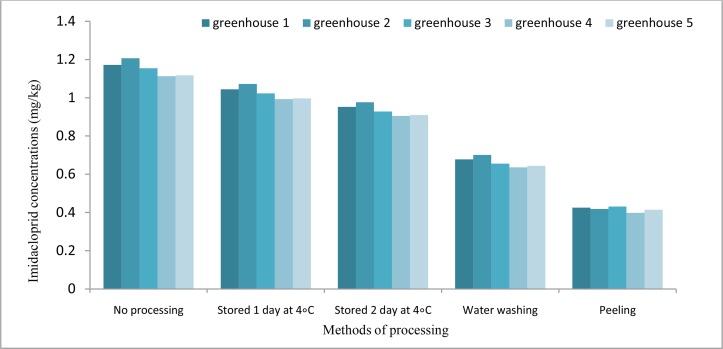
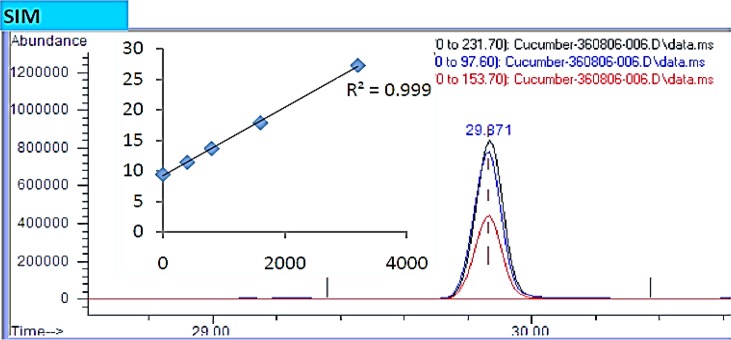
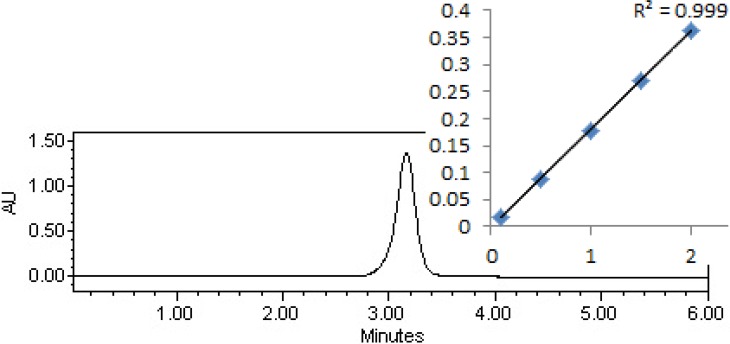
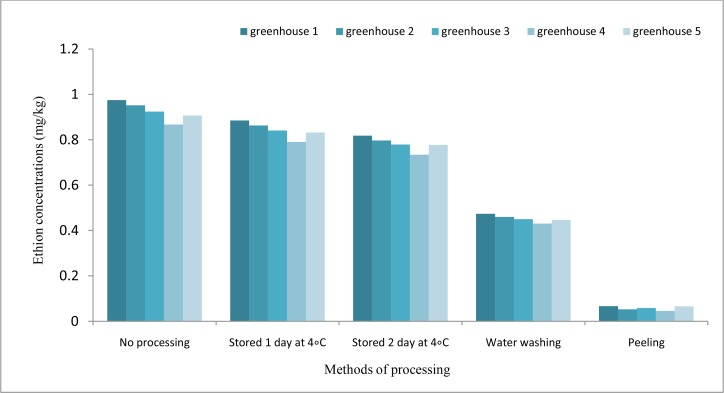
One hour after pesticide application; the maximum residue levels (MRLs) of ethion and imidacloprid were higher than that of Codex standard level. One day after pesticide application, the levels of pesticides were decreased about 35 and 31% for ethion and imidacloprid, respectively, which still were higher than the MRL. Washing procedure led to about 51 and 42.5% loss in ethion and imidacloprid residues, respectively. Peeling procedure also led to highest loss of 93.4 and 63.7% in ethion and imidacloprid residues, respectively. The recovery for both target analytes was in the range between 88 and 102%.
The residue values in collected samples one hour after pesticides application were higher than standard value. The storing, washing, and peeling procedures lead to the decrease of pesticide residues in greenhouse cucumbers. Among them, the peeling procedure has the greatest impact on residual reduction. Therefore, these procedures can be used as simple and effective processing techniques for reducing and removing pesticides from greenhouse products before their consumption.
本研究的目的是测定温室种植黄瓜中乙硫磷和吡虫啉的残留浓度。还研究了一些简单加工过程对乙硫磷和吡虫啉残留量的影响。
随机选取10个生产黄瓜的活性温室。在所研究温室的黄瓜样品中测定了作为使用最广泛的农药的乙硫磷和吡虫啉。此外,还研究了储存、洗涤和去皮等简单加工过程对乙硫磷和吡虫啉残留量的影响。
施药1小时后,乙硫磷和吡虫啉的最大残留限量高于食品法典标准水平。施药1天后,乙硫磷和吡虫啉的农药水平分别下降了约35%和31%,但仍高于最大残留限量。洗涤过程分别使乙硫磷和吡虫啉残留量损失约51%和42.5%。去皮过程也分别使乙硫磷和吡虫啉残留量损失最高,达93.4%和63.7%。两种目标分析物的回收率在88%至102%之间。
施药1小时后采集的样品中的残留值高于标准值。储存、洗涤和去皮过程导致温室黄瓜中农药残留量降低。其中,去皮过程对残留量降低的影响最大。因此,这些过程可作为在温室产品消费前减少和去除农药的简单有效加工技术。