Corless Samuel, Gilbert Nick
MRC Human Genetics Unit, Institute of Genetics and Molecular Medicine, University of Edinburgh, Crewe Road, Edinburgh, EH42XU UK.
Biophys Rev. 2016;8(Suppl 1):51-64. doi: 10.1007/s12551-016-0242-6. Epub 2016 Nov 14.
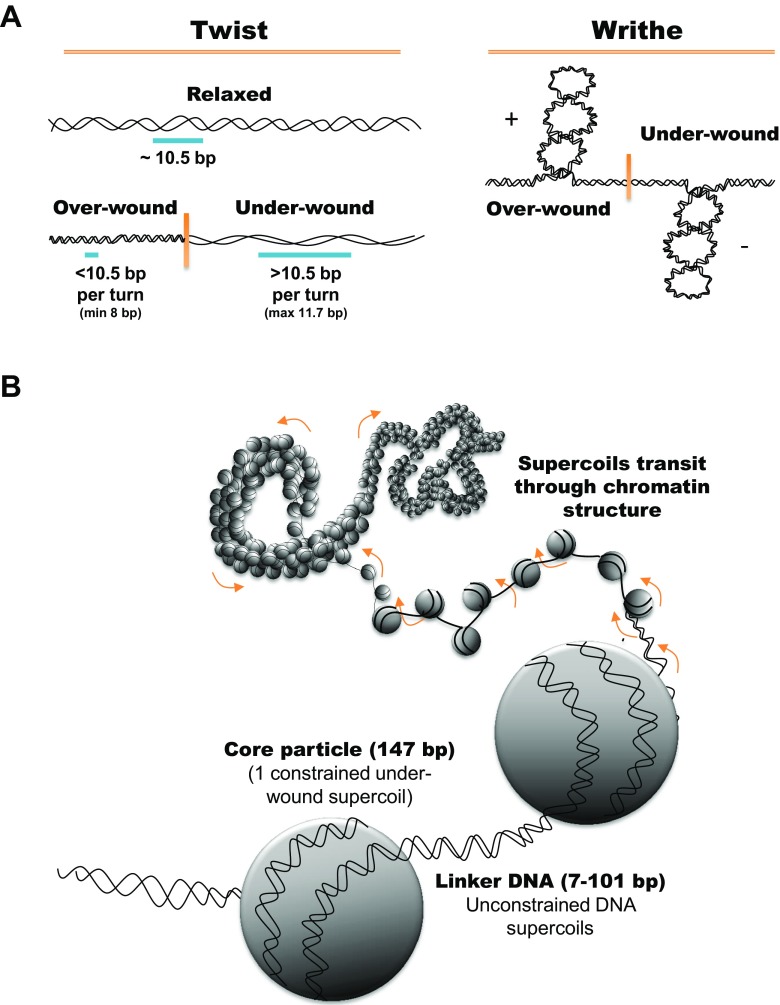
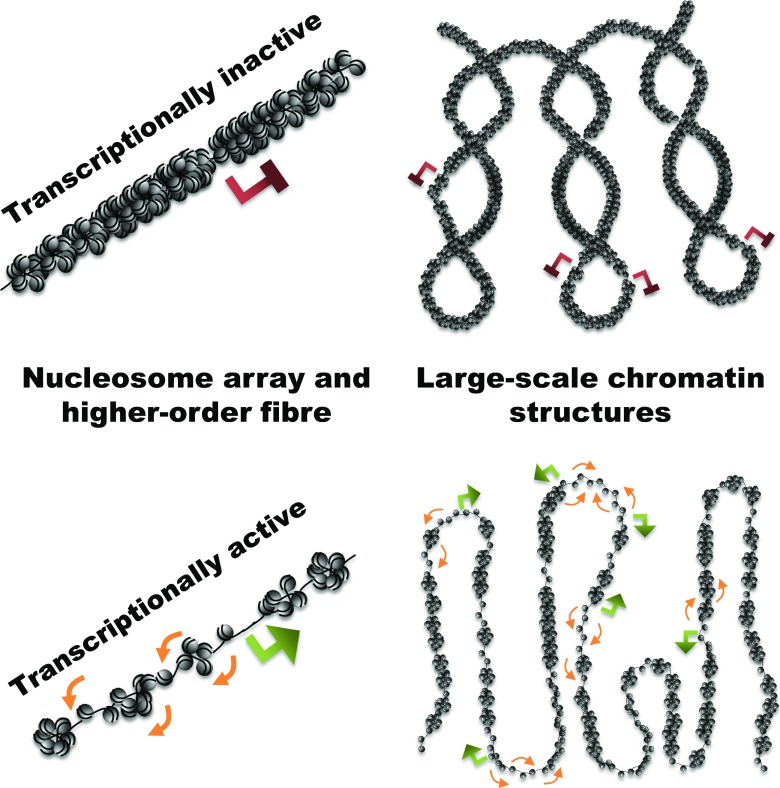
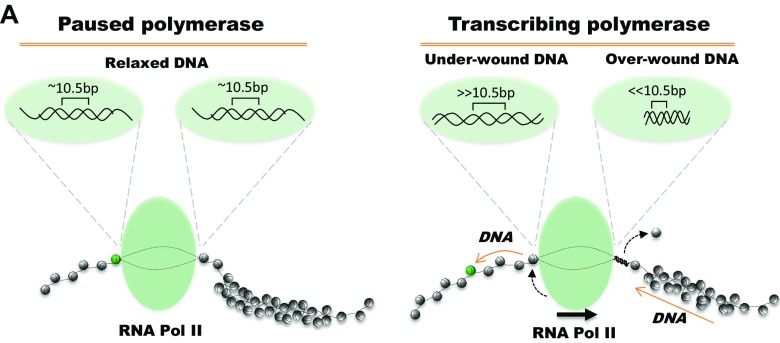
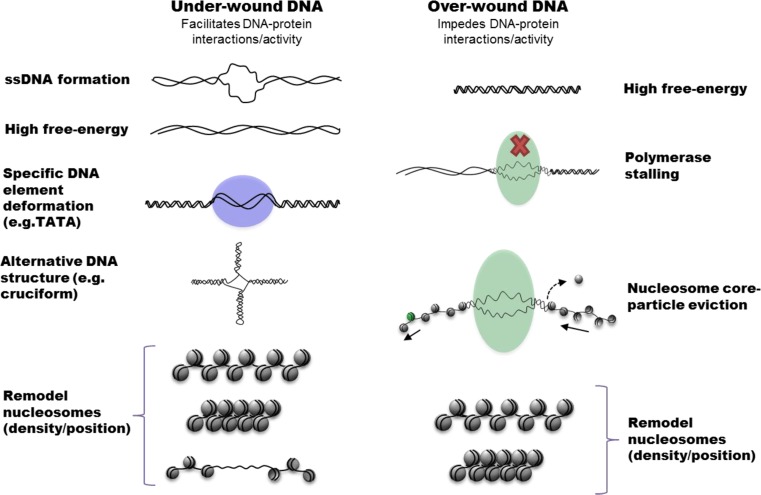
Disruptions in chromatin structure are necessary for the regulation of eukaryotic genomes, from remodelling of nucleosomes at the base pair level through to large-scale chromatin domains that are hundreds of kilobases in size. RNA polymerase is a powerful motor which, prevented from turning with the tight helical pitch of the DNA, generates over-wound DNA ahead of itself and under-wound DNA behind. Mounting evidence supports a central role for transcription-dependent DNA supercoiling in disrupting chromatin structure at all scales. This supercoiling changes the properties of the DNA helix in a manner that substantially alters the binding specificity of DNA binding proteins and complexes, including nucleosomes, polymerases, topoisomerases and transcription factors. For example, transient over-wound DNA destabilises nucleosome core particles ahead of a transcribing polymerase, whereas under-wound DNA facilitates pre-initiation complex formation, transcription factor binding and nucleosome core particle association behind the transcribing polymerase. Importantly, DNA supercoiling can also dissipate through DNA, even in a chromatinised context, to influence both local elements and large chromatin domains. We propose a model in which changes in unconstrained DNA supercoiling influences higher levels of chromatin organisation through the additive effects of DNA supercoiling on both DNA-protein and DNA-nucleosome interactions. This model links small-scale changes in DNA and chromatin to the higher-order fibre and large-scale chromatin structures, providing a mechanism relating gene regulation to chromatin architecture in vivo.
染色质结构的破坏对于真核生物基因组的调控是必要的,从碱基对水平的核小体重塑到数百千碱基大小的大规模染色质结构域。RNA聚合酶是一种强大的分子马达,由于DNA紧密的螺旋间距阻止其转动,会在自身前方产生过度缠绕的DNA,在自身后方产生缠绕不足的DNA。越来越多的证据支持转录依赖性DNA超螺旋在破坏所有尺度的染色质结构中起核心作用。这种超螺旋以一种显著改变DNA结合蛋白和复合物(包括核小体、聚合酶、拓扑异构酶和转录因子)结合特异性的方式改变DNA螺旋的性质。例如,短暂的过度缠绕DNA会使转录聚合酶前方的核小体核心颗粒不稳定,而缠绕不足的DNA则有助于转录起始前复合物的形成、转录因子结合以及转录聚合酶后方的核小体核心颗粒结合。重要的是,即使在染色质化的环境中,DNA超螺旋也可以通过DNA消散,从而影响局部元件和大型染色质结构域。我们提出了一个模型,其中无约束的DNA超螺旋变化通过DNA超螺旋对DNA - 蛋白质和DNA - 核小体相互作用的累加效应来影响更高层次的染色质组织。该模型将DNA和染色质的小规模变化与高阶纤维和大规模染色质结构联系起来,提供了一种在体内将基因调控与染色质结构联系起来的机制。