Yamano Tomoki, Kubo Shuji, Fukumoto Miki, Yano Aya, Mawatari-Furukawa Yuki, Okamura Haruki, Tomita Naohiro
Division of Lower Gastrointestinal Surgery, Department of Surgery , Hyogo College of Medicine , Nishinomiya, Japan.
Department of Genetics , Hyogo College of Medicine , Nishinomiya, Japan.
Mol Ther Oncolytics. 2016 Dec 14;3:16031. doi: 10.1038/mto.2016.31. eCollection 2016.
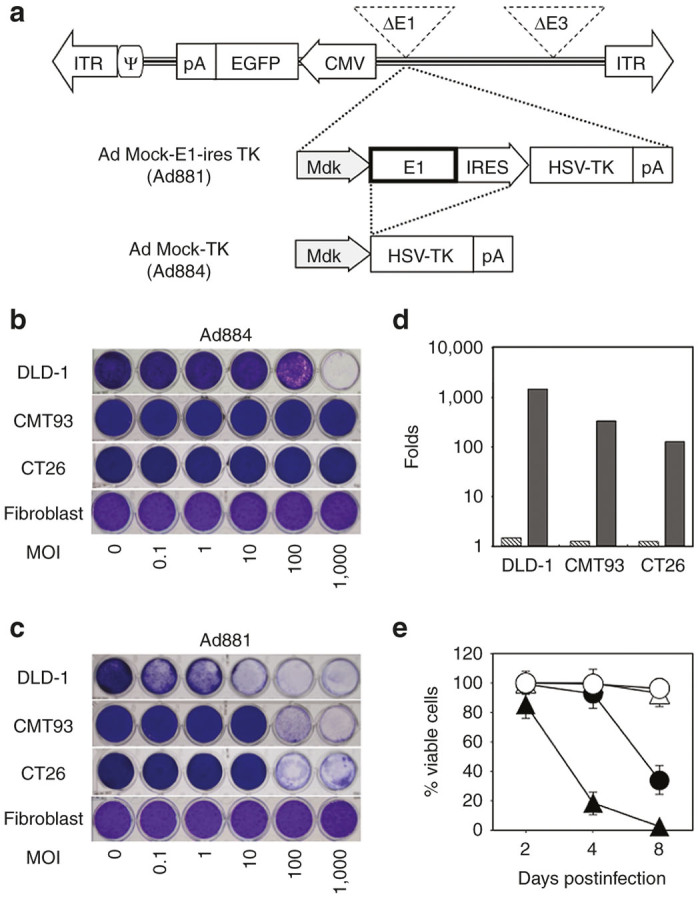
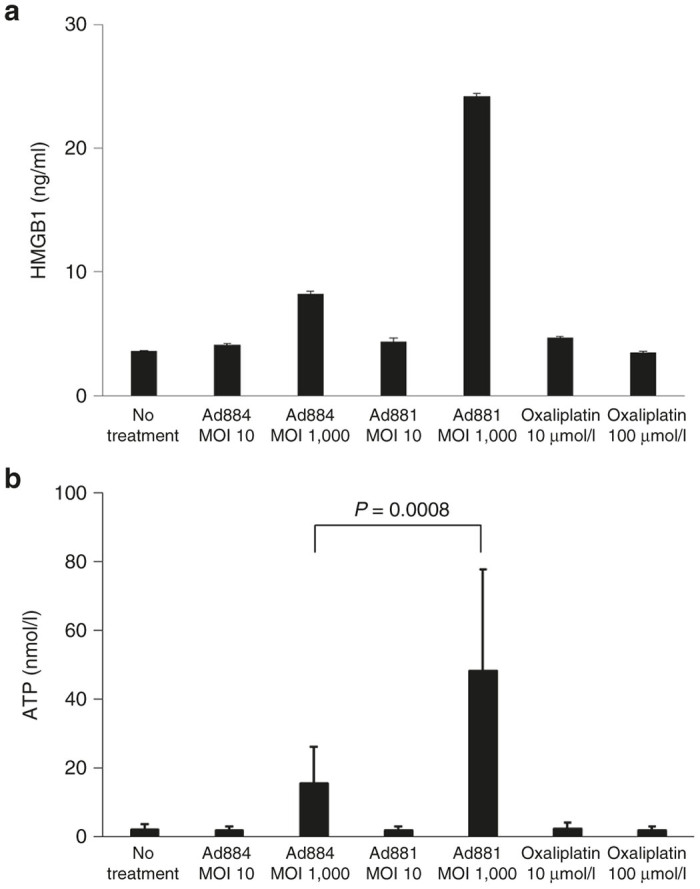
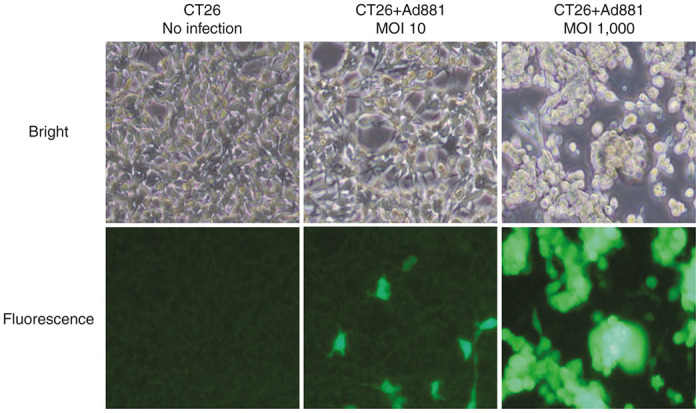
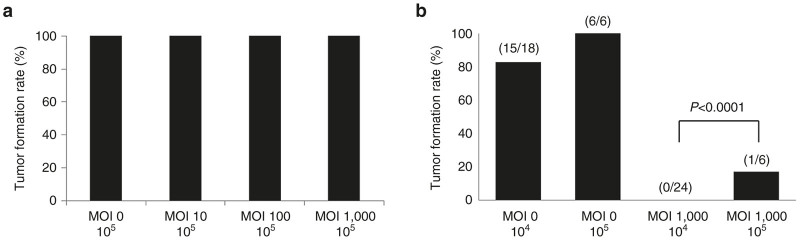
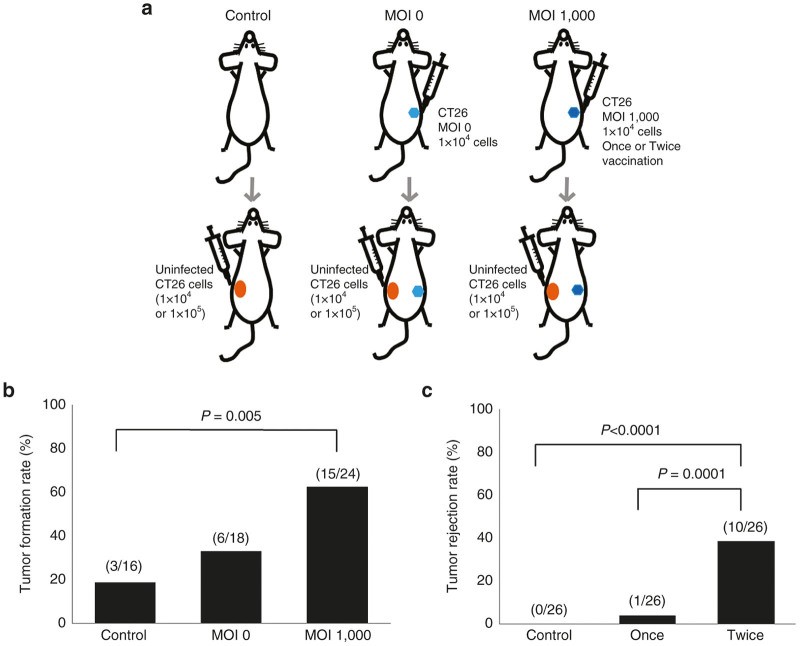
Cancer vaccine application is limited to specific cancer types because few cancer-associated antigens are known to induce tumor rejection. Accordingly, we assessed the utility of Ad881, an oncolytic adenovirus in which viral replication was strictly regulated by the cancer-specific midkine promoter, as a cancer vaccine in a murine colorectal cancer model lacking specific cancer-associated antigens. In CT26 and CMT93 cells, Ad881 (multiplicity of infection: 100 or 1,000) showed stronger cytotoxicity and oncolysis than its equivalent replication-defective adenovirus, Ad884. CT26 cells (1 × 10) infected with Ad881 (multiplicity of infection: 1,000) for 24 hours were suitable as vaccine antigens without tumor formation in our model. Repeated vaccinations, but not single vaccination, induced a greater prophylactic immune response. The percentage of mice that rejected the tumor challenge was 0, 4, and 38% after no vaccination, single vaccination, and repeated vaccinations, respectively. Immunogenic cell death marker high-mobility group box 1 protein (HMGB1) and adenosine triphosphate in culture medium were higher after Ad881 infection (24.3 ng/ml and 48.2 nmol/l, respectively) than after Ad884 infection (8.6 ng/ml and 15.4 nmol/l, respectively) or oxaliplatin treatment (3.7 ng/ml and 1.8 nmol/l, respectively). These results indicate that repeated whole cell vaccination using an oncolytic adenovirus may be a potent approach to evoke immunogenic cell death.
癌症疫苗的应用仅限于特定的癌症类型,因为已知很少有癌症相关抗原来诱导肿瘤排斥反应。因此,我们评估了Ad881(一种溶瘤腺病毒,其病毒复制由癌症特异性中期因子启动子严格调控)在缺乏特定癌症相关抗原的小鼠结直肠癌模型中作为癌症疫苗的效用。在CT26和CMT93细胞中,Ad881(感染复数:100或1000)比其等效的复制缺陷型腺病毒Ad884表现出更强的细胞毒性和溶瘤作用。在我们的模型中,用Ad881(感染复数:1000)感染24小时的CT26细胞(1×10)适合作为疫苗抗原,不会形成肿瘤。重复接种疫苗而非单次接种可诱导更强的预防性免疫反应。未接种疫苗、单次接种和重复接种后,分别有0%、4%和38%的小鼠能够排斥肿瘤攻击。Ad881感染后(分别为24.3 ng/ml和48.2 nmol/l),培养基中的免疫原性细胞死亡标志物高迁移率族蛋白B1(HMGB1)和三磷酸腺苷比Ad884感染后(分别为8.6 ng/ml和15.4 nmol/l)或奥沙利铂处理后(分别为3.7 ng/ml和1.8 nmol/l)更高。这些结果表明,使用溶瘤腺病毒进行重复全细胞疫苗接种可能是引发免疫原性细胞死亡的有效方法。