Timerman Dmitriy, McEnery-Stonelake Melissa, Joyce Cara J, Nambudiri Vinod E, Hodi F Stephen, Claus Elizabeth B, Ibrahim Nageatte, Lin Jennifer Y
Harvard-MIT Health Sciences and Technology (HST), Harvard Medical School, Boston, MA, USA.
Department of Dermatology, University of Alabama at Birmingham, Birmingham, AL, USA.
Oncotarget. 2017 Jan 24;8(4):6873-6882. doi: 10.18632/oncotarget.14316.
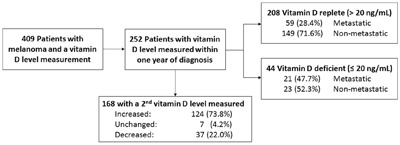
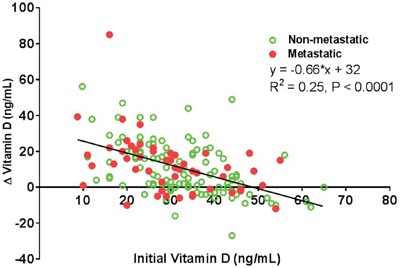
Vitamin D deficiency (≤20 ng/mL) is associated with an increased incidence and worse prognosis of various types of cancer including melanoma. A retrospective, single-center study of individuals diagnosed with melanoma from January 2007 through June 2013 who had a vitamin D (25(OH)D3) level measured within one year of diagnosis was performed to determine whether vitamin D deficiency and repletion are associated with melanoma outcome. A total of 409 individuals diagnosed with histopathology-confirmed melanoma who had an ever measured serum 25(OH)D3 level were identified. 252 individuals with a 25(OH)D3 level recorded within one year after diagnosis were included in the study and the individual and melanoma characteristics such as age, sex, Breslow thickness, ulceration, stage, mitotic rate, and LDH were obtained from the medical record. A worse melanoma prognosis was associated with vitamin D deficiency (P=0.012), higher stage (P<0.001), ulceration (P=0.001), and higher mitotic rate (P=0.001) (HR 1.93, 95% CI 1.15-3.22). In patients with stage IV metastatic melanoma, vitamin D deficiency was associated with significantly worse melanoma-specific mortality (adjusted HR 2.06, 95% CI 1.10-3.87). Patients with metastatic melanoma who were initially vitamin D deficient and subsequently had a decrease or ≤20 ng/mL increase in their 25(OH)D3 concentration had significantly worse outcomes (HR 4.68, 95% CI 1.05-20.88) compared to non-deficient patients who had a >20 ng/mL increase. Our results suggest that initial vitamin D deficiency and insufficient repletion is associated with a worse prognosis in patients with metastatic melanoma.
维生素D缺乏(≤20 ng/mL)与包括黑色素瘤在内的各种类型癌症的发病率增加及预后较差相关。进行了一项回顾性单中心研究,研究对象为2007年1月至2013年6月期间被诊断为黑色素瘤且在诊断后一年内测量了维生素D(25(OH)D3)水平的个体,以确定维生素D缺乏和补充与黑色素瘤预后是否相关。共确定了409名经组织病理学确诊为黑色素瘤且曾测量血清25(OH)D3水平的个体。252名在诊断后一年内记录了25(OH)D3水平的个体被纳入研究,并从病历中获取了个体及黑色素瘤的特征,如年龄、性别、Breslow厚度、溃疡、分期、有丝分裂率和乳酸脱氢酶。黑色素瘤预后较差与维生素D缺乏(P = 0.012)、更高分期(P < 0.001)、溃疡(P = 0.001)和更高有丝分裂率(P = 0.001)相关(风险比1.93,95%置信区间1.15 - 3.22)。在IV期转移性黑色素瘤患者中,维生素D缺乏与显著更差的黑色素瘤特异性死亡率相关(校正风险比2.06,95%置信区间1.10 - 3.87)。与25(OH)D3浓度增加>20 ng/mL的非缺乏患者相比,最初维生素D缺乏且随后25(OH)D3浓度降低或增加≤20 ng/mL的转移性黑色素瘤患者预后显著更差(风险比4.68,95%置信区间1.05 - 20.88)。我们的结果表明,初始维生素D缺乏和补充不足与转移性黑色素瘤患者的预后较差相关。