Sun Hong-Wei, Yu Xing-Juan, Wu Wen-Chao, Chen Jing, Shi Ming, Zheng Limin, Xu Jing
Sun Yat-sen University Cancer Center, State Key Laboratory of Oncology in South China, Collaborative Innovation Center for Cancer Medicine, Guangzhou, P. R. China.
School of Life Science, Sun Yat-sen University, Guangzhou, P. R. China.
PLoS One. 2016 Dec 30;11(12):e0168907. doi: 10.1371/journal.pone.0168907. eCollection 2016.
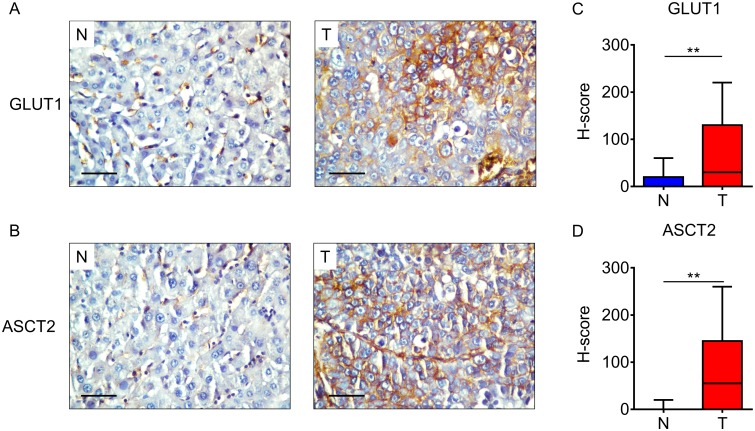
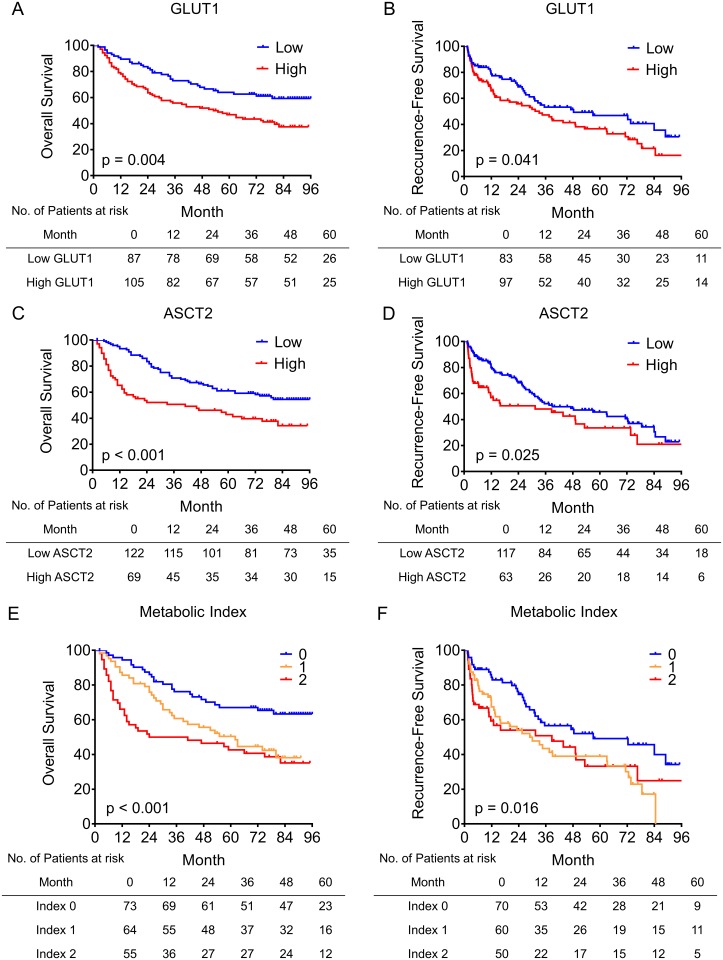
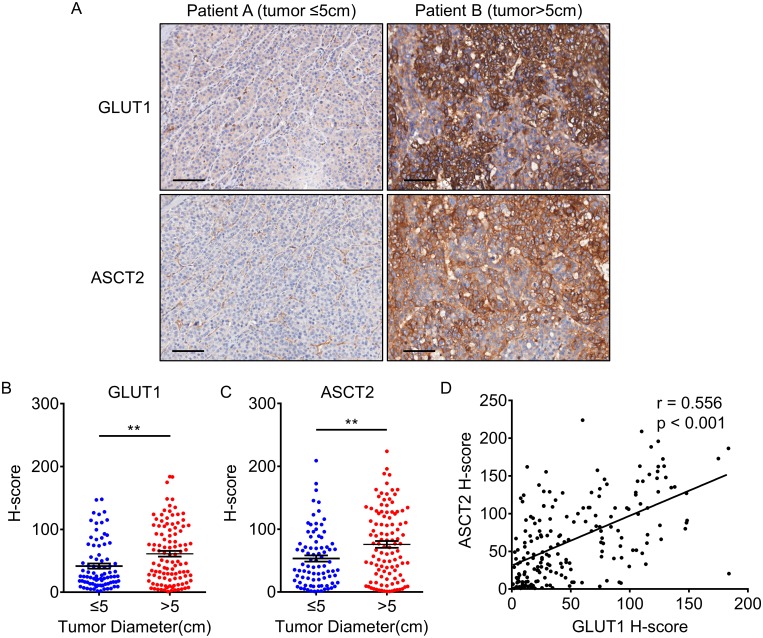
An emerging hallmark of cancer is reprogrammed cellular metabolism, and several cancers involve increased glucose intake and glutamine addiction. Hepatocellular carcinoma (HCC) is one of the most fatal cancers, and its molecular basis needs to be delineated to identify biomarkers for its potential treatment without resection. Therefore, this study aimed to determine the metabolism status of HCC by evaluating the expression of the glucose transporter GLUT1 and glutamine transporter ASCT2. We enrolled 192 patients with surgically resected HCC in this study. Their tissue samples were subjected to immunohistochemistry to detect GLUT1 and ASCT2 expression. The prognostic value of GLUT1 and ASCT2 expression and their combined metabolic index was determined by Kaplan-Meier analysis and the Cox proportional hazards model. We found that GLUT1 and ASCT2 expression was significantly upregulated in tumor tissues as compared to adjacent non-tumor tissues and was positively associated with tumor size. Survival analysis revealed that patients with high GLUT1 or ASCT2 expression had poor overall survival (OS) and recurrence-free survival (RFS). In HCC patients, ASCT2 expression was an independent negative prognostic factor for OS (hazard ratio [HR], 1.760; 95% confidence interval [CI] = 1.124-2.755; p = 0.013) and the metabolic index was an independent negative prognostic factor for OS (HR = 1.672, 95% CI = 1.275-2.193, p < 0.001) and RFS (HR = 1.362, 95% CI = 1.066-1.740, p = 0.013). In conclusion, the tumor metabolism status determined by expression of GLUT1 and ASCT2 and their metabolic index is a promising prognostic predictor for HCC patients.
癌症一个新出现的标志是细胞代谢重编程,并且几种癌症都存在葡萄糖摄取增加和谷氨酰胺依赖现象。肝细胞癌(HCC)是最致命的癌症之一,需要明确其分子基础以识别潜在的非手术治疗生物标志物。因此,本研究旨在通过评估葡萄糖转运蛋白GLUT1和谷氨酰胺转运蛋白ASCT2的表达来确定HCC的代谢状态。本研究纳入了192例行手术切除的HCC患者。对他们的组织样本进行免疫组织化学检测以检测GLUT1和ASCT2的表达。通过Kaplan-Meier分析和Cox比例风险模型确定GLUT1和ASCT2表达及其联合代谢指数的预后价值。我们发现,与相邻的非肿瘤组织相比,肿瘤组织中GLUT1和ASCT2表达显著上调,并且与肿瘤大小呈正相关。生存分析显示,GLUT1或ASCT2高表达的患者总生存期(OS)和无复发生存期(RFS)较差。在HCC患者中,ASCT2表达是OS的独立阴性预后因素(风险比[HR],1.760;95%置信区间[CI]=1.124-2.755;p=0.013),代谢指数是OS(HR=1.672,95%CI=1.275-2.193,p<0.001)和RFS(HR=1.362,95%CI=1.066-1.740,p=0.013)的独立阴性预后因素。总之,由GLUT1和ASCT2表达及其代谢指数所确定的肿瘤代谢状态是HCC患者一个有前景的预后预测指标。