Hagiwara Akiyoshi, Tanaka Noriko, Uemura Tatsuki, Matsuda Wataru, Kimura Akio
Department of Emergency Medicine and Critical Care, National Center for Global Health and Medicine, Tokyo, Japan.
Biostatistics Section, Department of Data Science Clinical Science Center, National Center for Global Health and Medicine, Tokyo, Japan.
BMJ Open. 2016 Dec 30;6(12):e012850. doi: 10.1136/bmjopen-2016-012850.
To determine whether treatment with recombinant human thrombomodulin (rhTM) increases survival among patients with severe septic-induced disseminated intravascular coagulation (DIC).
Single-centre, open-label, randomised controlled trial.
Single tertiary hospital.
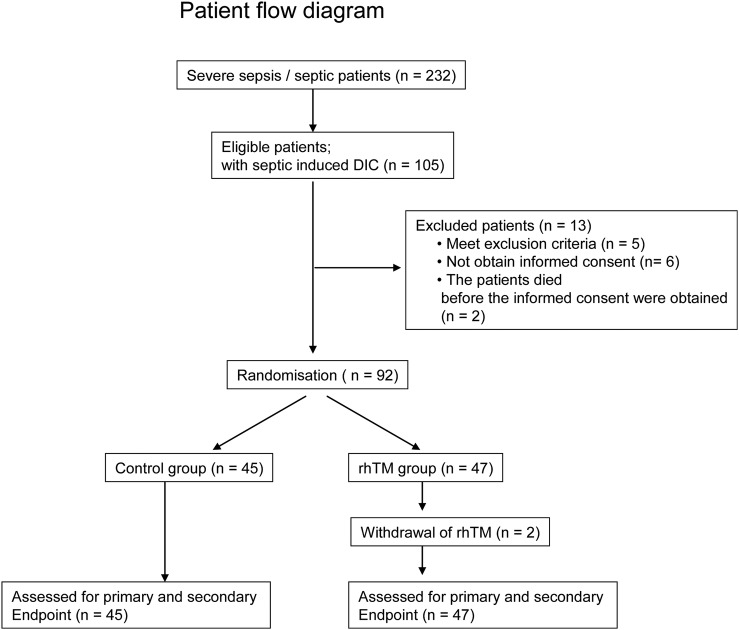
92 patients with severe septic-induced DIC.
Patients with DIC scores ≥4, as defined by the Japanese Association of Acute Medicine, were diagnosed with DIC. The envelope method was used for randomisation. The treatment group (rhTM group, n=47) was intravenously treated with rhTM within 24 hours of admission (day 0), and the control group (n=45) did not receive any anticoagulants, except in cases of deep venous thrombosis and pulmonary embolism.
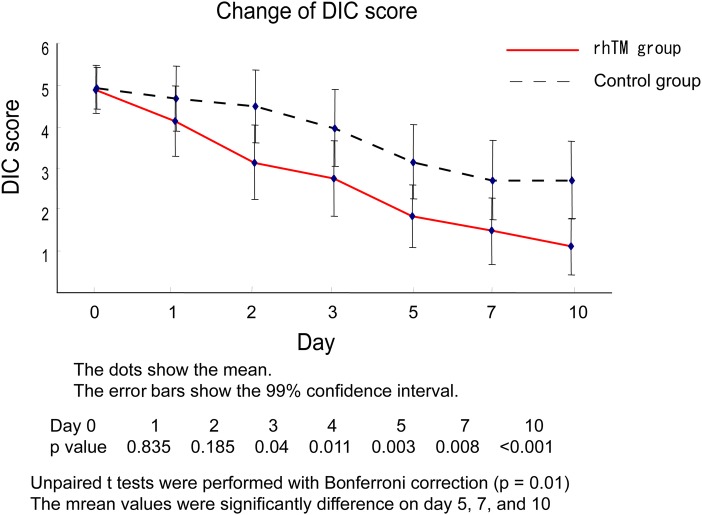
Data were collected on days 0 (admission), 1, 2, 3, 5, 7 and 10. The primary outcome was survival at 28 and 90 days. The secondary end points comprised changes in DIC scores, platelet counts, d-dimer, antithrombin III and C reactive protein levels, and Sequential Organ Failure Assessment (SOFA) scores. All analyses were conducted on an intent-to-treat basis.
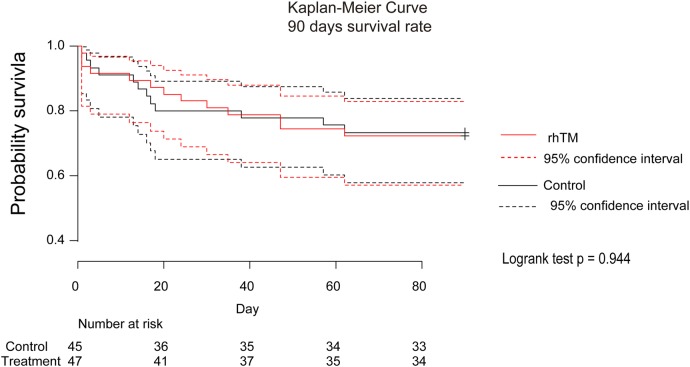
The 28-day survival rates were 84% and 83% in the control and rhTM groups, respectively (p=0.745, log-rank test). The 90-day survival rates were 73% and 72% in the control and rhTM groups, respectively (p=0.94, log-rank test). Meanwhile, the rates of recovery from DIC (<4) were significantly higher in the rhTM group than in the control group (p=0.001, log-rank test). Relative change from baseline of d-dimer levels was significantly lower in the rhTM group than in the control group, on days 3 and 5.
rhTM treatment decreased d-dimer levels and facilitated DIC recovery in patients with severe septic-induced DIC. However, the treatment did not improve survival in this cohort.
UMIN000008339.
确定重组人血栓调节蛋白(rhTM)治疗能否提高严重脓毒症诱发的弥散性血管内凝血(DIC)患者的生存率。
单中心、开放标签、随机对照试验。
单一的三级医院。
92例严重脓毒症诱发DIC的患者。
按照日本急性医学协会的定义,DIC评分≥4分的患者被诊断为DIC。采用信封法进行随机分组。治疗组(rhTM组,n = 47)在入院后24小时内(第0天)静脉注射rhTM,对照组(n = 45)除深静脉血栓形成和肺栓塞病例外不接受任何抗凝治疗。
在第0天(入院时)、第1天、第2天、第3天、第5天、第7天和第10天收集数据。主要结局是28天和90天的生存率。次要终点包括DIC评分、血小板计数、D-二聚体、抗凝血酶III和C反应蛋白水平的变化以及序贯器官衰竭评估(SOFA)评分。所有分析均基于意向性治疗原则进行。
对照组和rhTM组的28天生存率分别为84%和83%(p = 0.745,对数秩检验)。对照组和rhTM组的90天生存率分别为73%和72%(p = 0.94,对数秩检验)。同时,rhTM组DIC恢复(<4分)的比例显著高于对照组(p = 0.001,对数秩检验)。在第3天和第5天,rhTM组D-二聚体水平相对于基线的变化显著低于对照组。
rhTM治疗可降低严重脓毒症诱发DIC患者的D-二聚体水平并促进DIC恢复。然而,该治疗并未改善该队列患者的生存率。
UMIN000008339。