Bruno William, Martinuzzi Claudia, Andreotti Virginia, Pastorino Lorenza, Spagnolo Francesco, Dalmasso Bruna, Cabiddu Francesco, Gualco Marina, Ballestrero Alberto, Bianchi-Scarrà Giovanna, Queirolo Paola, Grillo Federica, Mastracci Luca, Ghiorzo Paola
Department of Internal Medicine and Medical Specialties (DiMI), University of Genoa and IRCCS AOU San Martino-IST, Genoa, Italy.
Department of Medical Oncology, IRCCS AOU San Martino-IST, Genoa, Italy.
Oncotarget. 2017 Jan 31;8(5):8069-8082. doi: 10.18632/oncotarget.14094.
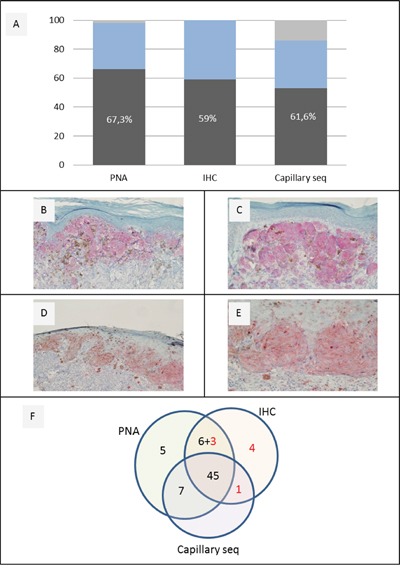
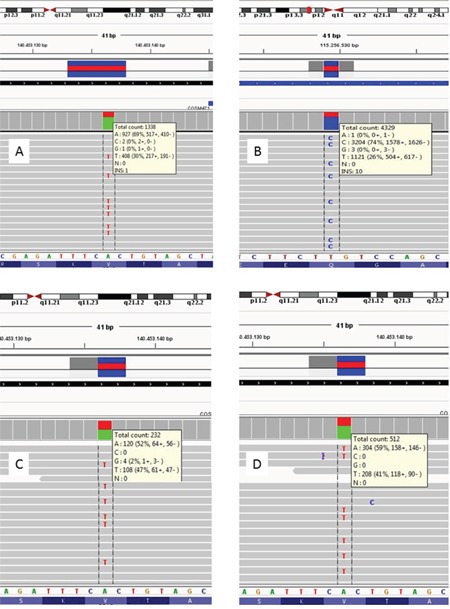
Finding the best technique to identify BRAF mutations with a high sensitivity and specificity is mandatory for accurate patient selection for target therapy. BRAF mutation frequency ranges from 40 to 60% depending on melanoma clinical characteristics and detection technique used.Intertumoral heterogeneity could lead to misinterpretation of BRAF mutational status; this is especially important if testing is performed on primary specimens, when metastatic lesions are unavailable.Aim of this study was to identify the best combination of methods for detecting BRAF mutations (among peptide nucleic acid - PNA-clamping real-time PCR, immunohistochemistry and capillary sequencing) and investigate BRAF mutation heterogeneity in a series of 100 primary melanomas and a subset of 25 matched metastatic samples.Overall, we obtained a BRAF mutation frequency of 62%, based on the combination of at least two techniques. Concordance between mutation status in primary and metastatic tumor was good but not complete (67%), when agreement of at least two techniques were considered. Next generation sequencing was used to quantify the threshold of detected mutant alleles in discordant samples. Combining different methods excludes that the observed heterogeneity is technique-based. We propose an algorithm for BRAF mutation testing based on agreement between immunohistochemistry and PNA; a third molecular method could be added in case of discordance of the results. Testing the primary tumor when the metastatic sample is unavailable is a good option if at least two methods of detection are used, however the presence of intertumoral heterogeneity or the occurrence of additional primaries should be carefully considered.
找到一种具有高灵敏度和特异性的最佳BRAF突变检测技术,对于准确选择适合靶向治疗的患者至关重要。BRAF突变频率在40%至60%之间,具体取决于黑色素瘤的临床特征和所使用的检测技术。肿瘤间的异质性可能导致对BRAF突变状态的错误解读;如果在无法获取转移病灶时对原发标本进行检测,这一点尤为重要。本研究的目的是确定检测BRAF突变的最佳方法组合(肽核酸 - PNA夹钳实时PCR、免疫组织化学和毛细管测序),并在100例原发性黑色素瘤及25例匹配的转移样本子集中研究BRAF突变的异质性。总体而言,基于至少两种技术的组合,我们获得的BRAF突变频率为62%。当考虑至少两种技术的一致性时,原发肿瘤和转移肿瘤的突变状态之间的一致性良好但并不完全一致(67%)。采用二代测序来量化不一致样本中检测到的突变等位基因的阈值。结合不同方法可排除观察到的异质性是基于技术的可能性。我们提出了一种基于免疫组织化学和PNA之间一致性的BRAF突变检测算法;如果结果不一致,可添加第三种分子方法。当无法获取转移样本时,如果使用至少两种检测方法检测原发肿瘤是一个不错的选择,然而应仔细考虑肿瘤间异质性的存在或额外原发灶的出现情况。