Kendrick Agnieszka A, Schafer Johnathon, Dzieciatkowska Monika, Nemkov Travis, D'Alessandro Angelo, Neelakantan Deepika, Ford Heide L, Pearson Chad G, Weekes Colin D, Hansen Kirk C, Eisenmesser Elan Z
Department of Biochemistry and Molecular Genetics, School of Medicine, University of Colorado Denver, CO, USA.
Department of Pharmacology, School of Medicine, University of Colorado Denver, CO, USA.
Oncotarget. 2017 Jan 24;8(4):6742-6762. doi: 10.18632/oncotarget.14272.
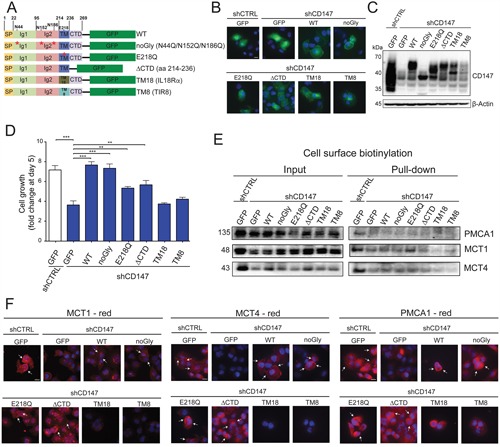
Increased expression of CD147 in pancreatic cancer has been proposed to play a critical role in cancer progression via CD147 chaperone function for lactate monocarboxylate transporters (MCTs). Here, we show for the first time that CD147 interacts with membrane transporters beyond MCTs and exhibits a protective role for several of its interacting partners. CD147 prevents its interacting partner's proteasome-dependent degradation and incorrect plasma membrane localization through the CD147 transmembrane (TM) region. The interactions with transmembrane small molecule and ion transporters identified here indicate a central role of CD147 in pancreatic cancer metabolic reprogramming, particularly with respect to amino acid anabolism and calcium signaling. Importantly, CD147 genetic ablation prevents pancreatic cancer cell proliferation and tumor growth in vitro and in vivo in conjunction with metabolic rewiring towards amino acid anabolism, thus paving the way for future combined pharmacological treatments.
胰腺癌中CD147表达增加被认为通过其对乳酸单羧酸转运蛋白(MCTs)的伴侣功能在癌症进展中起关键作用。在此,我们首次表明CD147与MCTs以外的膜转运蛋白相互作用,并对其几个相互作用伙伴发挥保护作用。CD147通过其跨膜(TM)区域防止其相互作用伙伴的蛋白酶体依赖性降解和错误的质膜定位。此处鉴定的与跨膜小分子和离子转运蛋白的相互作用表明CD147在胰腺癌代谢重编程中起核心作用,特别是在氨基酸合成代谢和钙信号传导方面。重要的是,CD147基因消融与向氨基酸合成代谢的代谢重塑相结合,可防止胰腺癌细胞在体外和体内的增殖及肿瘤生长,从而为未来的联合药物治疗铺平了道路。