Istituto Superiore di Sanità, National Center for Drug Research and Evaluation, 00161 Rome, Italy.
Int J Mol Sci. 2024 Aug 23;25(17):9178. doi: 10.3390/ijms25179178.
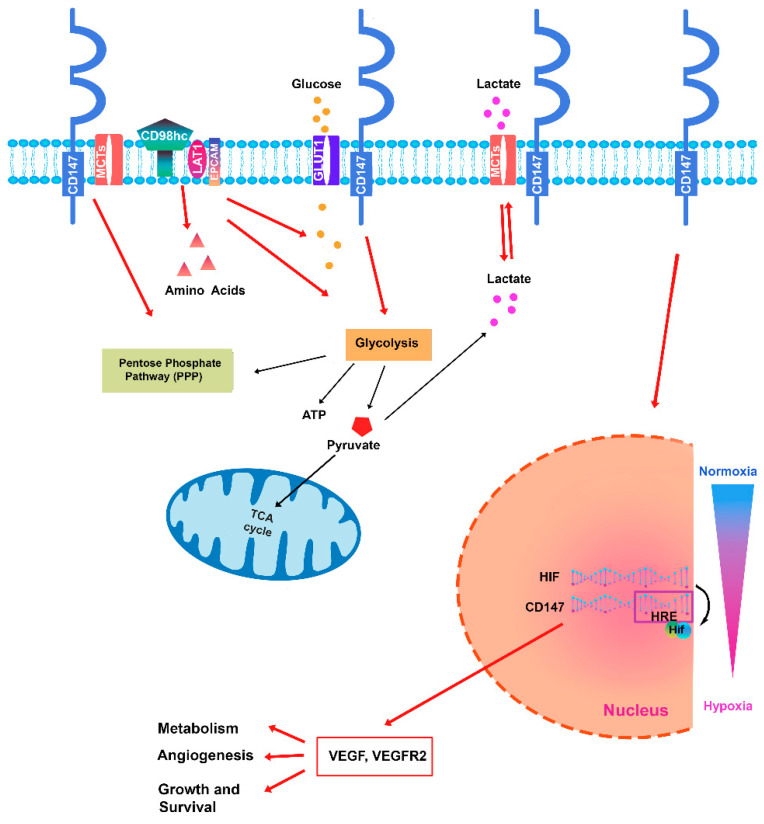
Hematological malignancies refer to a heterogeneous group of neoplastic conditions of lymphoid and hematopoietic tissues classified in leukemias, Hodgkin and non-Hodgkin lymphomas and multiple myeloma, according to their presumed cell of origin, genetic abnormalities, and clinical features. Metabolic adaptation and immune escape, which influence various cellular functions, including the proliferation and survival of hematological malignant tumor cells, are major aspects of these malignancies that lead to therapeutic drug resistance. Targeting specific metabolic pathways is emerging as a novel therapeutic strategy in hematopoietic neoplasms, particularly in acute myeloid leukemia and multiple myeloma. In this context, CD147, also known as extracellular matrix metalloproteinase inducer (EMMPRIN) or Basigin, is one target candidate involved in reprograming metabolism in different cancer cells, including hematological malignant tumor cells. CD147 overexpression significantly contributes to the metabolic transformation of these cancer cells, by mediating signaling pathway, growth, metastasis and metabolic reprogramming, through its interaction, direct or not, with various membrane proteins related to metabolic regulation, including monocarboxylate transporters, integrins, P-glycoprotein, and glucose transporter 1. This review explores the metabolic functions of CD147 and its impact on the tumor microenvironment, influencing the progression and neoplastic transformation of leukemias, myeloma, and lymphomas. Furthermore, we highlight new opportunities for the development of targeted therapies against CD147, potentially improving the treatment of hematologic malignancies.
血液系统恶性肿瘤是指一组起源于淋巴造血组织的异质性肿瘤性疾病,根据其假定的细胞起源、遗传异常和临床特征,可分为白血病、霍奇金和非霍奇金淋巴瘤以及多发性骨髓瘤。代谢适应和免疫逃逸影响着各种细胞功能,包括血液恶性肿瘤细胞的增殖和存活,这是这些恶性肿瘤导致治疗药物耐药的主要方面。针对特定代谢途径的靶向治疗方法正在成为造血肿瘤的一种新的治疗策略,特别是在急性髓系白血病和多发性骨髓瘤中。在这种情况下,CD147 也称为细胞外基质金属蛋白酶诱导因子(EMMPRIN)或 Basigin,是一个涉及不同癌细胞代谢重编程的靶标候选物,包括血液恶性肿瘤细胞。CD147 的过表达通过与其相关的代谢调节的各种膜蛋白(包括单羧酸转运蛋白、整合素、P-糖蛋白和葡萄糖转运蛋白 1)的直接或间接相互作用,显著促进这些癌细胞的代谢转化,从而介导信号通路、生长、转移和代谢重编程。本综述探讨了 CD147 的代谢功能及其对肿瘤微环境的影响,影响白血病、骨髓瘤和淋巴瘤的进展和肿瘤转化。此外,我们强调了针对 CD147 的靶向治疗的新机会,可能改善血液恶性肿瘤的治疗效果。