Kim Ran, Park Sang In, Lee Chang Youn, Lee Jihyun, Kim Pilseog, Oh Sekyung, Lee Hojin, Lee Min Young, Kim Jongmin, Chung Yong-An, Hwang Ki-Chul, Maeng Lee-So, Chang Woochul
Department of Biology Education, College of Education, Pusan National University, Pusan, 609-735, South Korea.
Institute of Catholic Integrative Medicine, Incheon St. Mary's Hospital, The Catholic University of Korea, College of Medicine, Incheon, 403-720, South Korea.
Mol Cell Biochem. 2017 Mar;427(1-2):177-185. doi: 10.1007/s11010-016-2909-5. Epub 2016 Dec 30.
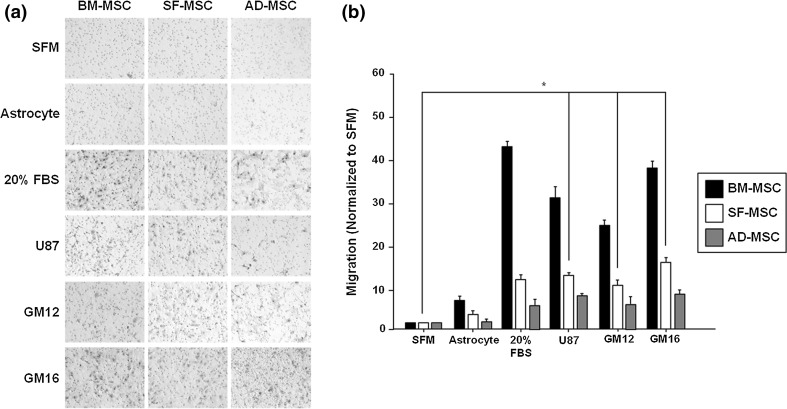
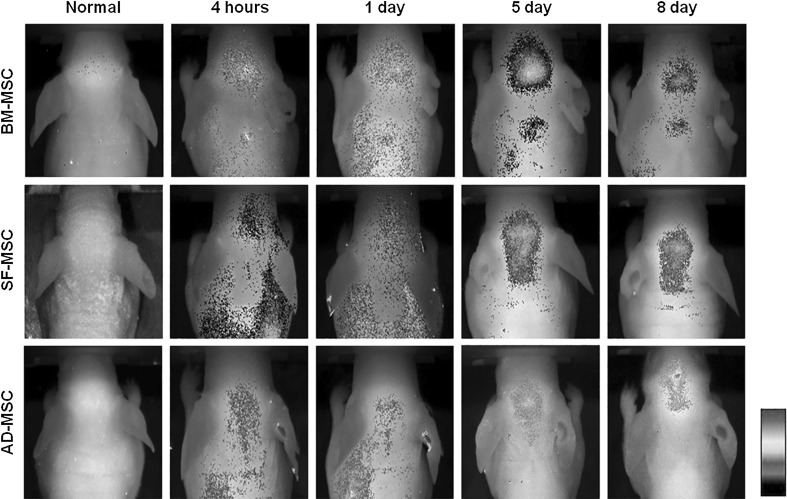
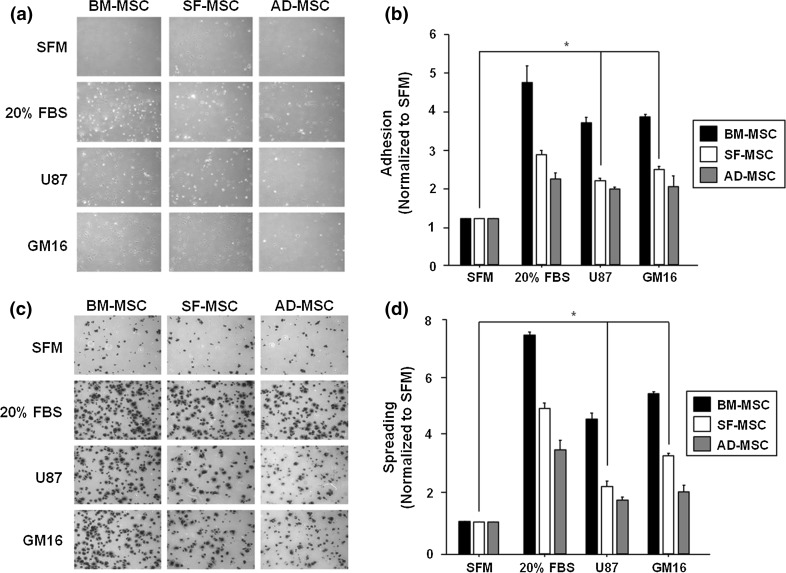
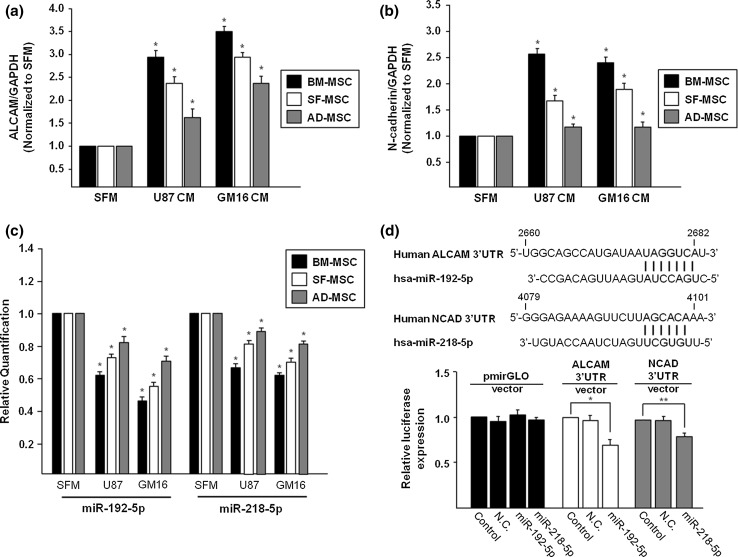
Gliomas are the most common type of malignant primary brain tumors. Some treatments of gliomas exist, but they are rarely curative. Mesenchymal stem cells (MSCs) are emerging as potential modes of targeted cancer therapy owing to their capacity for homing toward tumor sites. It has been proposed that MSCs derived from various sources, such as bone marrow, adipose tissue and umbilical cord blood, can be used as cell-based therapy for brain tumors. Here, MSCs obtained from the synovial fluid of osteoarthritis or rheumatoid arthritis patients were investigated as therapeutic candidates. Specifically, we compared migratory and adhesive abilities, as well as expression levels of related genes and microRNA in bone marrow derived-MSCs (BMMSCs), adipose derived-MSCs (ADMSCs), and synovial fluid derived-MSCs (SFMSCs) after treatment with conditioned medium from gliomas. Migration and adhesion of SFMSCs increased through upregulation of the activated lymphocyte cell adhesion molecule (ALCAM) and N-cadherin by microRNA-192 and -218 downregulation, similar to BMMSCs and ADMSCs. Migratory capacities of all types of MSCs were evaluated in vivo, and SFMSCs migrated intensively toward gliomas. These results suggest that SFMSCs have potential for use in cell-based antitumor therapies.
神经胶质瘤是最常见的原发性恶性脑肿瘤类型。目前存在一些神经胶质瘤的治疗方法,但很少能治愈。间充质干细胞(MSCs)因其归巢至肿瘤部位的能力而成为靶向癌症治疗的潜在模式。有人提出,源自各种来源(如骨髓、脂肪组织和脐带血)的间充质干细胞可用于脑肿瘤的细胞治疗。在此,对从骨关节炎或类风湿性关节炎患者的滑液中获取的间充质干细胞作为治疗候选物进行了研究。具体而言,我们比较了在使用神经胶质瘤条件培养基处理后,骨髓来源的间充质干细胞(BMMSCs)、脂肪来源的间充质干细胞(ADMSCs)和滑液来源的间充质干细胞(SFMSCs)的迁移和黏附能力,以及相关基因和微小RNA的表达水平。与BMMSCs和ADMSCs类似,通过微小RNA-192和-218的下调,激活淋巴细胞细胞黏附分子(ALCAM)和N-钙黏蛋白的上调,SFMSCs的迁移和黏附增加。在体内评估了所有类型间充质干细胞的迁移能力,SFMSCs向神经胶质瘤大量迁移。这些结果表明,SFMSCs有潜力用于基于细胞的抗肿瘤治疗。