Sahoo Farah, Hill Joshua A, Xie Hu, Leisenring Wendy, Yi Jessica, Goyal Sonia, Kimball Louise E, Lee Ingi, Seo Sachiko, Davis Chris, Pergam Stephen A, Flowers Mary E, Liaw Kai-Li, Holmberg Leona, Boeckh Michael
Vaccine and Infectious Disease Division, Fred Hutchinson Cancer Research Center, Seattle, Washington; Department of Public Health, University of Washington, Seattle, Washington.
Vaccine and Infectious Disease Division, Fred Hutchinson Cancer Research Center, Seattle, Washington; Department of Medicine, University of Washington, Seattle, Washington.
Biol Blood Marrow Transplant. 2017 Mar;23(3):505-511. doi: 10.1016/j.bbmt.2016.12.620. Epub 2016 Dec 28.
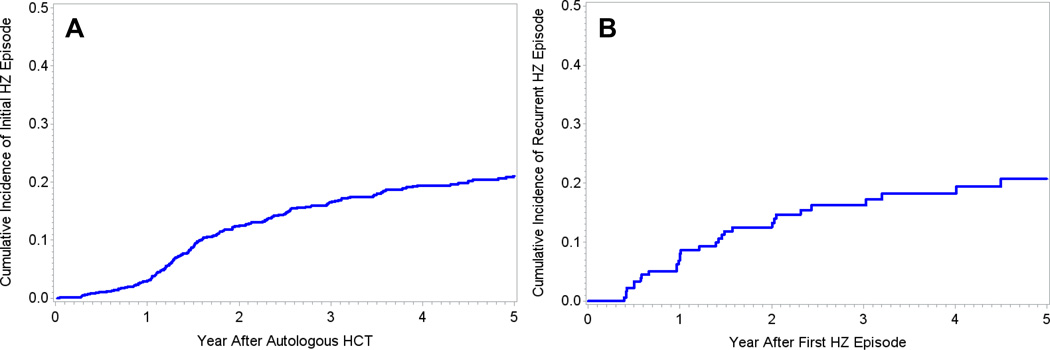
The epidemiology of herpes zoster (HZ) in contemporary autologous hematopoietic cell transplant (HCT) recipients, and the impact of acyclovir (ACV)/valacyclovir (VACV) prophylaxis, is not well described. In this observational study from 2002 to 2010, we retrospectively identified 1000 varicella zoster virus (VZV)-seropositive autologous HCT recipients with up to 5 years of follow-up. The incidence of HZ and use of ACV/VACV prophylaxis were determined through review of medical records and mailed questionnaires. Risk factors for HZ were determined by multivariable Cox regression. Over a period of 5 years after autologous HCT, 194 patients developed at least 1 HZ episode, with a cumulative incidence of 21%; 159 of 194 (82%) were not on prophylaxis at the time of HZ. A second episode of HZ occurred in 31 of 194 (16%) patients. Patients taking ACV/VACV had reduced risk for HZ (adjusted hazard ratio [aHR], .59; 95% confidence interval [CI], .37 to .91), whereas those older than the median age (≥55.5 years) had increased risk (aHR, 1.42; 95% CI, 1.05 to 1.9). Disseminated VZV was reported in 8% and postherpetic neuralgia in 13% of patients. We demonstrate a high burden of HZ late after autologous HCT, despite long-term antiviral prophylaxis. Improved prevention strategies are needed to provide sustained protection against HZ after autologous HCT.
当代自体造血细胞移植(HCT)受者中带状疱疹(HZ)的流行病学情况以及阿昔洛韦(ACV)/伐昔洛韦(VACV)预防措施的影响,目前尚无充分描述。在这项2002年至2010年的观察性研究中,我们回顾性确定了1000例水痘-带状疱疹病毒(VZV)血清学阳性的自体HCT受者,并进行了长达5年的随访。通过查阅病历和邮寄问卷调查确定HZ的发病率以及ACV/VACV预防措施的使用情况。通过多变量Cox回归确定HZ的危险因素。在自体HCT后的5年期间,194例患者至少发生1次HZ发作,累积发病率为21%;194例中的159例(82%)在发生HZ时未接受预防治疗。194例患者中有31例(16%)发生了第二次HZ发作。服用ACV/VACV的患者发生HZ的风险降低(调整后风险比[aHR]为0.59;95%置信区间[CI]为0.37至0.91),而年龄大于中位数年龄(≥55.5岁)者风险增加(aHR为1.42;95%CI为1.05至1.9)。8%的患者报告发生播散性VZV,13%的患者发生带状疱疹后神经痛。我们证明,尽管进行了长期抗病毒预防,但自体HCT后晚期HZ的负担仍然很高。需要改进预防策略,以提供针对自体HCT后HZ的持续保护。