Leibold Lori J, Buss Emily
Center for Hearing Research, Boys Town National Research Hospital, Omaha, Nebraska 68131, USA.
Department of Otolaryngology/Head and Neck Surgery, The University of North Carolina at Chapel Hill, Chapel Hill, North Carolina 27599, USA.
J Acoust Soc Am. 2016 Dec;140(6):4367. doi: 10.1121/1.4971780.
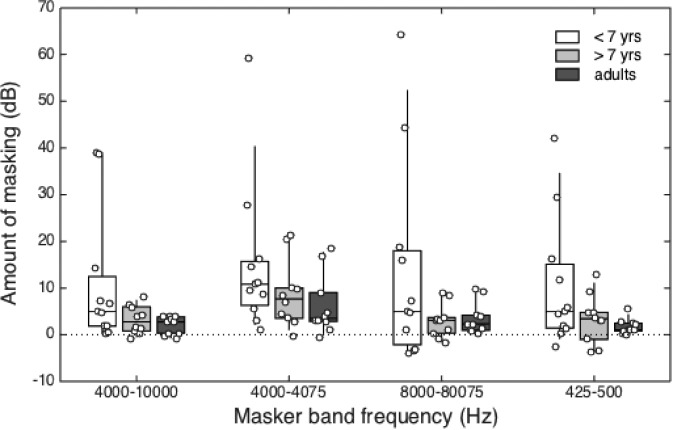
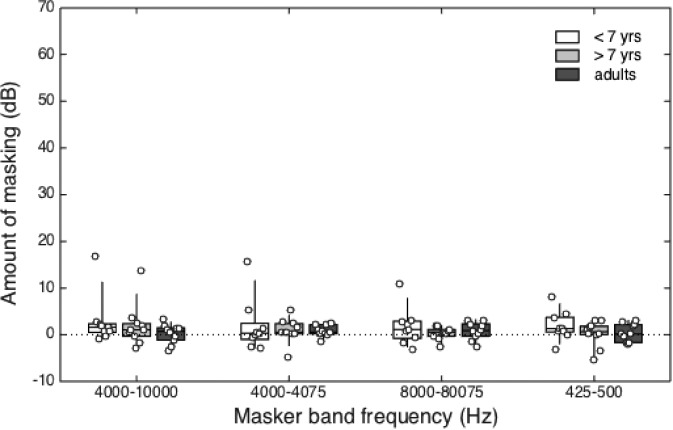
Susceptibility to remote-frequency masking in children and adults was evaluated with respect to three stimulus features: (1) masker bandwidth, (2) spectral separation of the signal and masker, and (3) gated versus continuous masker presentation. Listeners were 4- to 6-year-olds, 7- to 10-year-olds, and adults. Detection thresholds for a 500-ms, 2000-Hz signal were estimated in quiet or presented with a band of noise in one of four frequency regions: 425-500 Hz, 4000-4075 Hz, 8000-8075 Hz, or 4000-10 000 Hz. In experiment 1, maskers were gated on in each 500-ms interval of a three-interval, forced-choice adaptive procedure. Masking was observed for all ages in all maskers, but the greatest masking was observed for the 4000-4075 Hz masker. These findings suggest that signal/masker spectral proximity plays an important role in remote-frequency masking, even when peripheral excitation associated with the signal and masker does not overlap. Younger children tended to have more masking than older children or adults, consistent with a reduced ability to segregate simultaneous sounds and/or listen in a frequency-selective manner. In experiment 2, detection thresholds were estimated in the same noises, but maskers were presented continuously. Masking was reduced for all ages relative to gated conditions, suggesting improved segregation and/or frequency-selective listening.
针对儿童和成人对远频掩蔽的易感性,从三个刺激特征方面进行了评估:(1)掩蔽器带宽,(2)信号与掩蔽器的频谱分离,以及(3)门控掩蔽器与连续掩蔽器呈现方式。受试者包括4至6岁儿童、7至10岁儿童和成人。在安静环境中或在四个频率区域之一(425 - 500Hz、4000 - 4075Hz、8000 - 8075Hz或4000 - 10000Hz)呈现一段噪声的情况下,估计500毫秒、2000赫兹信号的检测阈值。在实验1中,掩蔽器在三间隔、强制选择自适应程序的每个500毫秒间隔内开启。在所有年龄段的所有掩蔽器中均观察到掩蔽现象,但在4000 - 4075Hz掩蔽器中观察到的掩蔽效果最强。这些发现表明,即使与信号和掩蔽器相关的外周兴奋不重叠,信号/掩蔽器频谱接近度在远频掩蔽中也起着重要作用。年幼儿童往往比年长儿童或成人有更多的掩蔽现象,这与同时分离声音和/或以频率选择方式聆听的能力下降一致。在实验2中,在相同噪声中估计检测阈值,但掩蔽器连续呈现。相对于门控条件,所有年龄段的掩蔽现象均减少,表明分离和/或频率选择聆听能力有所改善。