Yao Nina, O'Donnell Mike
Howard Hughes Medical Institute and DNA Replication Laboratory, The Rockefeller University, USA.
JSM Biochem Mol Biol. 2016;3(1). Epub 2016 May 30.
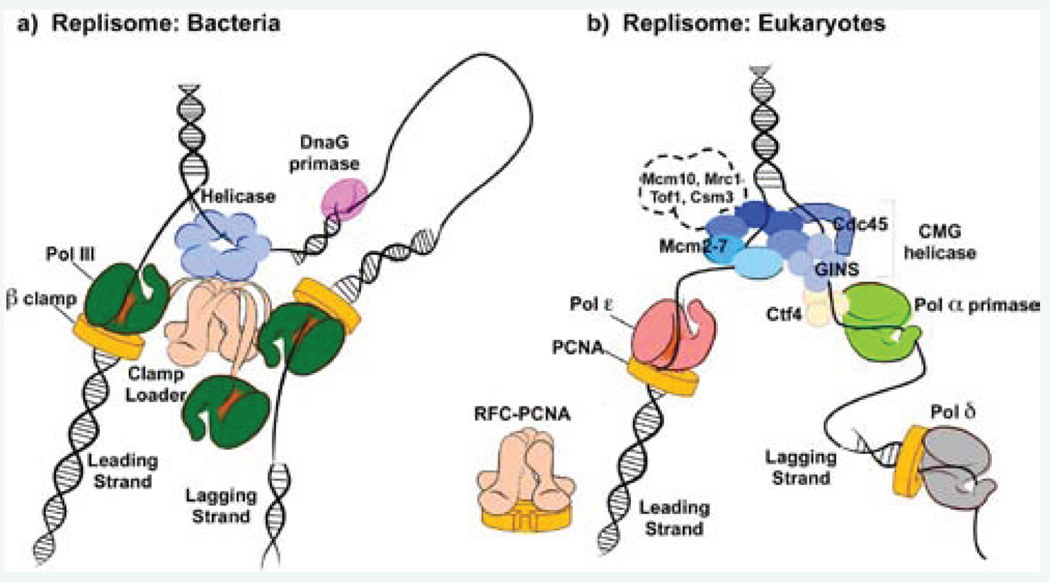
Cellular genomic DNA is replicated by a multiprotein replisome machine. The replisome contains numerous essential factors that unwind, prime and synthesize each of the two strands of duplex DNA. The antiparallel structure of DNA, and unidirectional activity of DNA polymerases, requires the two strands of DNA to be extended in opposite directions, and this structural feature requires distinctive processes for synthesis of the two strands. Genome duplication is of central importance to all cell types, and one may expect the replisome apparatus to be conserved from bacteria to human, as is the case with RNA polymerase driven transcription and ribosome mediated translation. However, it is known that the replication factors of bacteria are not homologous to those of archaea and eukaryotes, indicating that the replication process evolved twice, independently, rather than from a common ancestor cell. Thus, the different domains of life may exhibit significant differences in their mechanistic strategy of replication. In this review, we compare and contrast the different structures and mechanistic features of the cellular replication machinery in the three domains of life.
细胞基因组DNA由一种多蛋白复制体机器进行复制。复制体包含众多解开双链DNA的两条链、引发复制及合成这两条链的必需因子。DNA的反平行结构以及DNA聚合酶的单向活性,要求DNA的两条链沿相反方向延伸,而这一结构特征使得两条链的合成过程截然不同。基因组复制对所有细胞类型都至关重要,人们可能会认为复制体装置从细菌到人类都是保守的,就像RNA聚合酶驱动的转录和核糖体介导的翻译那样。然而,已知细菌的复制因子与古细菌和真核生物的复制因子并非同源,这表明复制过程是独立进化了两次,而非起源于共同的祖先细胞。因此,生命的不同域在其复制机制策略上可能存在显著差异。在本综述中,我们比较并对比了生命三个域中细胞复制机器的不同结构和机制特征。