Galanter Joshua M, Gignoux Christopher R, Oh Sam S, Torgerson Dara, Pino-Yanes Maria, Thakur Neeta, Eng Celeste, Hu Donglei, Huntsman Scott, Farber Harold J, Avila Pedro C, Brigino-Buenaventura Emerita, LeNoir Michael A, Meade Kelly, Serebrisky Denise, Rodríguez-Cintrón William, Kumar Rajesh, Rodríguez-Santana Jose R, Seibold Max A, Borrell Luisa N, Burchard Esteban G, Zaitlen Noah
Department of Medicine, University of California, San Francisco, United States.
Department of Bioengineering and Therapeutic Sciences, University of California, San Francisco, United States.
Elife. 2017 Jan 3;6:e20532. doi: 10.7554/eLife.20532.
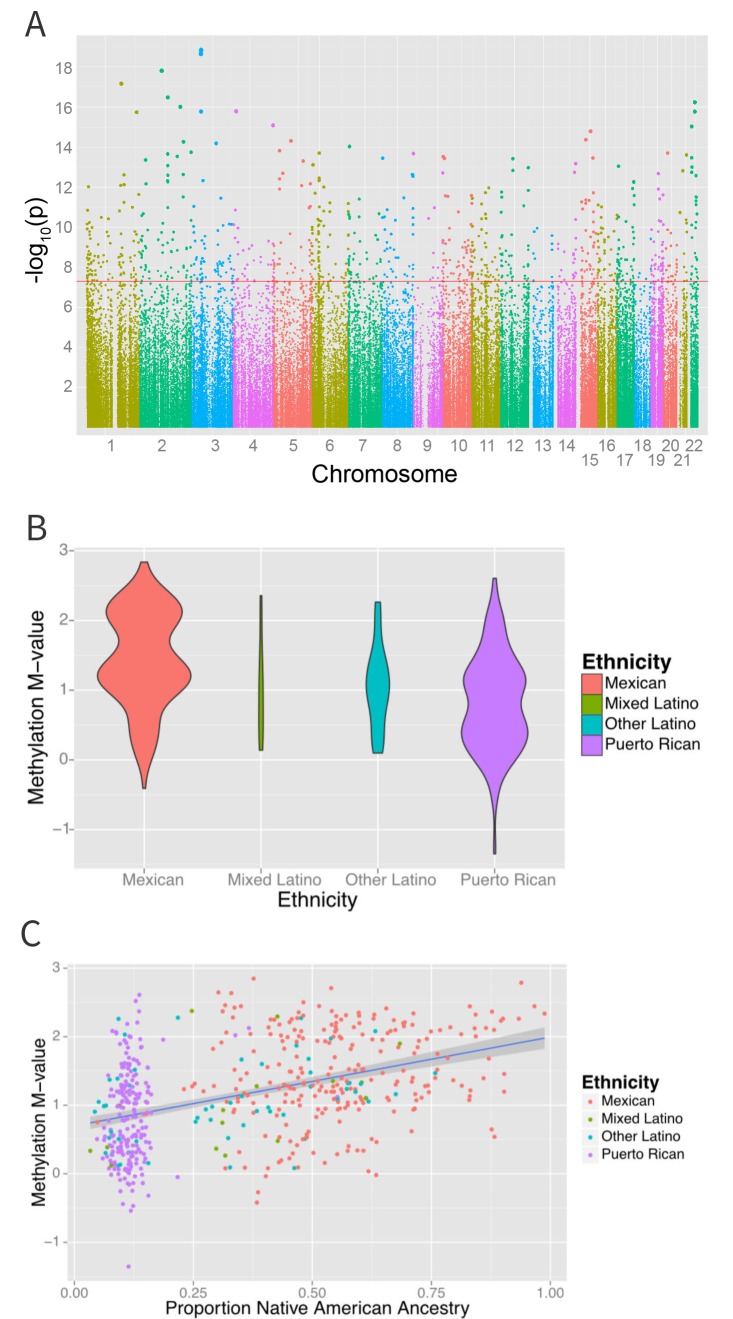
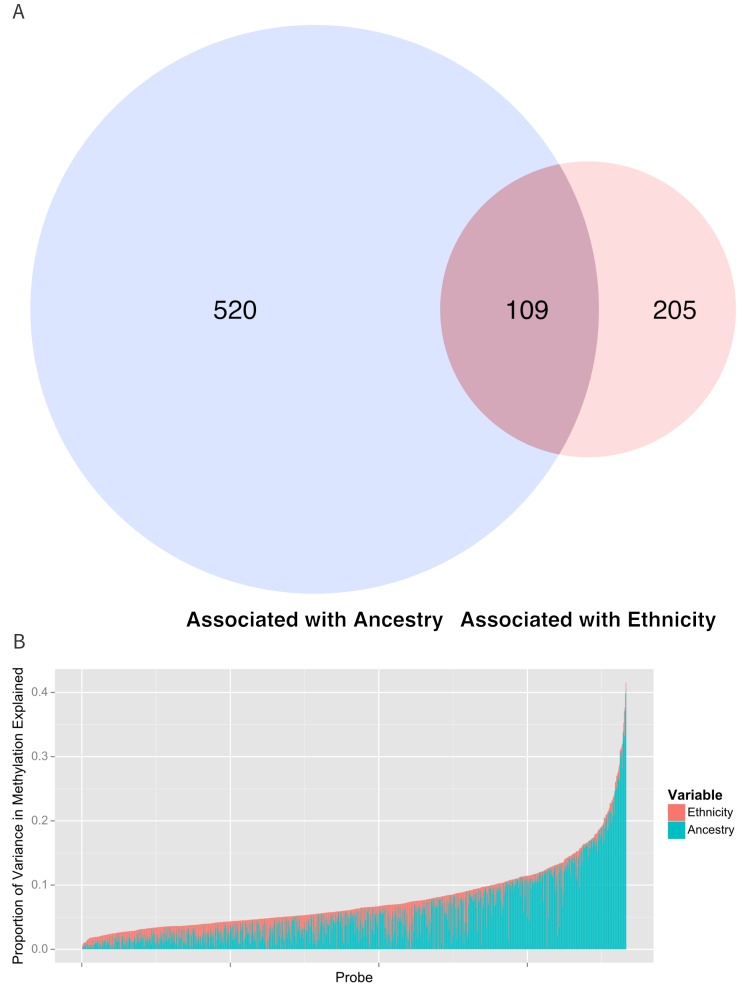
Populations are often divided categorically into distinct racial/ethnic groups based on social rather than biological constructs. Genetic ancestry has been suggested as an alternative to this categorization. Herein, we typed over 450,000 CpG sites in whole blood of 573 individuals of diverse Hispanic origin who also had high-density genotype data. We found that both self-identified ethnicity and genetically determined ancestry were each significantly associated with methylation levels at 916 and 194 CpGs, respectively, and that shared genomic ancestry accounted for a median of 75.7% (IQR 45.8% to 92%) of the variance in methylation associated with ethnicity. There was a significant enrichment (p=4.2×10) of ethnicity-associated sites amongst loci previously associated environmental exposures, particularly maternal smoking during pregnancy. We conclude that differential methylation between ethnic groups is partially explained by the shared genetic ancestry but that environmental factors not captured by ancestry significantly contribute to variation in methylation.
人群通常基于社会而非生物学结构被明确划分为不同的种族/族裔群体。有人提出将遗传血统作为这种分类的替代方法。在此,我们对573名不同西班牙裔血统个体的全血中的45万多个CpG位点进行了分型,这些个体同时还拥有高密度基因型数据。我们发现,自我认定的族裔和基因确定的血统分别与916个和194个CpG位点的甲基化水平显著相关,并且共享的基因组血统占与族裔相关的甲基化变异的中位数为75.7%(四分位间距为45.8%至92%)。在先前与环境暴露相关的基因座中,尤其是孕期母亲吸烟,族裔相关位点有显著富集(p = 4.2×10)。我们得出结论,种族群体之间的甲基化差异部分可由共享的遗传血统解释,但血统未涵盖的环境因素对甲基化变异有显著贡献。