Uppsala University, Department of Neuroscience, Clinical Neurophysiology, BMC, Husargatan 3, 75237 Uppsala, Sweden.
Sci Rep. 2017 Jan 3;7:39716. doi: 10.1038/srep39716.
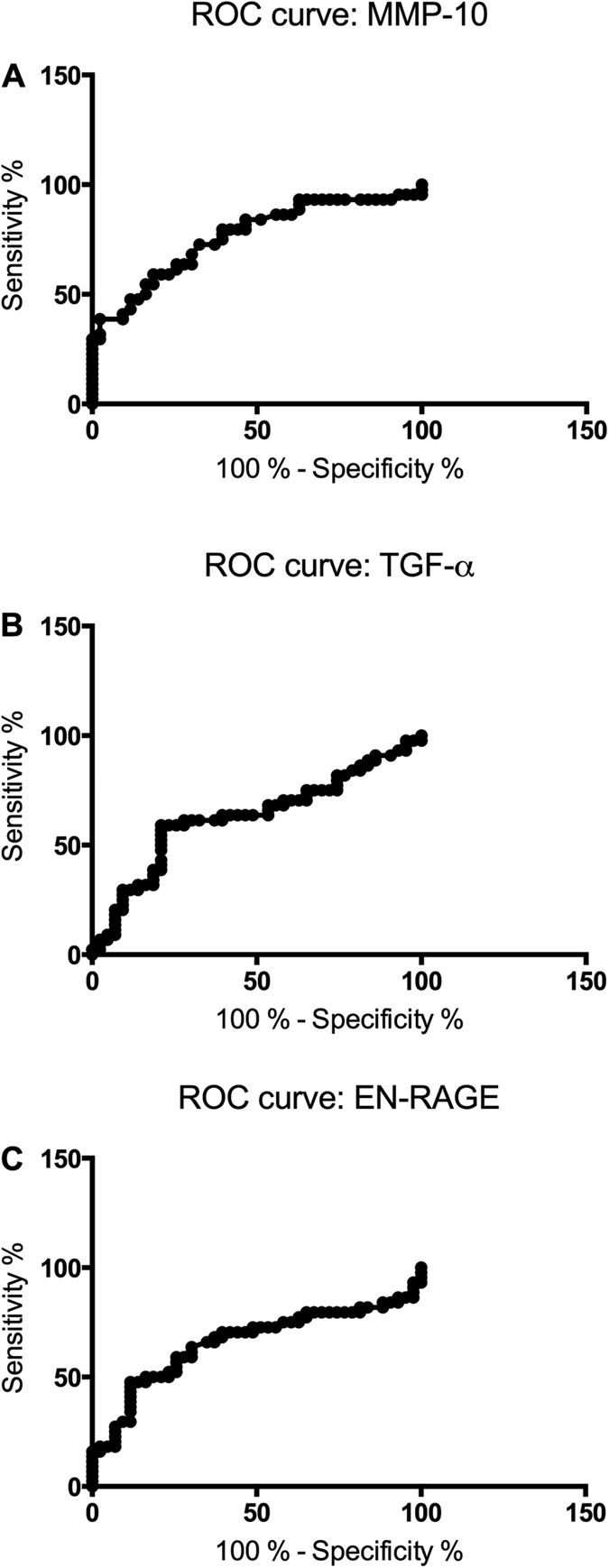
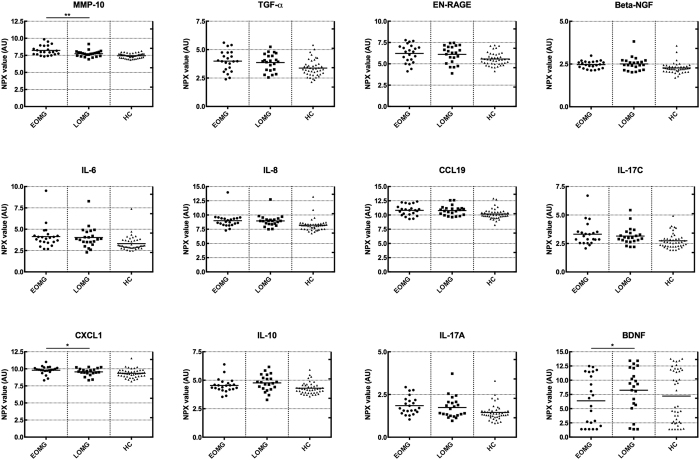
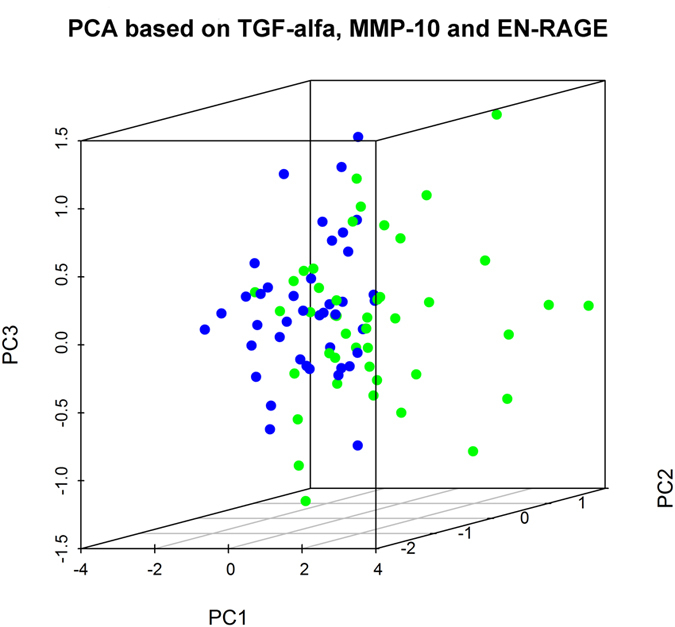
This study describes specific patterns of elevated inflammatory proteins in clinical subtypes of myasthenia gravis (MG) patients. MG is a chronic, autoimmune neuromuscular disease with antibodies most commonly targeting the acetylcholine receptors (AChRab), which causes fluctuating skeletal muscle fatigue. MG pathophysiology includes a strong component of inflammation, and a large proportion of patients with early onset MG additionally present thymus hyperplasia. Due to the fluctuating nature and heterogeneity of the disease, there is a great need for objective biomarkers as well as novel potential inflammatory targets. We examined the sera of 45 MG patients (40 AChRab seropositive and 5 AChRab seronegative), investigating 92 proteins associated with inflammation. Eleven of the analysed proteins were significantly elevated compared to healthy controls, out of which the three most significant were: matrix metalloproteinase 10 (MMP-10; p = 0.0004), transforming growth factor alpha (TGF-α; p = 0.0017) and extracellular newly identified receptor for advanced glycation end-products binding protein (EN-RAGE) (also known as protein S100-A12; p = 0.0054). Further, levels of MMP-10, C-X-C motif ligand 1 (CXCL1) and brain derived neurotrophic factor (BDNF) differed between early and late onset MG. These novel targets provide valuable additional insight into the systemic inflammatory response in MG.
这项研究描述了重症肌无力 (MG) 患者临床亚型中升高的炎症蛋白的特定模式。MG 是一种慢性自身免疫性神经肌肉疾病,最常见的抗体针对乙酰胆碱受体 (AChRab),导致骨骼肌疲劳波动。MG 病理生理学包括强烈的炎症成分,并且很大一部分早发性 MG 患者还存在胸腺增生。由于疾病的波动性和异质性,非常需要客观的生物标志物以及新的潜在炎症靶点。我们检查了 45 名 MG 患者(40 名 AChRab 血清阳性和 5 名 AChRab 血清阴性)的血清,研究了 92 种与炎症相关的蛋白。与健康对照组相比,分析的 11 种蛋白明显升高,其中最显著的三种是:基质金属蛋白酶 10 (MMP-10; p = 0.0004)、转化生长因子α (TGF-α; p = 0.0017) 和细胞外新鉴定的晚期糖基化终产物受体结合蛋白 (EN-RAGE)(也称为蛋白 S100-A12;p = 0.0054)。此外,MMP-10、C-X-C 基序配体 1 (CXCL1) 和脑源性神经营养因子 (BDNF) 的水平在早发性和晚发性 MG 之间存在差异。这些新靶点为 MG 中的系统性炎症反应提供了有价值的额外见解。