Venters Michael, Carlson Ross P, Gedeon Tomas, Heys Jeffrey J
Chemical and Biological Engineering Department, Montana State University, Bozeman, Montana, United States of America.
Department of Mathematical Sciences, Montana State University, Bozeman, Montana, United States of America.
PLoS One. 2017 Jan 3;12(1):e0168592. doi: 10.1371/journal.pone.0168592. eCollection 2017.
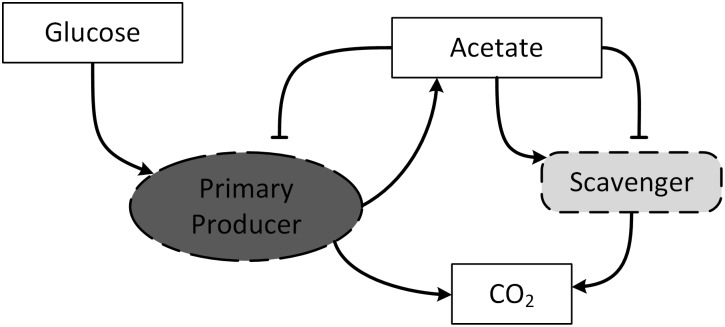
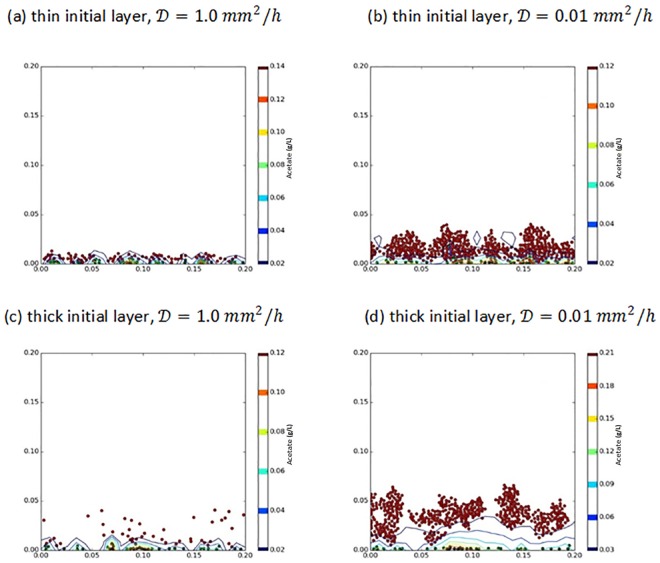
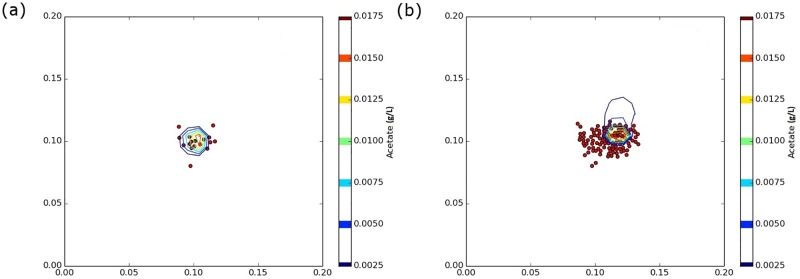
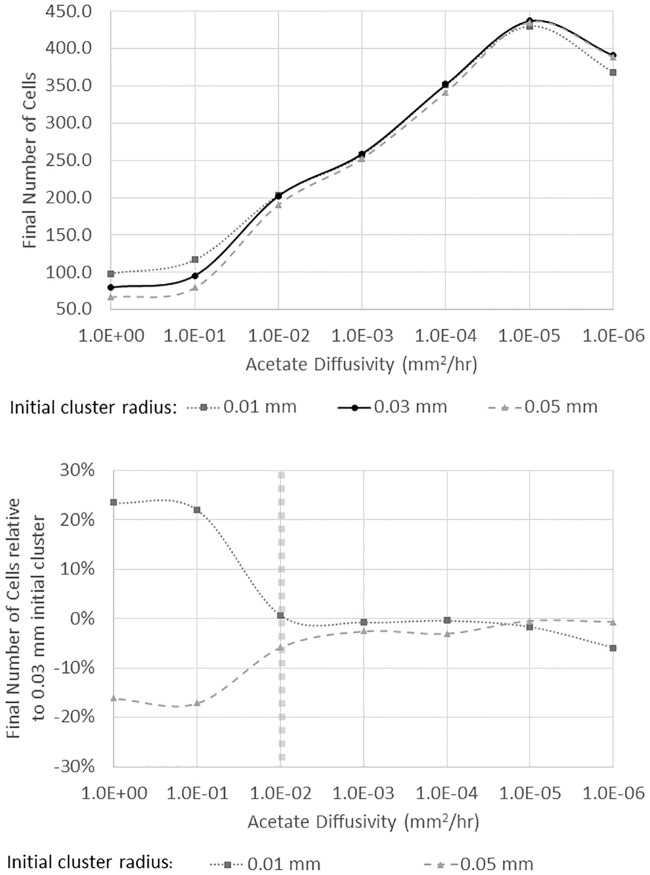
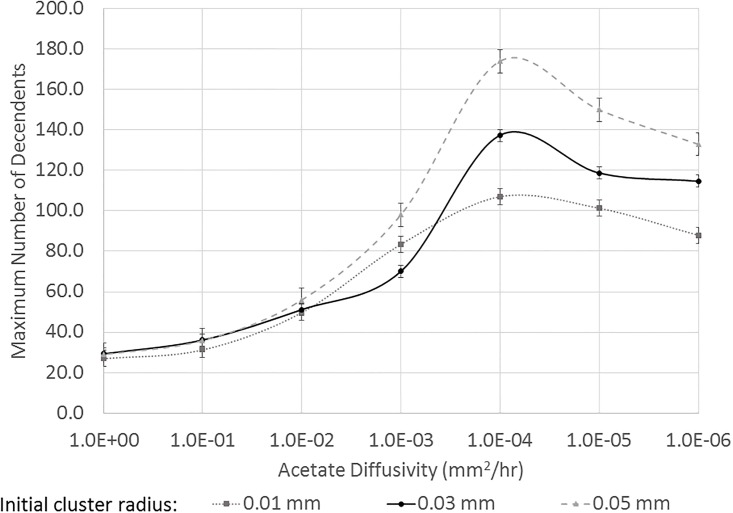
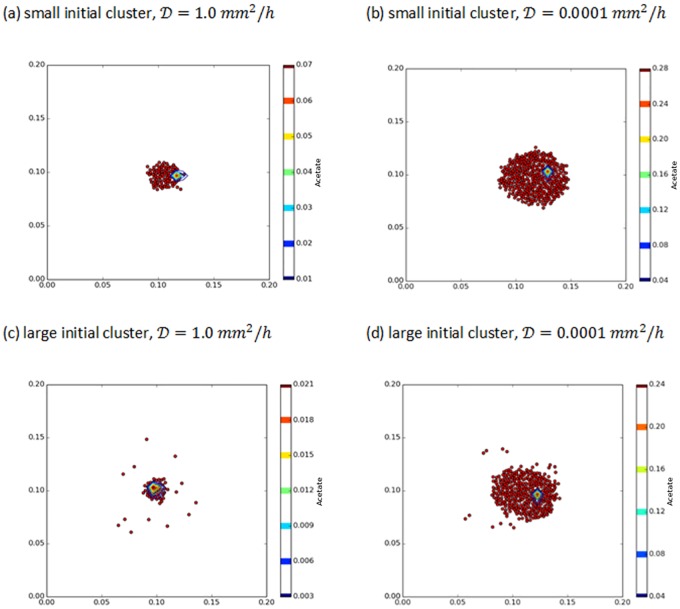
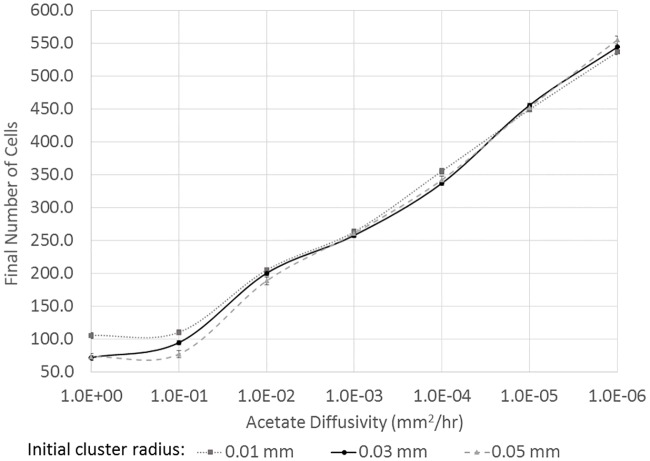
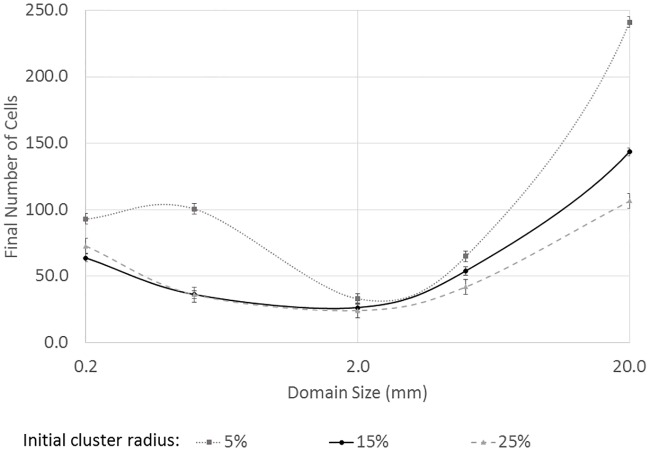
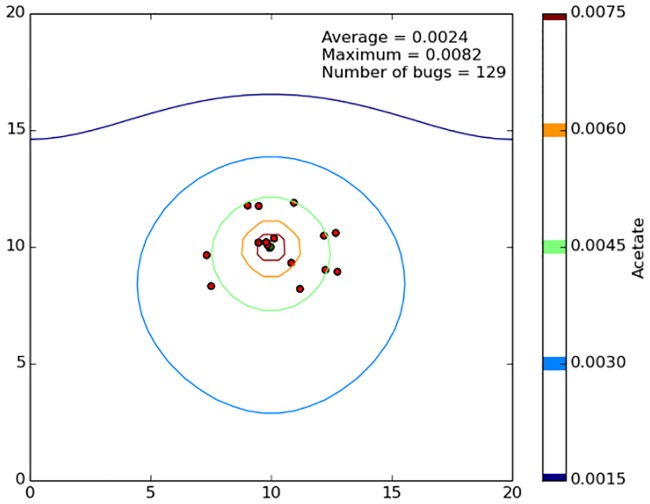
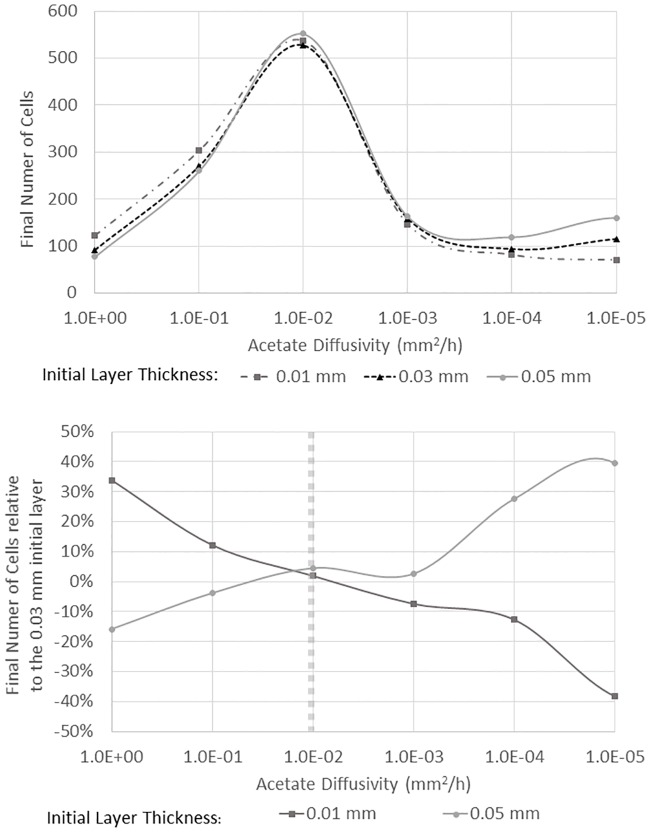
Microbial consortia are commonly observed in natural and synthetic systems, and these consortia frequently result in higher biomass production relative to monocultures. The focus here is on the impact of initial spatial localization and substrate diffusivity on the growth of a model microbial consortium consisting of a producer strain that consumes glucose and produces acetate and a scavenger strain that consumes the acetate. The mathematical model is based on an individual cell model where growth is described by Monod kinetics, and substrate transport is described by a continuum-based, non-equilibrium reaction-diffusion model where convective transport is negligible (e.g., in a biofilm). The first set of results focus on a single producer cell at the center of the domain and surrounded by an initial population of scavenger cells. The impact of the initial population density and substrate diffusivity is examined. A transition is observed from the highest initial density resulting in the greatest cell growth to cell growth being independent of initial density. A high initial density minimizes diffusive transport time and is typically expected to result in the highest growth, but this expected behavior is not predicted in environments with lower diffusivity or larger length scales. When the producer cells are placed on the bottom of the domain with the scavenger cells above in a layered biofilm arrangement, a similar critical transition is observed. For the highest diffusivity values examined, a thin, dense initial scavenger layer is optimal for cell growth. However, for smaller diffusivity values, a thicker, less dense initial scavenger layer provides maximal growth. The overall conclusion is that high density clustering of members of a food chain is optimal under most common transport conditions, but under some slow transport conditions, high density clustering may not be optimal for microbial growth.
微生物群落常见于自然和合成系统中,相对于单一培养物,这些群落通常能产生更高的生物量。本文重点研究初始空间定位和底物扩散率对一个模型微生物群落生长的影响,该群落由一个消耗葡萄糖并产生乙酸盐的生产者菌株和一个消耗乙酸盐的清除者菌株组成。数学模型基于个体细胞模型,其中生长由莫诺德动力学描述,底物运输由基于连续介质的非平衡反应扩散模型描述,其中对流运输可忽略不计(例如在生物膜中)。第一组结果聚焦于位于区域中心且被初始清除者细胞群体包围的单个生产者细胞。研究了初始群体密度和底物扩散率的影响。观察到从导致最大细胞生长的最高初始密度到细胞生长与初始密度无关的转变。高初始密度使扩散运输时间最小化,通常预期会导致最高生长,但在扩散率较低或长度尺度较大的环境中,这种预期行为并未得到预测。当生产者细胞置于区域底部,清除者细胞在上方以分层生物膜排列时,观察到类似的临界转变。对于所研究的最高扩散率值,薄而密集的初始清除者层最有利于细胞生长。然而,对于较小的扩散率值,较厚且密度较小的初始清除者层提供最大生长。总体结论是,在大多数常见运输条件下,食物链成员的高密度聚集是最优的,但在某些缓慢运输条件下,高密度聚集可能并非微生物生长的最优选择。