Essien Okon, Otu Akaninyene, Umoh Victor, Enang Ofem, Hicks Joseph Paul, Walley John
Department of Internal Medicine, University of Calabar, Calabar, Cross River State, Nigeria.
Department of Medicine, University of Uyo, Uyo, Akwa Ibom State, Nigeria.
PLoS One. 2017 Jan 3;12(1):e0168835. doi: 10.1371/journal.pone.0168835. eCollection 2017.
Diabetes is now a global epidemic, but most cases are now in low- and middle-income countries. Diabetes self-management education (DSME) is key to enabling patients to manage their chronic condition and can reduce the occurrence of costly and devastating complications. However, there is limited evidence on the effectiveness of different DSME programmes in resource limited settings.
We conducted an unblinded, parallel-group, individually-randomised controlled trial at the University of Calabar Teaching Hospital (Nigeria) to evaluate whether an intensive and systematic DSME programme, using structured guidelines, improved glycaemic control compared to the existing ad hoc patient education (clinical practice was unchanged). Eligible patients (≥18 years, HbA1c > 8.5% and physically able to participate) were randomly allocated by permuted block randomisation to participate for six months in either an intensive or conventional education group. The primary outcome was HbA1c (%) at six-months.
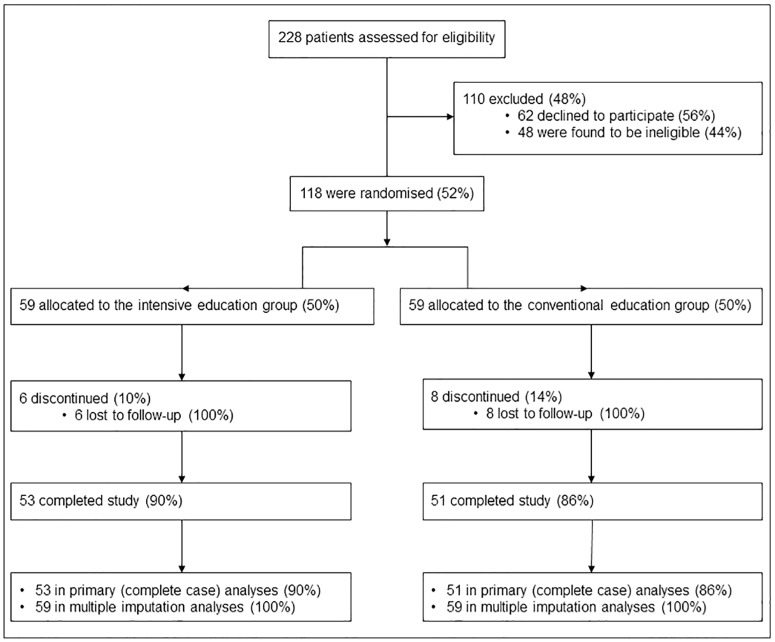
We randomised 59 participants to each group and obtained six-month HbA1c outcomes from 53 and 51 participants in the intensive and conventional education groups, respectively. Intensive group participants had a mean six-month HbA1c (%) of 8.4 (95% CI: 8 to 8.9), while participants in the conventional education group had a mean six-month HbA1c (%) of 10.2 (95% CI: 9.8 to 10.7). The difference was statistically (P < 0.0001) and clinically significant, with intensive group participants having HbA1c outcomes on average -1.8 (95% CI: -2.4 to -1.2) percentage points lower than conventional group participants. Results were robust to adjustment for a range of covariates and multiple imputation of missing outcome data.
This study demonstrates the effectiveness of a structured, guideline-based DSME intervention in a LMIC setting versus a pragmatic comparator. The intervention is potentially replicable at other levels of the Nigerian healthcare system and in other LMICs, where nurses/diabetes educators can run the programme.
Pan African Clinical Trial Registry PACTR20130200047835.
糖尿病如今已成为全球性流行病,但大多数病例目前出现在低收入和中等收入国家。糖尿病自我管理教育(DSME)是使患者能够管理其慢性病并可减少代价高昂且具有破坏性的并发症发生的关键。然而,在资源有限的环境中,关于不同DSME项目有效性的证据有限。
我们在卡拉巴尔大学教学医院(尼日利亚)进行了一项非盲、平行组、个体随机对照试验,以评估与现有的临时患者教育(临床实践不变)相比,使用结构化指南的强化且系统的DSME项目是否能改善血糖控制。符合条件的患者(≥18岁,糖化血红蛋白>8.5%且身体能够参与)通过置换区组随机化被随机分配,参加强化教育组或传统教育组为期六个月的项目。主要结局是六个月时的糖化血红蛋白(%)。
我们将59名参与者随机分配到每组,并分别从强化教育组和传统教育组的53名和51名参与者中获得了六个月的糖化血红蛋白结局。强化教育组参与者六个月糖化血红蛋白(%)的平均值为8.4(95%置信区间:8至8.9),而传统教育组参与者六个月糖化血红蛋白(%)的平均值为10.2(95%置信区间:9.8至10.7)。差异具有统计学意义(P<0.0001)且具有临床意义,强化教育组参与者的糖化血红蛋白结局平均比传统教育组参与者低-1.8(95%置信区间:-2.4至-1.2)个百分点。对一系列协变量进行调整以及对缺失结局数据进行多重插补后,结果依然稳健。
本研究证明了在低收入和中等收入国家环境中,与实用对照相比,基于指南的结构化DSME干预的有效性。该干预在尼日利亚医疗保健系统的其他层面以及其他低收入和中等收入国家可能具有可复制性,在这些地方护士/糖尿病教育者可以开展该项目。
泛非临床试验注册中心PACTR20130200047835 。