Ives Anthony R, Paull Cate, Hulthen Andrew, Downes Sharon, Andow David A, Haygood Ralph, Zalucki Myron P, Schellhorn Nancy A
Department of Zoology, University of Wisconsin-Madison, Madison, Wisconsin, United States of America.
CSIRO, Brisbane, Queensland, Australia.
PLoS One. 2017 Jan 3;12(1):e0169167. doi: 10.1371/journal.pone.0169167. eCollection 2017.
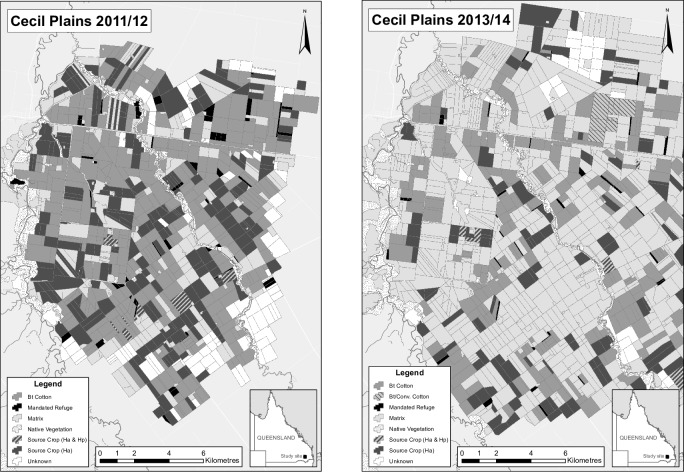
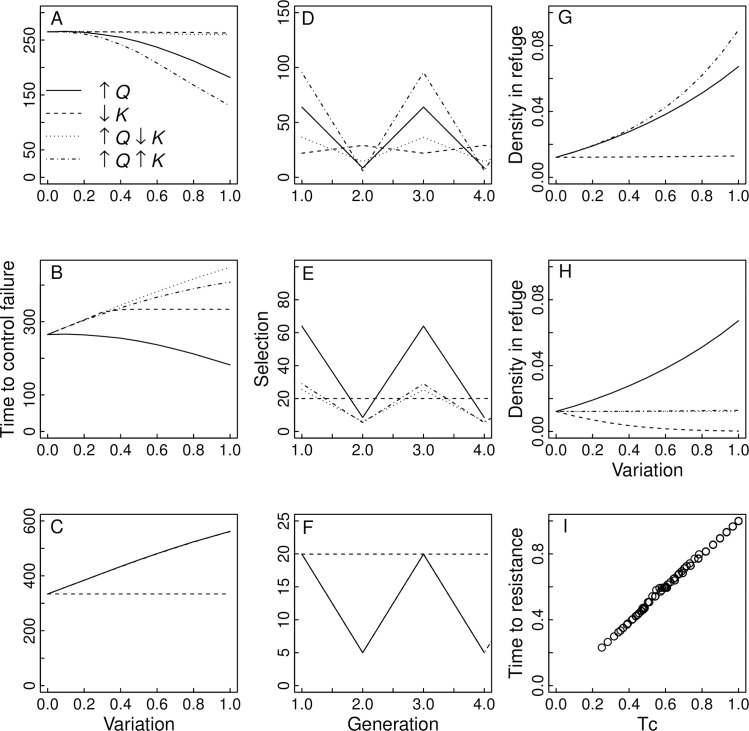
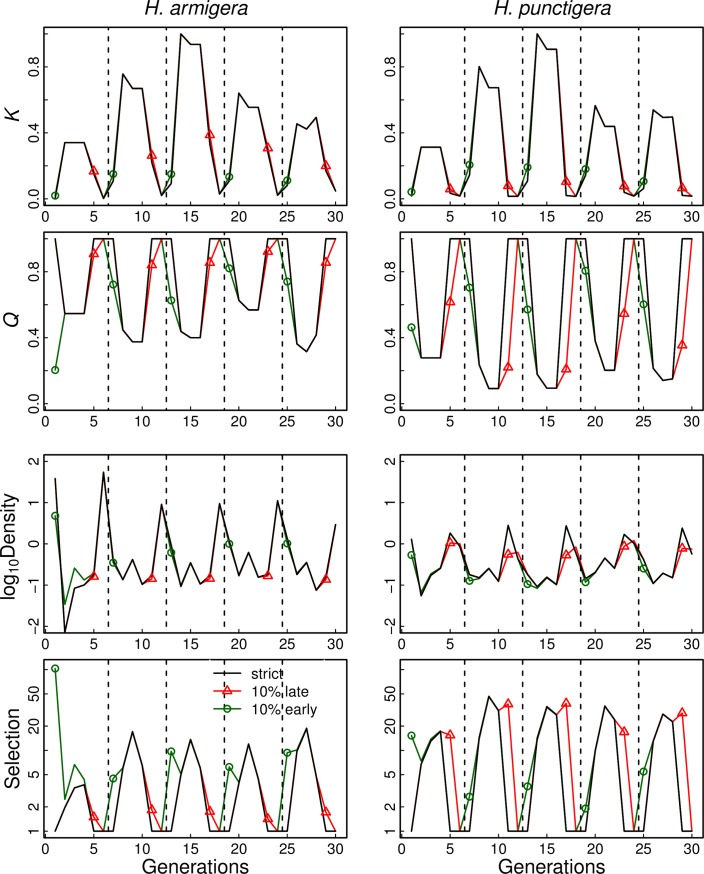
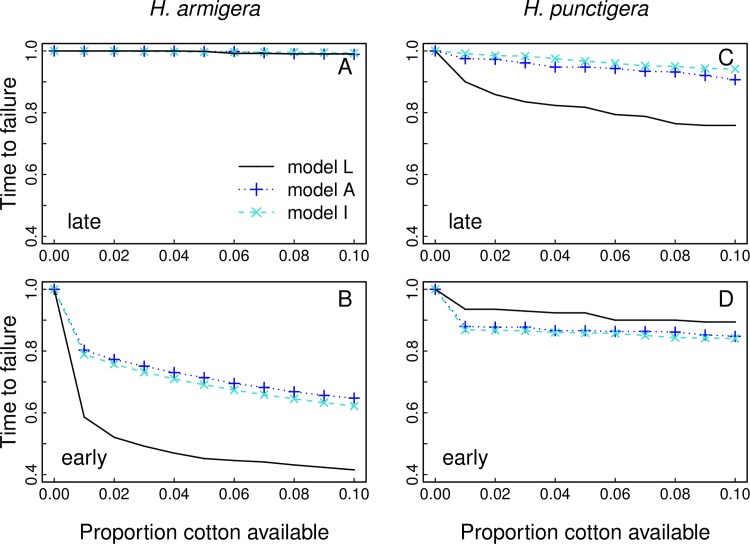
Transgenic crops that express insecticide genes from Bacillus thuringiensis (Bt) are used worldwide against moth and beetle pests. Because these engineered plants can kill over 95% of susceptible larvae, they can rapidly select for resistance. Here, we use a model for a pyramid two-toxin Bt crop to explore the consequences of spatio-temporal variation in the area of Bt crop and non-Bt refuge habitat. We show that variability over time in the proportion of suitable non-Bt breeding habitat, Q, or in the total area of Bt and suitable non-Bt habitat, K, can increase the overall rate of resistance evolution by causing short-term surges of intense selection. These surges can be exacerbated when temporal variation in Q and/or K cause high larval densities in refuges that increase density-dependent mortality; this will give resistant larvae in Bt fields a relative advantage over susceptible larvae that largely depend on refuges. We address the effects of spatio-temporal variation in a management setting for two bollworm pests of cotton, Helicoverpa armigera and H. punctigera, and field data on landscape crop distributions from Australia. Even a small proportion of Bt fields available to egg-laying females when refuges are sparse may result in high exposure to Bt for just a single generation per year and cause a surge in selection. Therefore, rapid resistance evolution can occur when Bt crops are rare rather than common in the landscape. These results highlight the need to understand spatio-temporal fluctuations in the landscape composition of Bt crops and non-Bt habitats in order to design effective resistance management strategies.
表达来自苏云金芽孢杆菌(Bt)杀虫基因的转基因作物在全球范围内用于防治蛾类和甲虫类害虫。由于这些转基因植物能杀死超过95%的易感幼虫,它们会迅速导致害虫产生抗性。在此,我们使用一个双毒素金字塔式Bt作物模型,来探究Bt作物种植面积和非Bt避难所栖息地的时空变化所带来的影响。我们发现,合适的非Bt繁殖栖息地比例Q,或Bt及合适的非Bt栖息地总面积K随时间的变化,会因导致短期强烈选择激增,从而提高抗性进化的总体速率。当Q和/或K的时间变化导致避难所内幼虫密度升高,进而增加密度依赖性死亡率时,这种激增会加剧;这将使Bt田中的抗性幼虫相对于主要依赖避难所的易感幼虫具有相对优势。我们针对棉花的两种棉铃虫害虫——棉铃虫和澳洲棉铃虫,以及来自澳大利亚的景观作物分布实地数据,探讨了管理环境下时空变化的影响。当避难所稀少时,即使可供产卵雌虫选择的Bt田比例很小,也可能导致每年仅一代幼虫就会大量接触Bt,并引发选择激增。因此,当Bt作物在景观中稀少而非常见时,抗性可能会迅速进化。这些结果凸显了了解Bt作物和非Bt栖息地景观组成的时空波动对于设计有效抗性管理策略的必要性。