Lou Yanhong, Zhao Peng, Wang Deling, Amombo Erick, Sun Xin, Wang Hui, Zhuge Yuping
College of Resources and Environment, Shandong Agricultural University, Tai'an City, Shandong, P. R. China.
PLoS One. 2017 Jan 3;12(1):e0169495. doi: 10.1371/journal.pone.0169495. eCollection 2017.
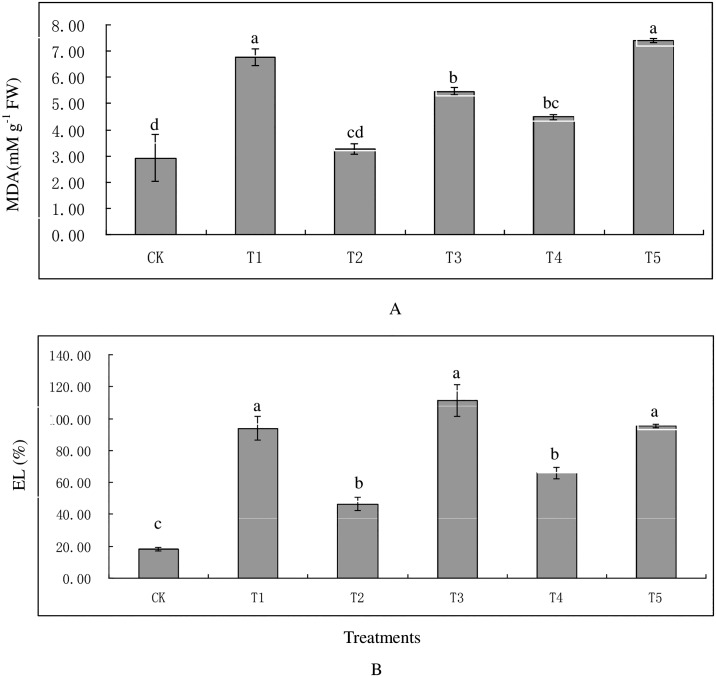
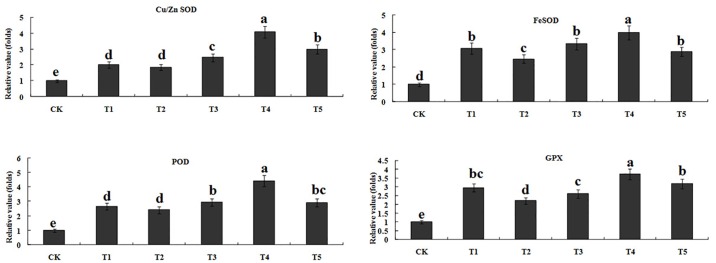
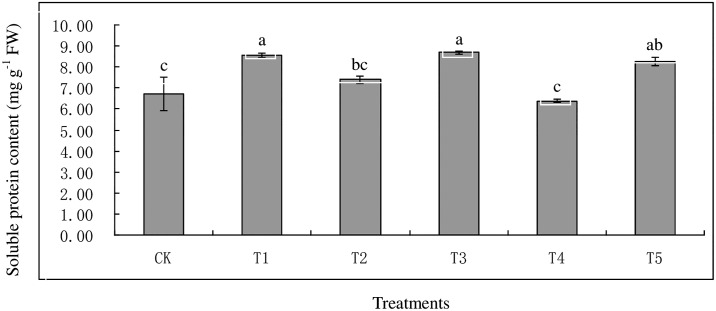
Cadmium (Cd) and lead (Pb) are recognized as the most toxic metal ions due to their detrimental effects not only to plants, but also to humans. The objective of this study was to investigate the effects of Cd and Pb treatments on seed germination, plant growth, and physiological response in tall fescue (Festuca arundinacea Schreb.). We employed six treatments: CK (nutrient solution as control), T1 (1000 mg L-1 Pb), T2 (50 mg L-1 Cd), T3 (150 mg L-1 Cd), T4 (1000 mg L-1 Pb+50 mg L-1 Cd), T5 (1000 mg L-1 Pb+150 mg L-1 Cd). Antagonistic and synergistic actions were observed in tall fescue under Pb and Cd combined treatments. Under low Cd, plants exhibited higher relative germination rate, germ length, VSGR, catalase (CAT) and peroxidase (POD) activities. Additionally, in the shoots, the gene expression level of Cu/Zn SOD, FeSOD, POD, GPX, translocation factors, MDA, EL, and soluble protein contents were reduced under Pb stress. Conversely, under high Cd level, there was a decline in NRT, Pb content in shoots, Pb translocation factors, CAT activity; and an increase in VSGR, Pb content in roots, gene expression level of Cu/ZnSOD and POD in tall fescue exposed to Pb2+ regimes. On the other hand, tall fescue plants treated with low Cd exhibited lower relative germination rate, germination index, germ length, NRT, Cd content in roots. On the other hand there was higher Cd content, Cd translocation factor, CAT and POD activities, and gene expression level of Cu/Zn SOD, FeSOD, POD, GPX under Pb treatment compared with single Cd2+ treatment in the shoots. However, after high Cd exposure, plants displayed lower NRT, Cd content, CAT activity, and exhibited higher Cd contents, Cd translocation factor, MDA content, gene expression level of Cu/ZnSOD and GPX with the presence of Pb2+ relative to single Cd2+ treatment. These findings lead to a conclusion that the presence of low Cd level impacted positively towards tall fescue growth under Pb stress, while high level of Cd impacted negatively. In summary, antioxidant enzymes responded to Cd and Pb interaction at an early stage of exposure, and their gene expression profiles provided more details of the activation of those systems.
镉(Cd)和铅(Pb)被认为是毒性最强的金属离子,因为它们不仅对植物,而且对人类都有有害影响。本研究的目的是调查镉和铅处理对高羊茅(Festuca arundinacea Schreb.)种子萌发、植株生长和生理反应的影响。我们采用了六种处理方式:CK(营养液作为对照)、T1(1000 mg L-1铅)、T2(50 mg L-1镉)、T3(150 mg L-1镉)、T4(1000 mg L-1铅 + 50 mg L-1镉)、T5(1000 mg L-1铅 + 150 mg L-1镉)。在铅和镉联合处理下,高羊茅中观察到了拮抗和协同作用。在低镉水平下,植株表现出较高的相对发芽率、胚根长度、活力指数、过氧化氢酶(CAT)和过氧化物酶(POD)活性。此外,在地上部分,铅胁迫下铜/锌超氧化物歧化酶(Cu/Zn SOD)、铁超氧化物歧化酶(FeSOD)、POD、谷胱甘肽过氧化物酶(GPX)的基因表达水平、转运因子、丙二醛(MDA)含量、电解质渗漏率(EL)和可溶性蛋白含量均降低。相反,在高镉水平下,暴露于铅处理下的高羊茅中硝酸还原酶(NRT)活性下降、地上部分铅含量、铅转运因子、CAT活性下降;活力指数、根系铅含量、地上部分铜/锌超氧化物歧化酶和POD的基因表达水平升高。另一方面,低镉处理的高羊茅植株相对发芽率、发芽指数、胚根长度、NRT、根系镉含量较低;另一方面,与单一镉离子处理相比,铅处理下地上部分镉含量、镉转运因子、CAT和POD活性以及铜/锌超氧化物歧化酶、铁超氧化物歧化酶、POD、谷胱甘肽过氧化物酶的基因表达水平较高。然而,在高镉暴露后与单一镉离子处理相比植物表现出较低的NRT、镉含量、CAT活性,以及在铅离子存在下较高的镉含量、镉转运因子、MDA含量、铜/锌超氧化物歧化酶和谷胱甘肽过氧化物酶的基因表达水平。这些发现得出一个结论,即低镉水平的存在对铅胁迫下的高羊茅生长有积极影响,而高镉水平则有负面影响。总之,抗氧化酶在暴露早期对镉和铅的相互作用有反应,它们的基因表达谱提供了这些系统激活的更多细节。