Begonia M T, Begonia G B, Ighoavodha M, Gilliard D
Department of Biology, Jackson State University, 1400 Lynch St., P.O. Box 18540, Jackson, MS 39217, USA.
Int J Environ Res Public Health. 2005 Aug;2(2):228-33. doi: 10.3390/ijerph2005020005.
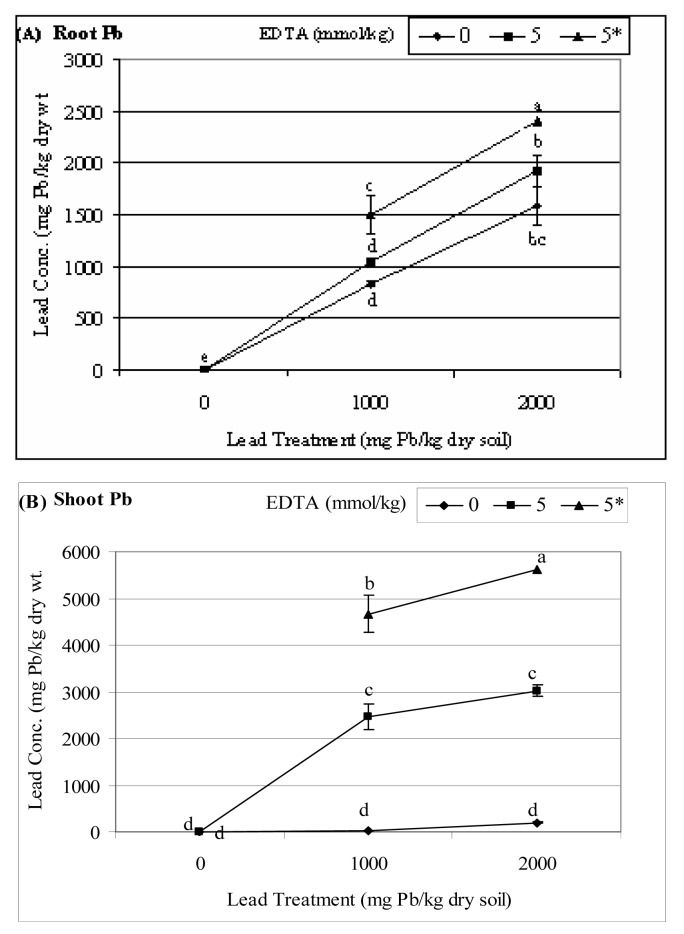
Phytoextraction is gaining acceptance as a cost-effective and environmentally friendly phytoremediation strategy for reducing toxic metal levels from contaminated soils. Cognizant of the potential of this phytoremediation technique as an alternative to expensive engineering-based remediation technologies, experiments were conducted to evaluate the suitability of some plants as phytoextraction species. From one of our preliminary studies, we found that tall fescue (Festuca arundinacea Schreb. cv. Spirit) can tolerate and accumulate significant amounts of lead (Pb) in its shoots when grown in Pb-amended sand. To further evaluate the suitability of tall fescue as one of the potential crop rotation species for phytoextraction, a study was conducted to determine whether the addition of ethylenediaminetetraacetic acid (EDTA) alone or in combination with acetic acid can further enhance the shoot uptake of Pb. Seeds were planted in 3.8 L plastic pots containing top soil, peat, and sand (4:2:1, v:v:v) spiked with various levels (0,1000, 2000 mg Pb/kg dry soil) of lead. At six weeks after planting, aqueous solutions (0, 5 mmol/kg dry soil) of EDTA and acetic acid (5 mmol/kg dry soil) were applied to the root zone, and all plants were harvested a week later. Results revealed that tall fescue was relatively tolerant to moderate levels of Pb as shown by non-significant differences in root and shoot biomass among treatments. An exception to this trend however, was the slight reduction in root and shoot biomass of plants exposed to the highest Pb level in combination with the two chelates. Root Pb concentration increased with increasing level of soil-applied Pb. Further increases in root Pb concentrations were attributed to chelate amendments. Translocation index, which is a measure of the partitioning of the metal to the shoots, was significantly enhanced with chelate addition especially when both EDTA and acetic acid were used. Chelate-induced increases in translocation indices correspondingly led to higher shoot Pb concentrations.
植物提取作为一种经济高效且环境友好的植物修复策略,正逐渐被认可,用于降低污染土壤中的有毒金属含量。鉴于这种植物修复技术作为昂贵的基于工程的修复技术的替代方法的潜力,开展了实验以评估某些植物作为植物提取物种的适用性。从我们的一项初步研究中,我们发现高羊茅(Festuca arundinacea Schreb. cv. Spirit)在添加铅的沙子中生长时,能够耐受并在其地上部分积累大量铅(Pb)。为了进一步评估高羊茅作为植物提取潜在轮作作物之一的适用性,进行了一项研究,以确定单独添加乙二胺四乙酸(EDTA)或与乙酸联合添加是否能进一步提高地上部分对铅的吸收。将种子种植在装有添加了不同水平(0、1000、2000毫克铅/千克干土)铅的表层土、泥炭和沙子(4:2:1,体积比)的3.8升塑料盆中。种植六周后,将EDTA水溶液(0、5毫摩尔/千克干土)和乙酸(5毫摩尔/千克干土)施用于根区,一周后收获所有植物。结果表明,高羊茅对中等水平的铅具有相对耐受性,各处理间根和地上部分生物量无显著差异。然而,这一趋势的一个例外是,暴露于最高铅水平并添加两种螯合剂的植物的根和地上部分生物量略有减少。根中铅浓度随土壤中添加铅水平的增加而增加。根中铅浓度的进一步增加归因于螯合剂的添加。转运指数是衡量金属向地上部分分配的指标,添加螯合剂后显著提高,尤其是同时使用EDTA和乙酸时。螯合剂诱导的转运指数增加相应地导致地上部分铅浓度升高。