Ha Xiaoqin, Peng Junhua, Zhao Hongbin, Deng Zhiyun, Dong Juzi, Fan Hongyan, Zhao Yong, Li Bing, Feng Qiangsheng, Yang Zhihua
Department of Clinical Laboratory Medicine, Lanzhou General Hospital of Lanzhou Military Region, People's Liberation Army, Key Laboratory of Stem Cell and Gene Drug in Gansu Province, Lanzhou, China.
J Korean Med Sci. 2017 Feb;32(2):186-194. doi: 10.3346/jkms.2017.32.2.186.
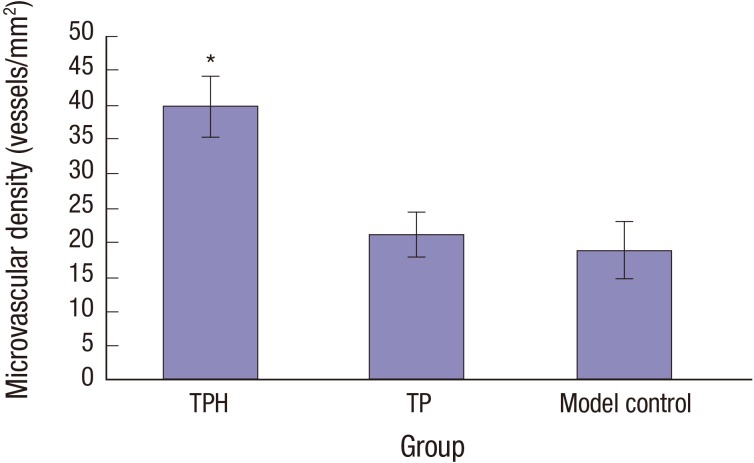
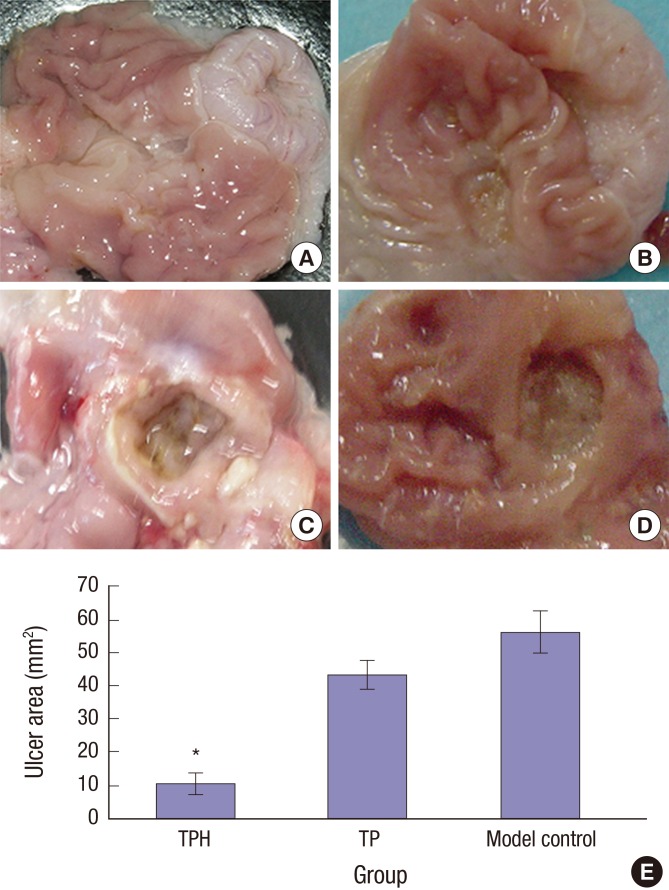
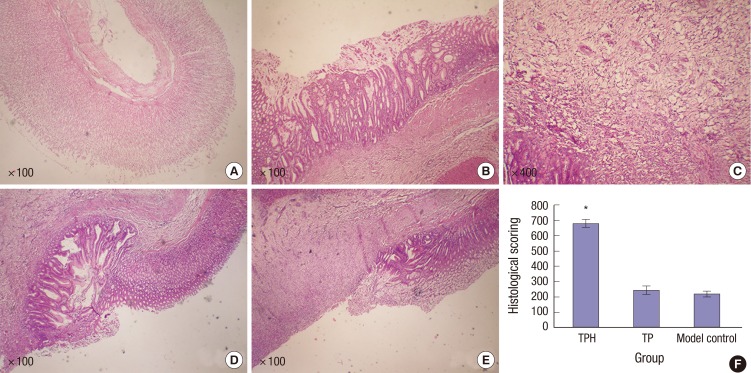
The present study developed an oral hepatocyte growth factor (HGF) gene therapy strategy for gastric ulcers treatment. An attenuated Salmonella typhimurium that stably expressed high HGF (named as TPH) was constructed, and the antiulcerogenic effect of TPH was evaluated in a rat model of gastric ulcers that created by acetic acid subserosal injection. From day 5 after injection, TPH (1 × 10⁹ cfu), vehicle (TP, 1 × 10⁹ cfu), or sodium bicarbonate (model control) was administered orally every alternate day for three times. Then ulcer size was measured at day 21 after ulcer induction. The ulcer area in TPH-treated group was 10.56 ± 3.30 mm², which was smaller when compared with those in the TP-treated and model control groups (43.47 ± 4.18 and 56.25 ± 6.38 mm², respectively). A higher level of reepithelialization was found in TPH-treated group and the crawling length of gastric epithelial cells was significantly longer than in the other two groups (P < 0.05). The microvessel density in the ulcer granulation tissues of the TPH-treated rats was 39.9 vessels/mm², which was greater than in the TP-treated and model control rats, with a significant statistical difference. These results suggest that TPH treatment significantly accelerates the healing of gastric ulcers via stimulating proliferation of gastric epithelial cells and enhancing angiogenesis on gastric ulcer site.
本研究开发了一种用于治疗胃溃疡的口服肝细胞生长因子(HGF)基因治疗策略。构建了一种稳定表达高HGF的减毒鼠伤寒沙门氏菌(命名为TPH),并在通过乙酸浆膜下注射创建的胃溃疡大鼠模型中评估了TPH的抗溃疡作用。从注射后第5天开始,每隔一天口服给予TPH(1×10⁹cfu)、载体(TP,1×10⁹cfu)或碳酸氢钠(模型对照),共三次。然后在溃疡诱导后第21天测量溃疡大小。TPH治疗组的溃疡面积为10.56±3.30mm²,与TP治疗组和模型对照组相比更小(分别为43.47±4.18和56.25±6.38mm²)。在TPH治疗组中发现了更高水平的再上皮化,并且胃上皮细胞的爬行长度明显长于其他两组(P<0.05)。TPH治疗大鼠溃疡肉芽组织中的微血管密度为39.9个血管/mm²,大于TP治疗大鼠和模型对照大鼠,具有显著统计学差异。这些结果表明,TPH治疗通过刺激胃上皮细胞增殖和增强胃溃疡部位的血管生成,显著加速胃溃疡的愈合。