Piechotta Michael, Wyler Emanuel, Ohler Uwe, Landthaler Markus, Dieterich Christoph
Max Planck Institute for Biology of Ageing, Joseph-Stelzmann Str. 9b, Cologne, 50931, Germany.
Berlin Institute for Medical Systems Biology, Max-Delbrück-Center for Molecular Medicine, Robert-Rössle-Strasse 10, Berlin, 13125, Germany.
BMC Bioinformatics. 2017 Jan 3;18(1):7. doi: 10.1186/s12859-016-1432-8.
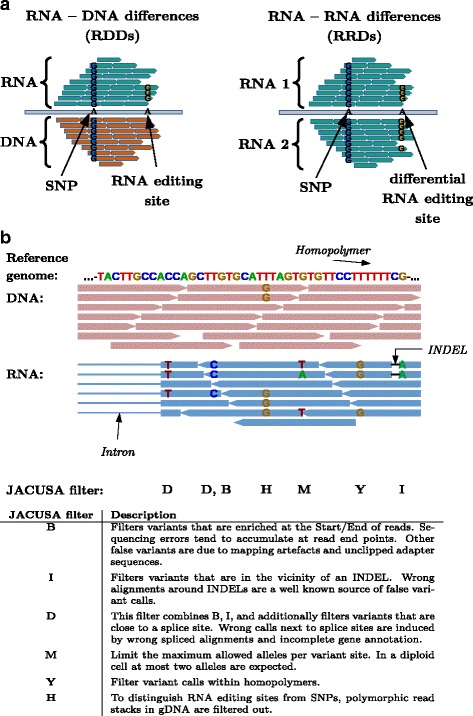
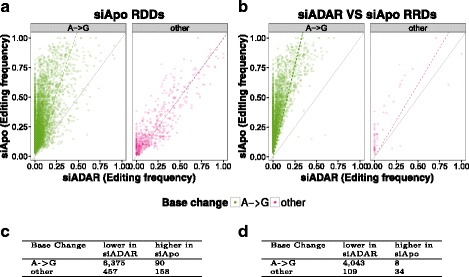
RNA editing is a co-transcriptional modification that increases the molecular diversity, alters secondary structure and protein coding sequences by changing the sequence of transcripts. The most common RNA editing modification is the single base substitution (A→I) that is catalyzed by the members of the Adenosine deaminases that act on RNA (ADAR) family. Typically, editing sites are identified as RNA-DNA-differences (RDDs) in a comparison of genome and transcriptome data from next-generation sequencing experiments. However, a method for robust detection of site-specific editing events from replicate RNA-seq data has not been published so far. Even more surprising, condition-specific editing events, which would show up as differences in RNA-RNA comparisons (RRDs) and depend on particular cellular states, are rarely discussed in the literature.
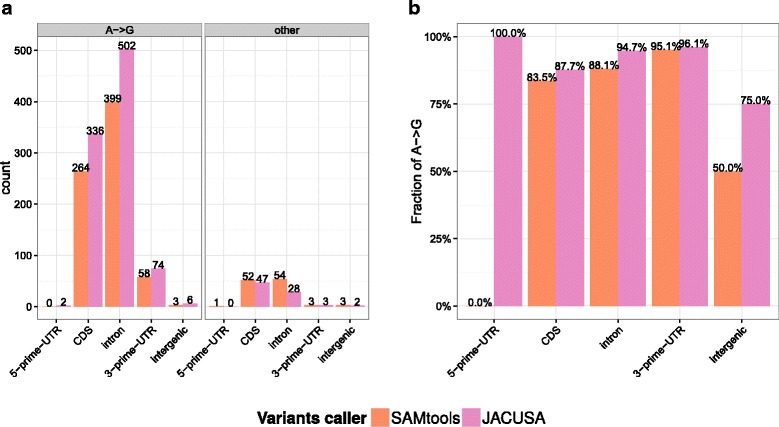
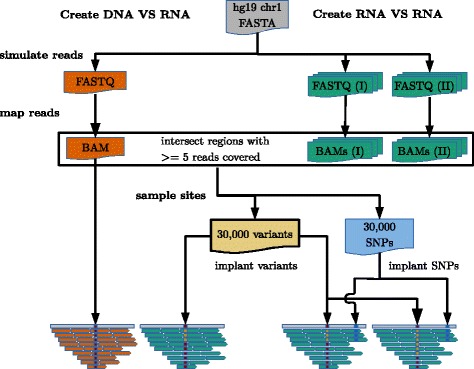
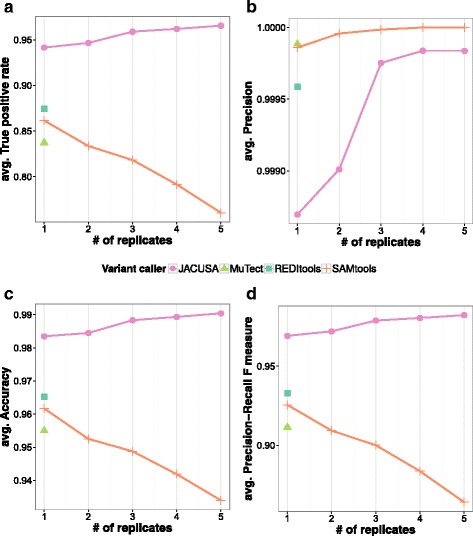
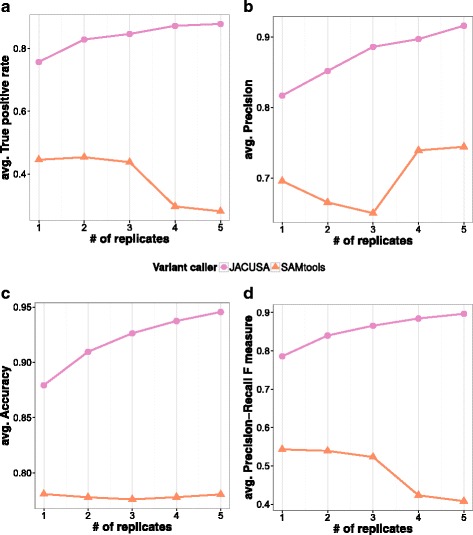
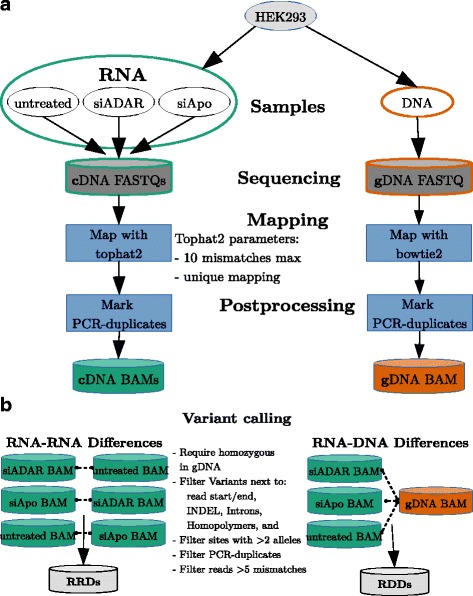
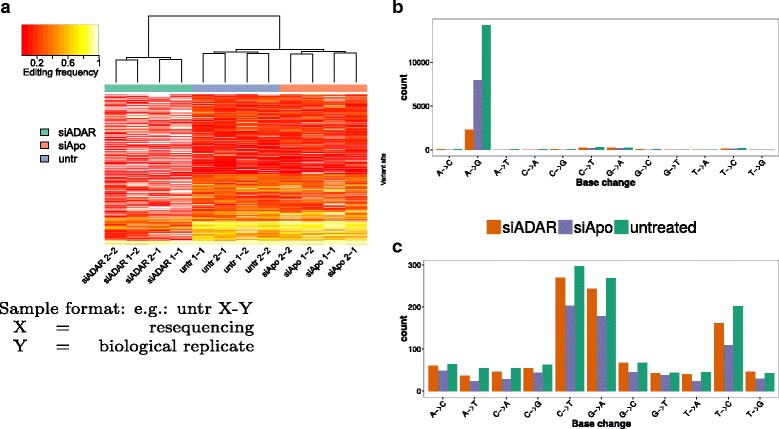
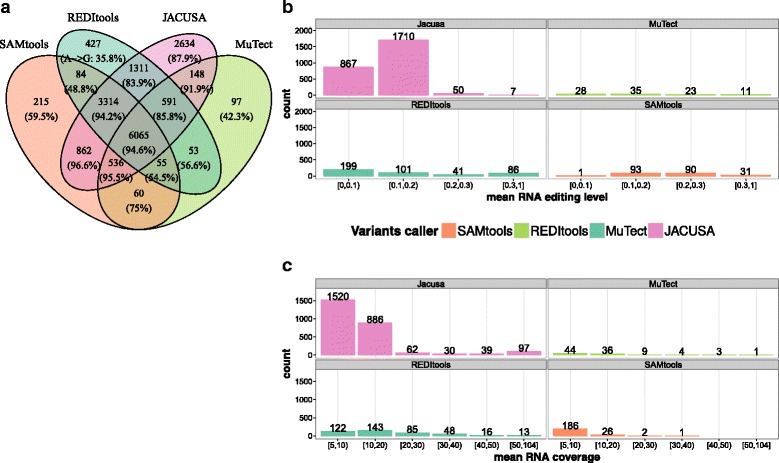
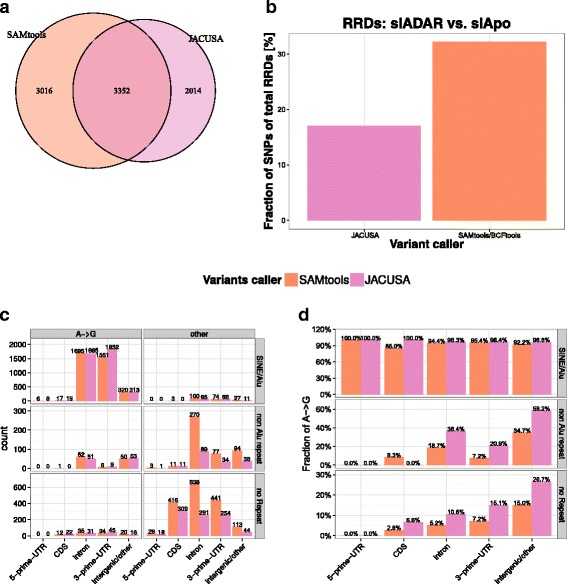
We present JACUSA, a versatile one-stop solution to detect single nucleotide variant positions from comparing RNA-DNA and/or RNA-RNA sequencing samples. The performance of JACUSA has been carefully evaluated and compared to other variant callers in an in silico benchmark. JACUSA outperforms other algorithms in terms of the F measure, which combines precision and recall, in all benchmark scenarios. This performance margin is highest for the RNA-RNA comparison scenario. We further validated JACUSA's performance by testing its ability to detect A→I events using sequencing data from a human cell culture experiment and publicly available RNA-seq data from Drosophila melanogaster heads. To this end, we performed whole genome and RNA sequencing of HEK-293 cells on samples with lowered activity of candidate RNA editing enzymes. JACUSA has a higher recall and comparable precision for detecting true editing sites in RDD comparisons of HEK-293 data. Intriguingly, JACUSA captures most A→I events from RRD comparisons of RNA sequencing data derived from Drosophila and HEK-293 data sets.
Our software JACUSA detects single nucleotide variants by comparing data from next-generation sequencing experiments (RNA-DNA or RNA-RNA). In practice, JACUSA shows higher recall and comparable precision in detecting A→I sites from RNA-DNA comparisons, while showing higher precision and recall in RNA-RNA comparisons.
RNA编辑是一种共转录修饰,它通过改变转录本序列来增加分子多样性、改变二级结构和蛋白质编码序列。最常见的RNA编辑修饰是单碱基替换(A→I),由作用于RNA的腺苷脱氨酶(ADAR)家族成员催化。通常,在比较来自下一代测序实验的基因组和转录组数据时,编辑位点被识别为RNA-DNA差异(RDD)。然而,迄今为止尚未发表一种从重复RNA-seq数据中可靠检测位点特异性编辑事件的方法。更令人惊讶的是,条件特异性编辑事件在文献中很少被讨论,这种事件在RNA-RNA比较(RRD)中表现为差异,并取决于特定的细胞状态。
我们展示了JACUSA,这是一种通过比较RNA-DNA和/或RNA-RNA测序样本检测单核苷酸变异位置的通用一站式解决方案。JACUSA的性能已经在计算机模拟基准测试中进行了仔细评估,并与其他变异检测工具进行了比较。在所有基准测试场景中,就结合了精确率和召回率的F度量而言,JACUSA优于其他算法。在RNA-RNA比较场景中,这种性能优势最为明显。我们通过使用来自人类细胞培养实验的测序数据和来自黑腹果蝇头部的公开可用RNA-seq数据测试其检测A→I事件的能力,进一步验证了JACUSA的性能。为此,我们对候选RNA编辑酶活性降低的样本进行了HEK-293细胞的全基因组和RNA测序。在HEK-293数据的RDD比较中,JACUSA在检测真正的编辑位点方面具有更高的召回率和相当的精确率。有趣的是,JACUSA从来自果蝇和HEK-293数据集的RNA测序数据的RRD比较中捕获了大多数A→I事件。
我们的软件JACUSA通过比较下一代测序实验(RNA-DNA或RNA-RNA)的数据来检测单核苷酸变异。在实际应用中,JACUSA在从RNA-DNA比较中检测A→I位点时显示出更高的召回率和相当的精确率,而在RNA-RNA比较中显示出更高的精确率和召回率。