Zhu Yelin, Hua Yan, Zhang Biao, Sun Lianhong, Li Wenjie, Kong Xin, Hong Jiong
School of Life Sciences, University of Science and Technology of China, Hefei, Anhui, 230027, People's Republic of China.
Microb Cell Fact. 2017 Jan 3;16(1):2. doi: 10.1186/s12934-016-0620-6.
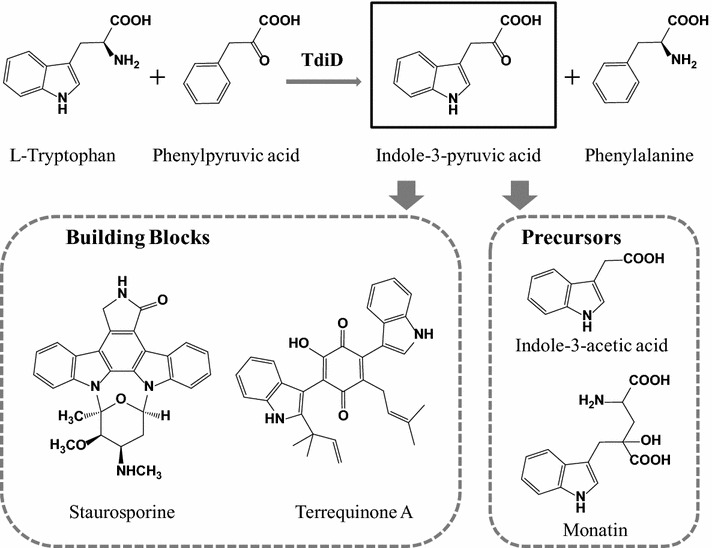
Indole pyruvic acid (IPA) is a versatile platform intermediate and building block for a number of high-value products in the pharmaceutical and food industries. It also has a wide range of applications, such as drugs for the nervous system, cosmetics, and luminophores. Chemical synthesis of IPA is a complicated and costly process. Moreover, through the biosynthesis route employing L-amino acid oxidase, the byproduct hydrogen peroxide leads the degradation of IPA. TdiD, identified as a specific tryptophan aminotransferase, could be an alternative solution for efficient IPA biosynthesis.
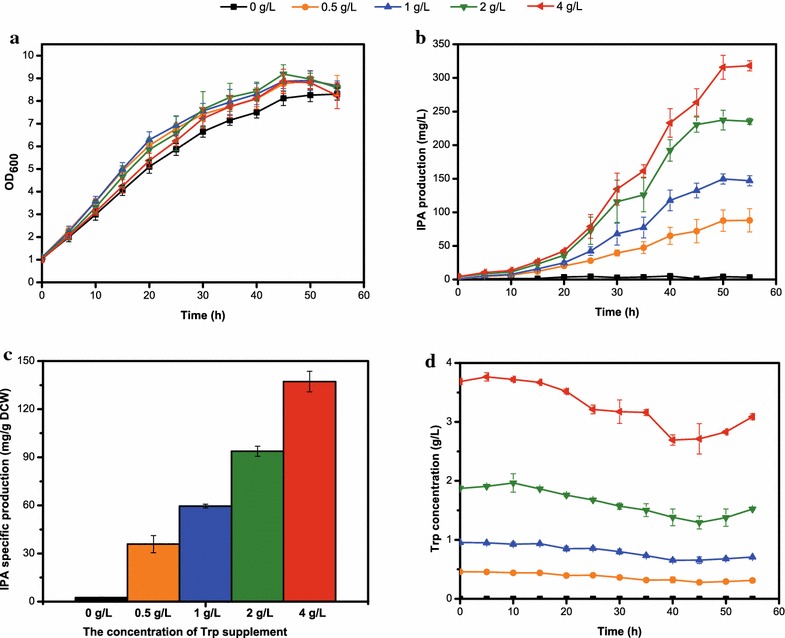
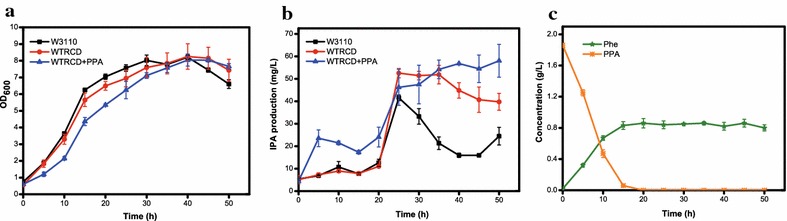
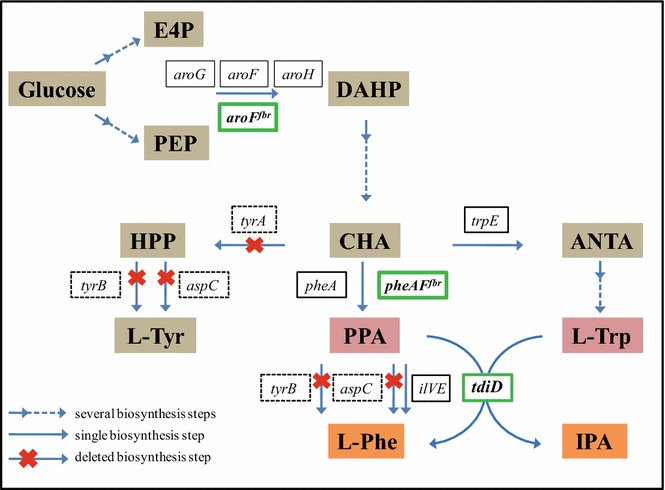
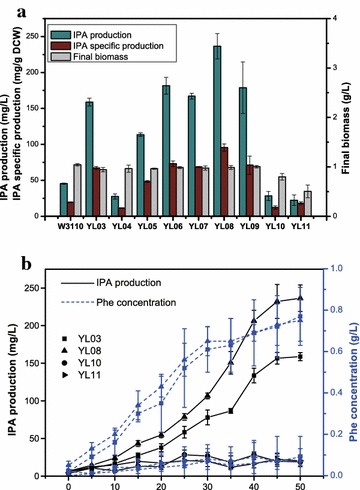
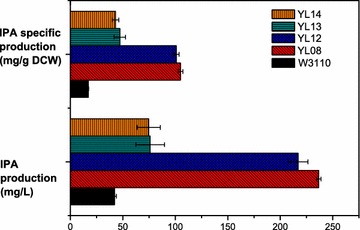
Escherichia coli strain W3110, which demonstrates basic production when supplied with tryptophan, was engineered for IPA biosynthesis. Several strategies were implemented to improve IPA production. First, through incorporating the codon-optimized tdiD into W3110, IPA levels increased from 41.54 ± 1.26 to 52.54 ± 2.08 mg/L. Second, after verifying the benefit of an increased phenylpyruvate pool, a YL03 strain was constructed based on a previously reported mutant strain of W3110 with a plasmid carrying aroF and pheA to further improve IPA production. The recombinant YL03 strain accumulated IPA at 158.85 ± 5.36 mg/L, which was 3.82-fold higher than that of the wild-type W3110 strain. Third, optimization of tdiD expression was carried out by replacing the Trc promoter with a series of constitutively active promoters along with increasing the plasmid copy numbers. The highest IPA production was observed in YL08, which achieved 236.42 ± 17.66 mg/L and represented a greater than 5-fold increase as compared to W3110. Finally, the effects of deletion and overexpression of tnaA on IPA biosynthesis were evaluated. The removal of tnaA led to slightly reduced IPA levels, whereas the overexpression of tnaA resulted in a considerable decline in production.
This study illustrates the feasibility of IPA biosynthesis in E. coli through tdiD. An efficient IPA producing strain, YL08, was developed, which provides a new possibility for biosynthesis of IPA. Although the final production was limited, this study demonstrates a convenient method of IPA synthesis.
吲哚丙酮酸(IPA)是制药和食品工业中多种高价值产品的通用平台中间体和构建模块。它还具有广泛的应用,如用于神经系统的药物、化妆品和发光体。IPA的化学合成是一个复杂且成本高昂的过程。此外,通过使用L-氨基酸氧化酶的生物合成途径,副产物过氧化氢会导致IPA降解。TdiD被鉴定为一种特异性色氨酸转氨酶,可能是高效IPA生物合成的替代解决方案。
在提供色氨酸时表现出基础产量的大肠杆菌菌株W3110被改造用于IPA生物合成。实施了几种策略来提高IPA产量。首先,通过将密码子优化的tdiD整合到W3110中,IPA水平从41.54±1.26毫克/升增加到52.54±2.08毫克/升。其次,在验证增加苯丙酮酸库的益处后,基于先前报道的携带aroF和pheA的质粒的W3110突变菌株构建了YL03菌株,以进一步提高IPA产量。重组YL03菌株积累的IPA为158.85±5.36毫克/升,比野生型W3110菌株高3.82倍。第三,通过用一系列组成型活性启动子替换Trc启动子并增加质粒拷贝数来优化tdiD的表达。在YL08中观察到最高的IPA产量,达到236.42±17.66毫克/升,与W3110相比增加了5倍以上。最后,评估了tnaA缺失和过表达对IPA生物合成的影响。去除tnaA导致IPA水平略有降低,而tnaA的过表达导致产量大幅下降。
本研究说明了通过tdiD在大肠杆菌中进行IPA生物合成的可行性。开发了一种高效的IPA生产菌株YL08,为IPA的生物合成提供了新的可能性。尽管最终产量有限,但本研究展示了一种方便的IPA合成方法。