Patel Vijay M, Rains Anna W, Clark Christopher T
Department of Pathology, University of Tennessee Graduate School of Medicine, 1924 Alcoa Highway, Knoxville, TN 37920, USA.
Department of Quality and Patient Safety, University of Tennessee Medical Center, 1924 Alcoa Highway, Knoxville, TN 37920, USA.
J Blood Transfus. 2016;2016:2859720. doi: 10.1155/2016/2859720. Epub 2016 Dec 5.
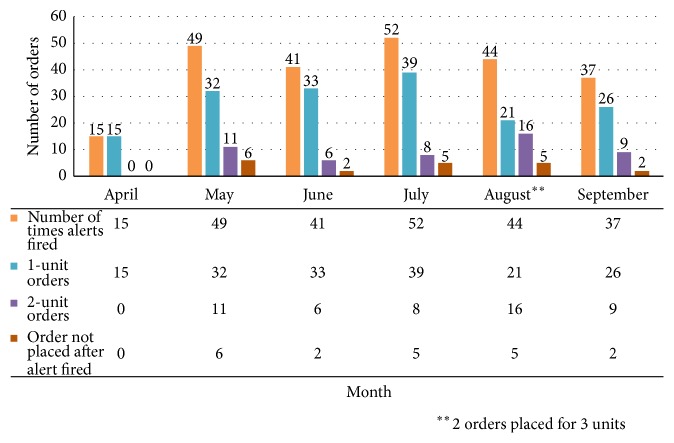
To reduce the rate of inappropriate red blood cell transfusion, a provider education program, followed by alerts in the computerized provider order entry system (CPOE), was established to encourage AABB transfusion guidelines. Metrics were established for nonemergent inpatient transfusions. Service lines with high order volume were targeted with formal education regarding AABB 2012 transfusion guidelines. Transfusion orders were reviewed in real time with email communications sent to ordering providers falling outside of AABB recommendations. After 12 months of provider education, alerts were activated in CPOE. With provider education alone, the incidence of pretransfusion hemoglobin levels greater than 8 g/dL decreased from 16.64% to 6.36%, posttransfusion hemoglobin levels greater than 10 g/dL from 14.03% to 3.78%, and number of nonemergent two-unit red blood cell orders from 45.26% to 22.66%. Red blood cell utilization decreased by 13%. No additional significant reduction in nonemergent two-unit orders was observed with CPOE alerts. Provider education, an effective and low-cost method, should be considered as a first-line method for reducing inappropriate red blood cell transfusion rates in stable adult inpatients. Alerts in the computerized order entry system did not significantly lower the percentage of two-unit red blood cells orders but may help to maintain educational efforts.
为降低不适当红细胞输注率,制定了一项提供者教育计划,并在计算机化提供者医嘱录入系统(CPOE)中设置警报,以鼓励遵循美国血库协会(AABB)的输血指南。为非紧急住院患者输血制定了衡量标准。针对高医嘱量的服务线开展了关于AABB 2012输血指南的正规教育。对输血医嘱进行实时审查,并向不符合AABB建议的医嘱开具提供者发送电子邮件。在进行了12个月的提供者教育后,在CPOE中启动了警报。仅通过提供者教育,输血前血红蛋白水平大于8 g/dL的发生率从16.64%降至6.36%,输血后血红蛋白水平大于10 g/dL的发生率从14.03%降至3.78%,非紧急两单位红细胞医嘱数量从45.26%降至22.66%。红细胞使用率下降了13%。CPOE警报未观察到非紧急两单位医嘱有进一步显著减少。提供者教育是一种有效且低成本的方法,应被视为降低稳定成年住院患者不适当红细胞输注率的一线方法。计算机化医嘱录入系统中的警报并未显著降低两单位红细胞医嘱的百分比,但可能有助于维持教育效果。