Masuyama Kotoka, Shojo Hideki, Nakanishi Hiroaki, Inokuchi Shota, Adachi Noboru
Department of Legal Medicine, Interdisciplinary Graduate School of Medicine and Engineering, University of Yamanashi, Chuo, Yamanashi, Japan.
Department of Forensic Medicine, Juntendo University School of Medicine, Bunkyo-ku, Tokyo, Japan.
PLoS One. 2017 Jan 4;12(1):e0169348. doi: 10.1371/journal.pone.0169348. eCollection 2017.
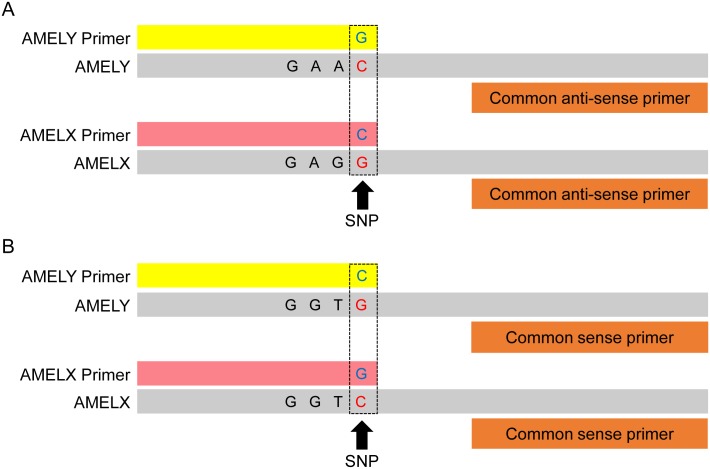
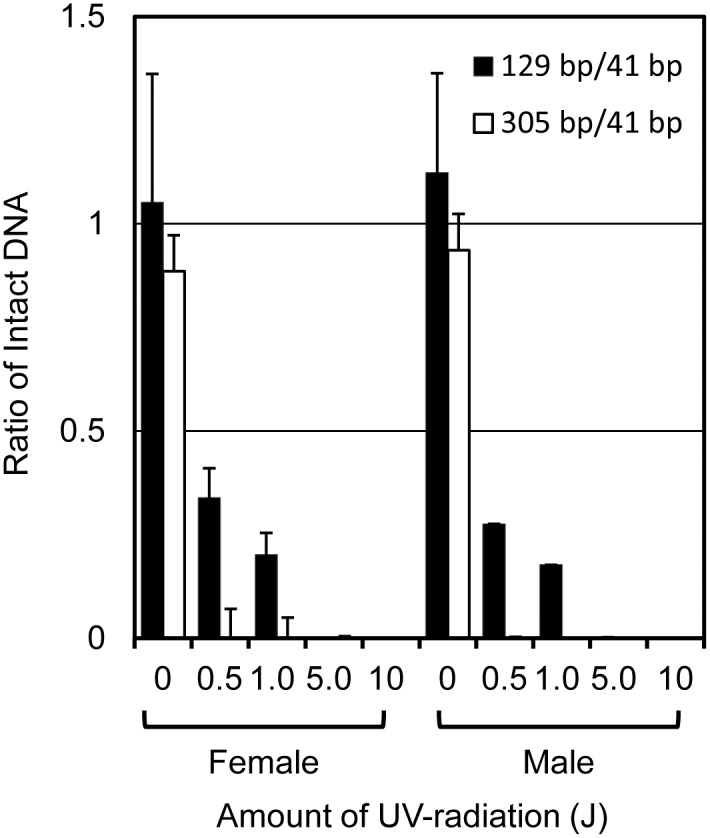
Sex determination is important in archeology and anthropology for the study of past societies, cultures, and human activities. Sex determination is also one of the most important components of individual identification in criminal investigations. We developed a new method of sex determination by detecting a single-nucleotide polymorphism in the amelogenin gene using amplified product-length polymorphisms in combination with sex-determining region Y analysis. We particularly focused on the most common types of postmortem DNA damage in ancient and forensic samples: fragmentation and nucleotide modification resulting from deamination. Amplicon size was designed to be less than 60 bp to make the method more useful for analyzing degraded DNA samples. All DNA samples collected from eight Japanese individuals (four male, four female) were evaluated correctly using our method. The detection limit for accurate sex determination was determined to be 20 pg of DNA. We compared our new method with commercial short tandem repeat analysis kits using DNA samples artificially fragmented by ultraviolet irradiation. Our novel method was the most robust for highly fragmented DNA samples. To deal with allelic dropout resulting from deamination, we adopted "bidirectional analysis," which analyzed samples from both sense and antisense strands. This new method was applied to 14 Jomon individuals (3500-year-old bone samples) whose sex had been identified morphologically. We could correctly identify the sex of 11 out of 14 individuals. These results show that our method is reliable for the sex determination of highly degenerated samples.
性别鉴定在考古学和人类学中对于研究过去的社会、文化及人类活动至关重要。性别鉴定也是刑事调查中个体识别最重要的组成部分之一。我们开发了一种新的性别鉴定方法,通过利用扩增产物长度多态性结合Y染色体性别决定区分析来检测牙釉蛋白基因中的单核苷酸多态性。我们特别关注古代和法医样本中最常见的死后DNA损伤类型:由脱氨基作用导致的片段化和核苷酸修饰。扩增子大小设计为小于60 bp,以使该方法更适用于分析降解的DNA样本。使用我们的方法对从8名日本个体(4名男性,4名女性)采集的所有DNA样本进行评估,结果均正确。确定准确性别鉴定的检测限为20 pg DNA。我们使用经紫外线照射人工片段化的DNA样本,将我们的新方法与商业短串联重复序列分析试剂盒进行了比较。我们的新方法对于高度片段化的DNA样本最为稳健。为了处理由脱氨基作用导致的等位基因缺失,我们采用了“双向分析”,即从有义链和反义链分析样本。这种新方法应用于14名绳纹时代个体(3500年前的骨骼样本),其性别已通过形态学鉴定。我们能够正确鉴定出14名个体中的11名的性别。这些结果表明,我们的方法对于高度降解样本的性别鉴定是可靠的。