Proton Therapy Center, National Cancer Center, Goyang, Korea.
Department of Radiation Oncology, Soonchunhyang University Seoul Hospital, Seoul, Korea.
Cancer Res Treat. 2017 Oct;49(4):960-969. doi: 10.4143/crt.2016.204. Epub 2017 Jan 4.
This study was conducted to investigate the neurocognitive functioning of children with intracranial germ cell tumor (IGCT) prior to receiving proton beam therapy (PBT), and to identify differential characteristics of their neurocognitive functioning depending on tumor location. As a secondary object of this study, neurocognitive functions were followed up at 1-2 years after PBT to examine early post-treatment changes.
Between 2008 and 2014, 34 childrenwith IGCT treatedwho received PBT atNational Cancer Center, Korea were enrolled in this study. Standardized neurocognitive tests of intelligence, memory, and executive functioning were performed with baseline psychological assessments using the Child Behavior Checklist (CBCL). Follow-up assessments after PBT were conducted in 20 patients (T2). The results were analyzed based on the locations of tumors, which included the suprasellar, pineal gland, basal ganglia, and bifocal regions.
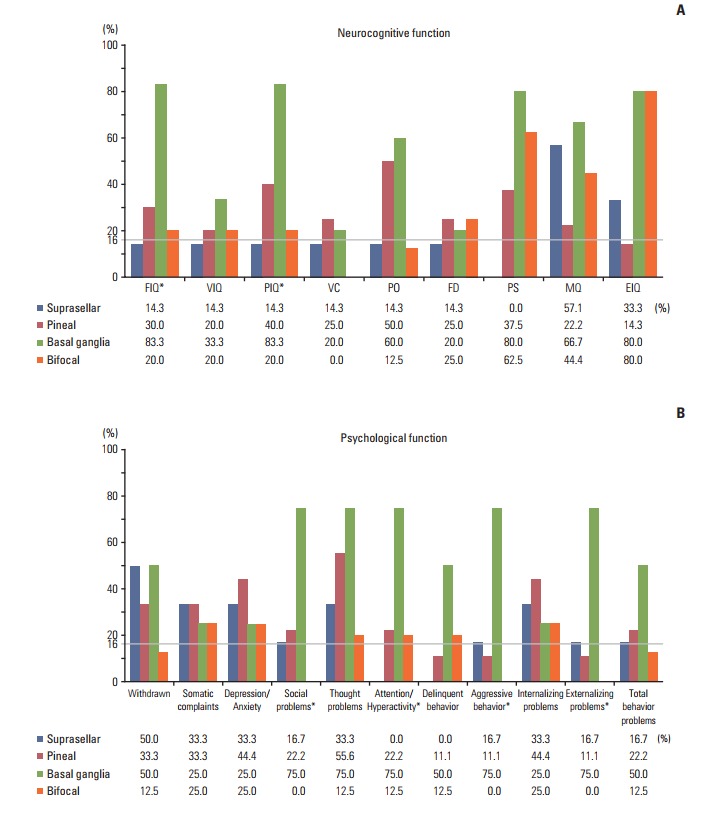
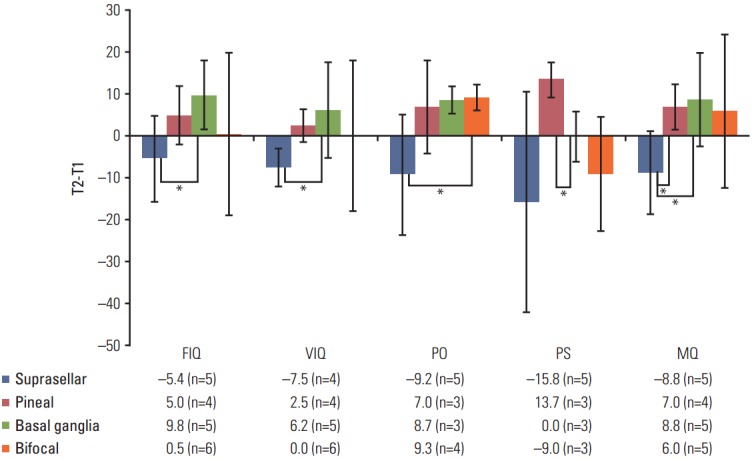
The neurocognitive function of IGCT patients was significantly lower than that of the normal population in performance intelligence quotient (p=0.041), processing speed (p=0.007), memory (p < 0.001), and executive functioning (p=0.010). Patients with basal ganglia tumors had significantly lower scores for most domains of neurocognitive functioning and higher scores for CBCL than both the normal population and patients with IGCT in other locations. There was no significant change in neurocognitive function between T1 and T2 for all types of IGCT patients in first 1-2 years after PBT.
Tumor location significantly affects the neuropsychological functioning in patients with IGCT. Neuropsychological functioning should be closely monitored from the time of diagnosis in IGCT patients.
本研究旨在探讨颅内生殖细胞瘤(IGCT)患儿在接受质子束治疗(PBT)前的神经认知功能,并确定其神经认知功能的差异特征取决于肿瘤位置。作为本研究的次要目的,在 PBT 后 1-2 年对神经认知功能进行随访,以检查治疗后早期的变化。
2008 年至 2014 年间,韩国国家癌症中心收治的 34 例接受 PBT 治疗的 IGCT 患儿纳入本研究。在基线心理评估中使用儿童行为检查表(CBCL)对智力、记忆和执行功能进行标准化神经认知测试。在 20 例患者(T2)中进行 PBT 后随访评估。结果根据肿瘤位置进行分析,包括鞍上、松果体、基底节和双焦点区。
IGCT 患者的神经认知功能在表现智商(p=0.041)、加工速度(p=0.007)、记忆(p<0.001)和执行功能(p=0.010)方面明显低于正常人群。基底节肿瘤患者在大多数神经认知功能领域的得分明显较低,而在 CBCL 中的得分明显较高,高于正常人群和其他部位的 IGCT 患者。在 PBT 后 1-2 年内,所有类型的 IGCT 患者的神经认知功能在 T1 和 T2 之间均无明显变化。
肿瘤位置显著影响 IGCT 患者的神经心理功能。在 IGCT 患者中,应从诊断时开始密切监测神经心理功能。